Share the post "VO₂max: pro training to perform"
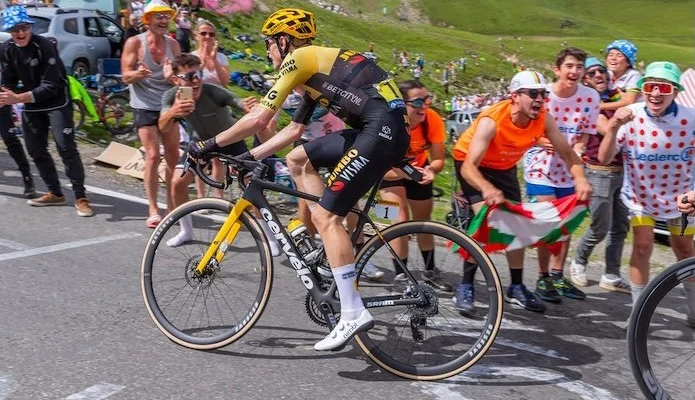
VO₂max*, or maximal oxygen consumption, is a fundamental pillar of aerobic performance in cycling, where the ability to sustain intense efforts over long periods is key to making a difference in competition. Far from being a simple test of suffering, improving VO₂max relies on a precise and methodical approach, inspired by the training strategies of elite riders like Jonas Vingegaard. Here’s how to optimize your training to elevate your physical level to the maximum.
*VO₂max is very often used in the feminine form in French, as it is an abbreviation of “consommation maximale en oxygène” (maximal oxygen consumption). However, the term should be used in the masculine form because V is the symbol for a flow rate.
By Guillaume Judas – Photos: depositphotos.com
VO₂max measures the maximum amount of oxygen your body can absorb, transport, and use during intense exercise. In cycling, this value plays a decisive role in the ability to sustain prolonged efforts, whether it’s to follow an attack on a climb or a pass, make the difference to finish solo near the finish, or perform well in a time trial. According to a study by Bassett and Howley (2000) published in the Journal of Applied Physiology, VO₂max is a key indicator of endurance performance, although it is not the only factor.
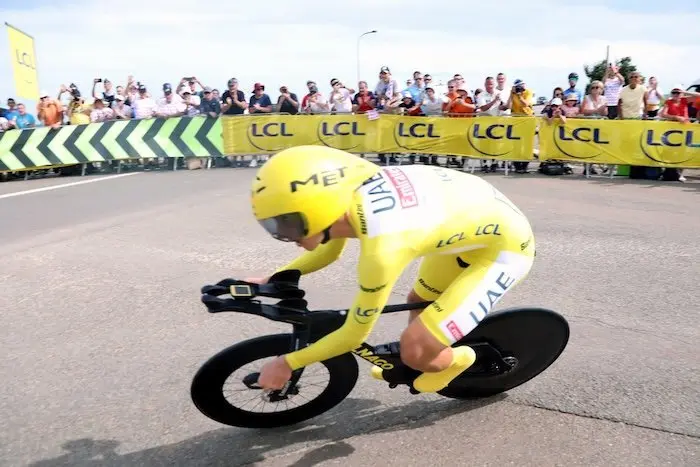
By elevating your VO₂max, you increase your maximal aerobic capacity, which not only improves your endurance but also your recovery, an essential asset in demanding competitions like stage races (or Grand Tours for pros).
A structured approach to improving VO₂max
To optimize one’s VO₂max, training must be methodical, combining a solid aerobic base with specific high-intensity efforts. For Elite riders, it all starts with a weekly volume of 18 to 25 hours of cycling, 70 to 80% of which is in Zone 2, a moderate intensity where the body primarily burns fat. This approach strengthens basic endurance and physical condition stability, allowing for high training loads. As Seiler and Kjerland (2006) show in Scandinavian Journal of Medicine & Science in Sports, spending the majority of time in Zone 2 improves metabolic efficiency, an indispensable foundation for prolonged efforts.
In addition, specific sessions to work on VO₂max are at the heart of the program. A typical structure for already highly trained riders consists of performing 5 intervals of 5 minutes at 110–120% of FTP (Functional Threshold Power), followed by 5 minutes of active recovery in Zone 2. To vary the routine, alternatives such as 6 intervals of 4 minutes at 115% of FTP with equivalent rest, or 4 intervals of 8 minutes at 108–110% of FTP, allow for working on sustained high-intensity power. These intervals, as confirmed by a meta-analysis by Bacon et al. (2013) in Sports Medicine, effectively stimulate aerobic capacity by maximally engaging the cardiorespiratory system.

Finally, complementary anaerobic threshold work strengthens the entire program. Work blocks such as 2 x 20 minutes at 95–100% of FTP develop the ability to maintain high intensity over time. Furthermore, short, maximal power sprints (e.g., 8 to 10 efforts of 12 seconds with full rest) improve explosive power and coordination.
Pros add at least two weekly core strengthening and mobility sessions to optimize their efficiency in an aerodynamic position. A study by Hansen et al. (2014) in the Journal of Strength and Conditioning Research shows that core work improves performance by reducing energy expenditure.
Physiological mechanisms
This approach is effective due to the physiological adaptations it induces. Intervals of 4 to 8 minutes push the body to function near its maximal oxygen uptake, which fully utilizes the heart’s stroke volume, i.e., the amount of blood pumped per beat, as explained by Levine (2008) in Circulation. Moreover, these efforts promote the expansion of muscle capillaries, improving oxygen delivery to active muscles. They also stimulate mitochondrial biogenesis, increasing aerobic energy production, according to Holloszy and Coyle (1984) in the Journal of Applied Physiology.
Finally, a high VO₂max improves recovery, allowing for intense efforts day after day, a crucial advantage in stage races.
Why VO₂max changes the game
An optimized VO₂max offers concrete advantages in competition. During attacks or changes of pace on long climbs, a high aerobic capacity allows one to stay in the lead group or take the initiative. In Grand Tours, where stages follow one another, a high aerobic ceiling becomes essential for quick recovery and maintaining performance. Obviously, there are genetic factors that explain why some athletes have a higher VO₂max than others. But its improvement and optimization also reward rigorous and consistent discipline.

Warning and personalization
These training examples, although inspired by what is practiced by pros, must be adapted to your level, your goals, and your basic physical condition. This is an approach based on validated scientific principles, but individualization is crucial to maximize benefits while avoiding overtraining. Before adopting it, it is essential to consult a coach to adjust intensities and volumes to your profile. It would be entirely counterproductive to try to reproduce these intensities without framing them with a substantial weekly volume.
What to remember is that by combining a solid aerobic base, targeted intervals, and complementary work, you can push your aerobic ceiling and achieve higher performances. As the adage goes, success rewards those who train with intensity and consistency.
Share the post "VO₂max: pro training to perform"