Share the post "Why isn’t 1 hour on a stationary bike the same as 1 hour outdoors?"
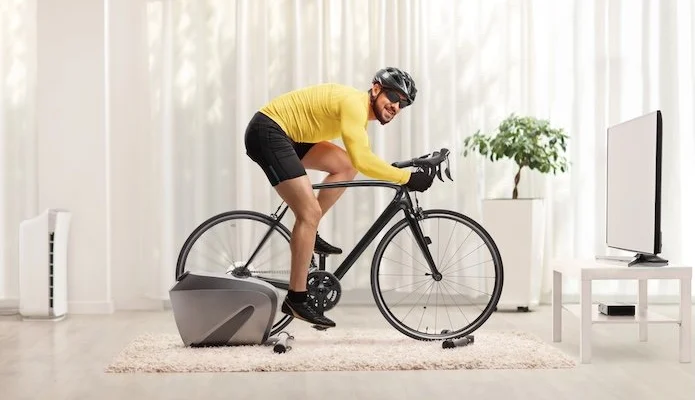
Perhaps you’ve heard this claim before: an hour on a stationary bike isn’t as good as an hour of outdoor cycling. And yet, both activities engage the cardiovascular system and the same muscles. As summer draws to a close and it’s time to get back on the stationary bike to keep riding despite the bad weather and shorter days, we’ll explain why there are significant physiological and environmental differences between the two types of workouts.
By Guillaume Judas – Photos: depositphotos.com
A Higher Heart Rate Indoors
On a stationary bike, even when staying in a low-intensity zone (basic endurance), your heart rate is often higher than when riding outdoors. Why? The absence of wind, changes in terrain, and recovery periods (such as coasting or easing off on downhills) maintains a constant workload. It’s a bit like during a running session, where downhill sections aren’t enough to lower your heart rate sufficiently because you still have to support your body weight.
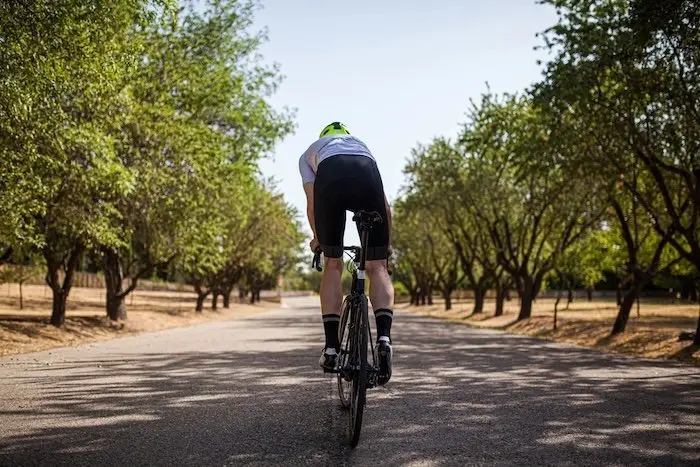
On a stationary bike, you pedal continuously, which increases the physiological load compared to a ride in natural surroundings. Outdoors, changes in terrain provide micro-recoveries that lighten the overall effort. The stationary bike is a great tool for working on intensity in specific zones, but it doesn’t replace the variety of demands of an outdoor ride—whether it’s recovery periods or even the power spikes lasting just a few seconds needed for frequent accelerations.
According to a study by Brown & Banister (1985) published in the European Journal of Applied Physiology, continuous exercise on a stationary bike increases the average heart rate compared to an equivalent outdoor ride.
Higher thermal load
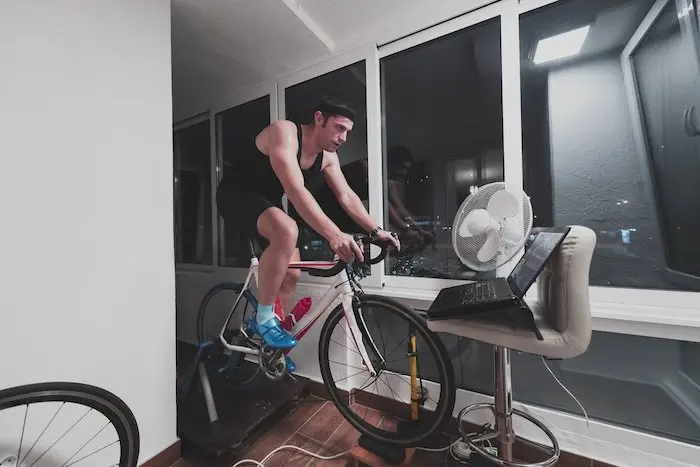
Indoors, body temperature rises more quickly. Without natural wind to cool the body, the heat load is greater, even with a fan. This overheating can increase fatigue and make the workout more grueling. As a result, an hour on a stationary bike may feel much more intense than an hour outdoors.
Why This Affects Your Training Load
A session on a stationary bike is often more physiologically demanding than an equivalent outdoor ride. This can be an advantage for building power and endurance, but misjudging the intensity and duration can lead to excessive fatigue.
To optimize your indoor trainer sessions, you need to adjust the duration. To avoid accumulating fatigue, you can shorten the warm-up and cool-down times compared to a typical outdoor ride. The lack of a freewheel and the rapid rise in temperature reduce the warm-up time needed before performing intense exercise. Thus, 45 minutes to an hour on the indoor trainer can be equivalent to 1 hour and 15 minutes to 1 hour and 30 minutes on the road, depending on the intensity. Keep this in mind when calculating your training load or your weekly “mileage.”
Also, don’t forget to ventilate the room where you’re riding. Use a fan to prevent overheating if necessary—unless you’re doing specific heat acclimatization training, which shouldn’t be improvised.
Also, vary your workouts. Incorporate interval sessions to simulate changes in outdoor terrain, and avoid repeating the same workouts over and over. Be careful: virtual rides on certain apps like Zwift are very demanding and shouldn’t be repeated too often, as this risks completely throwing off your fitness balance by dedicating too little time to endurance training.
Finally, stay hydrated with electrolyte-rich or mineral-rich drinks. You sweat more indoors, so drink regularly.
Practical Tips
If you’re training for a race or a cycling event, always alternate between the indoor trainer (for intensity) and outdoor rides (for volume and technique).
One hour on an indoor trainer isn’t really equivalent to one hour of road cycling. It’s generally more demanding. The higher heart rate, increased heat load, and lack of recovery make indoor sessions more difficult. Factor these differences into your training plan to make progress without overtraining.
Share the post "Why isn’t 1 hour on a stationary bike the same as 1 hour outdoors?"