Share the post "Ötztaler Radmarathon: the myth of the Alpine sportive"
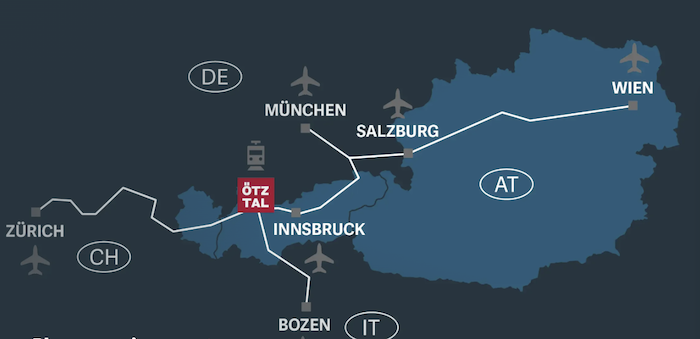
Every year, granfondos bring together thousands of enthusiasts across France: the Marmotte, the Ardéchoise, and the famous Étape du Tour are unmissable events. But beyond our borders, other equally mythical granfondos have endured for decades and embody the essence of cyclosport. In the heart of the Austrian Alps, in the Ötztal valley, lies Sölden, an alpine resort prized for its glaciers culminating at over 3,300 meters and the spectacular opening of the Alpine Ski World Cup each autumn. In summer, Sölden becomes the stage for a cycling legend: the Ötztaler Radmarathon.
By David Polveroni – Photos: soelden.com, All rights reserved
Why is it so mythical?
Created in 1982, this event began modestly with about sixty locals tackling four passes (three of which are over 2,000 m) on a 225 km loop with 5,500 meters of elevation gain, a true challenge, the very essence of cyclosport, which is gradually being lost today. Since then, the race has continued to grow, attracting passionate amateurs and seasoned professionals, all united by the beauty and difficulty of the mountains on a course unchanged since its creation.
If you know the Marmotte, be aware that the Ötztaler offers a similar challenge in terms of elevation gain, but with an additional 50 km and 500 m of elevation gain, which means 1h30 to 2h30 more cycling depending on your level. Suffice to say that determination and training are essential to complete this demanding course. To illustrate, it’s like a loop combining Alpe d’Huez and the Galibier before a finish in La Grave!
Many big names in the peloton have ridden these roads: Primož Roglič, three-time Vuelta winner, used it as high-altitude training ground; Romain Bardet rode there in 2016 and 2020 to prepare for his seasons. In 2017, Roman Kreuziger won the professional version, the “Pro Ötztaler 5500,” on the same route, surrounded by a prestigious WorldTour field including riders like Špilak and Ciccone. This pro version did not last for financial reasons.
Another rare feature for an amateur event: the Ötztaler Radmarathon benefits from a privatized road and is broadcast live on YouTube, offering total immersion for participants and fans worldwide.
The 2025 course, pass by pass
On August 31st, at 6:45 AM, Sölden will awaken to the sound of freehubs and the clicking of derailleurs. The morning light illuminates the glaciers, the air is fresh, and the riders will set off from the resort’s 1,377 meters of altitude.
Kühtai: the first pass (km 35)
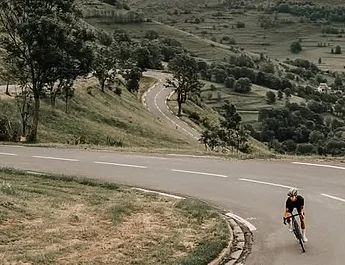
Immediately after leaving Sölden, a fast descent towards Oetz serves as a warm-up… but also a trap: vigilance is essential in these first kilometers where the peloton is dense. In Oetz (820 m), the first pass rises without warning: 18.5 km of climbing with 1,200 m of elevation gain and an average gradient of 5.5%, but sections at 18% in the final kilometers. The first wooded ramps give way to a panorama of lakes and alpine pastures. Here, you must manage your effort: it’s long, and there are more than 170 km left to cover.
At the summit (2,020 m), the air is crisp, and a fast descent (with sections at 14% where some riders approach 100 km/h) propels the riders towards Kematen, at 600 m altitude.
Brennerpass: the endless false flat (km 70 to 110)
At the exit of Innsbruck, the Brenner appears. It’s the antithesis of the Kühtai: 36 km of steady climbing at 2-3%, on a wide national road. This “at a steady pace” pass favors the formation of fast-rolling groups. You ride along rivers and villages, and the Italian border is crossed almost without noticing. This is where you need to eat and drink: the main challenge of the day is still to come.
Passo Giovo: the slap (km 155 to 170)
In San Leonardo, after a deceptive flat section, the ascent resumes with renewed vigor: 15.5 km at an average of 7.5%, with peaks at 12%. The road climbs in tight switchbacks through the forest, before opening onto vast pastures. The effort is sustained, the sun often beats down hard at this hour, and every turn seems to push back the summit. At 2,094 m, the pass marks the end of the third major ascent. A short visual break on the surrounding mountains… then it’s time for the most technical descent of the course: narrow, winding, with sometimes imperfect asphalt (long live Italy!).
Timmelsjoch: the final judge (km 193 to 222)
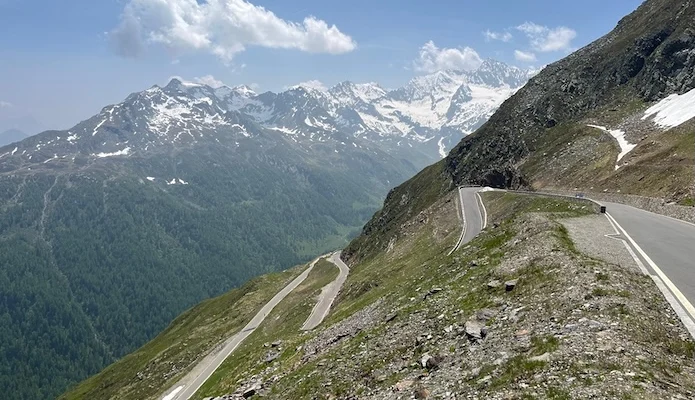
This is the mythical pass: 29 km, 1,759 m of elevation gain, an average gradient of 6% but with several kilometers above 10%. After the first rolling kilometers, the road plunges into a mineral, almost lunar landscape. Hairpin bends follow one another, vegetation disappears, and oxygen becomes scarce. Sections at 14% arrive when the legs are screaming for mercy. The final kilometers, exposed to the wind, offer a breathtaking view of the Ötztal valley, while reminding you that a fast descent to Sölden still needs to be negotiated.
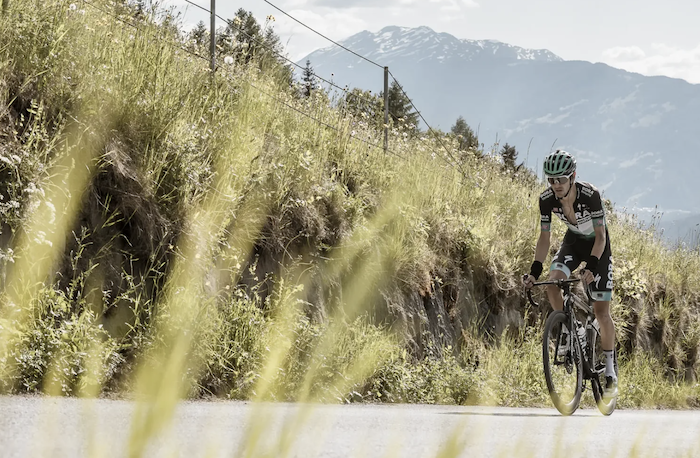
225 km, 5,500 m of elevation gain, four extraordinary passes, and a finish in a festive atmosphere in the heart of the resort. For many, finishing the Ötztaler is a personal victory; others will aim for a time. What matters is to complete one of the most beautiful sportives in the world with a smile!
In 18 days, 4,000 participants will take on this challenge. To register for the 2026 edition, follow the information on the official website or social media (Instagram, for example), where registrations generally open in December, followed by a lottery at the beginning of the year. In the meantime, on August 31st, follow the race live on the event’s website: HERE
Share the post "Ötztaler Radmarathon: the myth of the Alpine sportive"