Share the post "Tire pressure, ground temperature, and tire behavior"
Pressure, Ground Temperature, and Tire Behavior: What Théo Nonnez Adds to Our Previous Article
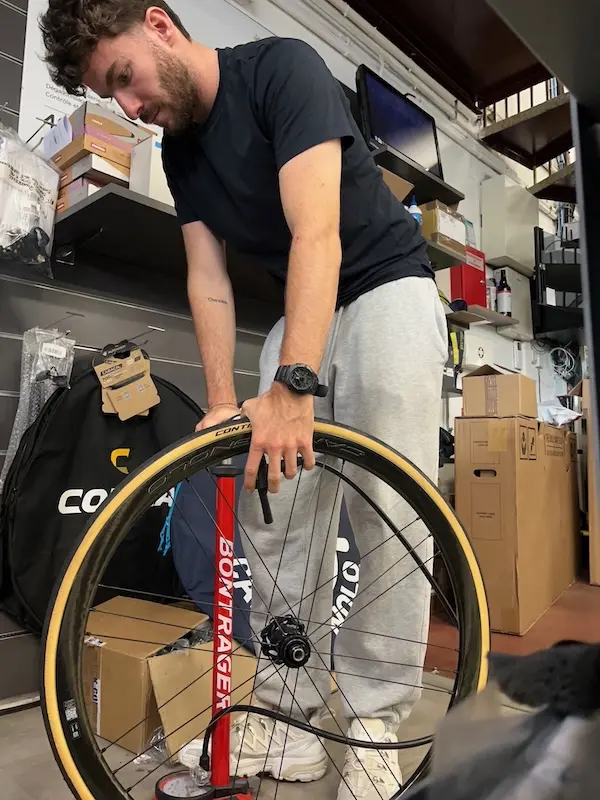
In a previous article earlier this week, we discussed an often-overlooked factor: heat inside a car’s cabin and its consequences on tire pressure, especially for tubeless setups. Today, we’re taking the analysis a step further with Théo Nonnez, a former professional cyclist with FDJ and now a skilled technician at a bike shop in Val d’Oise, who shares his insights on ground temperature and tire behavior once on the road.
By Jeff Tatard – Photos: All rights reserved
When the Heat Comes… From the Asphalt
“We often talk about the heat in the car, but on the bike, it’s the burning asphalt that can make the pressure climb faster than expected, especially after a stop,” explains Théo.
And this phenomenon is even more pronounced with:
- Tires with flexible casings
- Wide tire widths
- Tubeless setups that are a bit “tight”
He also reminds us that some tires heat up faster than others: the choice of tire therefore has a real impact on thermal stability.
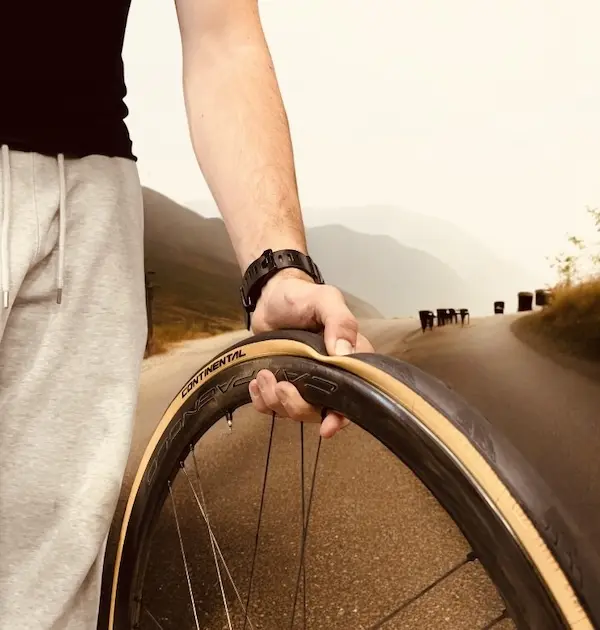
Should You Re-inflate After a Break? Not Always.
“Many cyclists mechanically re-inflate after a break. Bad idea, especially if the tires are still hot. It’s better to wait for the temperature to stabilize before touching the pressure. Otherwise, you risk an over-evaluated pressure… and a hard, vague tire for the first few kilometers.”
In short: wait 5 to 10 minutes in the shade after a break in direct sunlight before adjusting your pressure. Why? Because the internal tire temperature drops more slowly than the ambient temperature.
Théo’s “Field” Tip
“When it’s very hot and you know you’re going to stop in direct sunlight, I sometimes recommend a small spray of cool water (or better: a light cooling spray) on the sidewalls. This helps to balance the tire/air temperature more quickly.” Without excess, of course: it’s about accelerating stabilization, not violently cooling. A simple technique, but incredibly effective in extreme conditions.
What to Remember (in addition to the first article)
- The heat from the asphalt can continue to increase pressure, even once you’re on the bike
- Tires with flexible casings or light tubeless setups heat up faster and stabilize less effectively
- After a break, it’s better to wait a few minutes before re-inflating, especially in summer
- A spray of cool water or cooling spray on the sidewalls can help return to a reliable pressure more quickly
- Never adjust pressure when hot, except in absolute necessity
In Summary
The impact of temperature doesn’t stop at the car: it continues to play a key role on the road. After Mickaël Guillermet in our previous article, Théo Nonnez completes the picture: between fine pressure management, anticipating the terrain, and mechanical common sense, tires truly leave nothing to chance.
If you missed the first part on heat in the car and transport precautions, it’s here:

Share the post "Tire pressure, ground temperature, and tire behavior"