Share the post "Pressure, heat, tubeless: what every cyclist needs to know before transporting their bike by car"
When it comes to performance, every detail counts. Whether you’re a road cyclist or a meticulous triathlete, you’ve probably already considered tire pressure to optimize efficiency or comfort. But there’s a much more insidious, often overlooked factor: heat. And when it comes to transporting a bike in a car in the middle of summer, this parameter can literally make you “blow a fuse”… or a tire. To clarify the subject, we asked for the opinion of Mickaël Guillermet, a pro mechanic, tire dynamics expert, and seasoned mountain biker. His verdict is clear: “The worst enemy of a tubeless tire isn’t a puncture… it’s poorly managed heat.” We’ll explain why.
By Jeff Tatard – Photos: All rights reserved
Heat: The Silent Enemy in the Car Interior
In summer, a car’s interior can easily reach 50 to 70°C, especially if your bike is in the trunk or wedged between two suitcases on the back seat. And this furnace has a direct consequence: your tire pressure climbs.
A quick physics reminder (thanks, Mr. Gay-Lussac): gas pressure increases with temperature. As a result, a tire inflated to 6 bar at 20°C can flirt with 7 bar at 50°C. And with a tubeless setup, known for its tighter tolerances, this can cause:
- A bead unseating
- A micro-leak of sealant
- In extreme cases, a pure and simple explosion
And as Mickaël says: “A tire blowing in a hot car wakes you up faster than a double espresso.”
Should you deflate before transporting your bike? Yes.
The good practice, simple but often forgotten: deflate by 0.3 to 0.5 bar before loading the bike, especially in hot weather. Why? To anticipate the temperature rise in the car and avoid overpressure.
And when you take the bike out of the car, wait a few minutes for everything to stabilize temperature-wise before reinflating to the target pressure.
Note: the air in the tire can also cool down when exposed to a cooler environment, and the pressure will naturally drop. Hence the importance of reinflating just before riding, not during the post-unloading coffee.
Once reinflated, will the pressure drop again?
No. This is a common myth. Once you have reinflated your tire to ambient temperature, the pressure remains stable, unless there is:
- A micro-leak (often invisible)
- A problem with a poorly tightened valve
- A sudden cooling (for example, climbing a pass very early in the morning)
But as Mickaël reminds us: “A well-mounted, well-inflated tire doesn’t deflate by magic.”
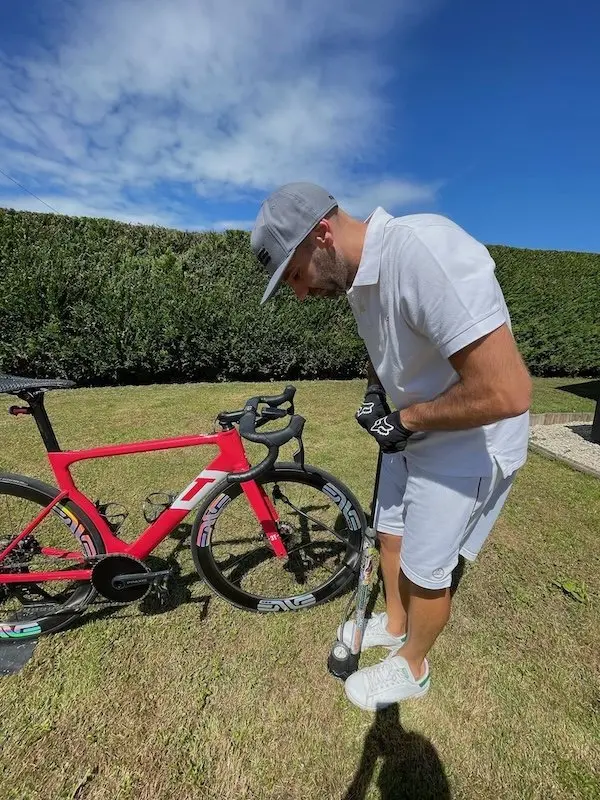
Tubeless: Sensitive but Performing
We love tubeless for its qualities: efficiency, comfort, puncture resistance. But it is also more sensitive to thermal variations, because:
- The air pushes directly on the tire bead
- The setup must be perfectly airtight
- The sealant must be present and active
If the heat increases the pressure too much, and the setup is borderline or the sealant insufficient, you risk:
- A bead unseating
- A sudden leak
- Pressure slowly dropping, like a soft tire after too long an aperitif
What Mickaël recommends: “In summer, check your sealant every 3 to 4 weeks, not every 3 months.”
And also:
- Clean mounting, bead properly seated
- Valve tightened (not like the Hulk, but well tightened)
- Pressure adjusted just before departure.
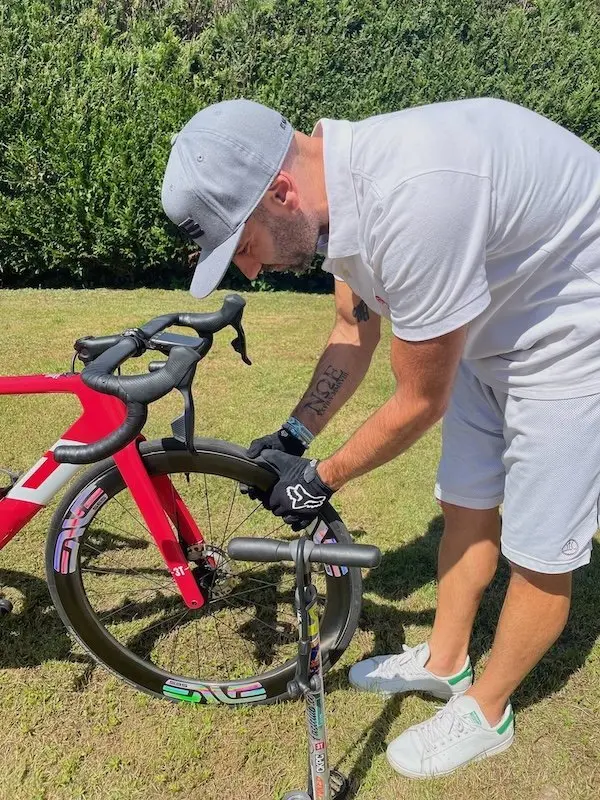
The Anti-Bad Surprise Routine
Here’s a simple checklist, to mentally stick on your dashboard:
1. Before transport, deflate by 0.3 to 0.5 bar if it’s very hot.
2. Once out of the car, let the tires stabilize for a few minutes.
3. Reinflate to the ideal pressure just before riding.
4. On the bike, monitor behavior: vagueness, softness, or weeping = alert.
And above all, don’t forget: “It’s not the road that damages tires, it’s the poorly ventilated car,” says Mickaël.
To Remember (and Pass On to the Next Friend Who Punctures at the Start)
- Heat increases pressure in your tires, sometimes dangerously
- Tubeless is particularly affected
- A slight deflation before transport avoids overpressure and problems
- Reinflation just before the ride is essential
- A clean setup + up-to-date sealant = peace of mind.
Cycling is a clever mix of science, intuition… and good reflexes. Understanding the impact of heat on pressure is a sign of race intelligence — and it can make a difference over 90 or 180 kilometers.
And as Mickaël says, with his inimitable style: “A cyclist who knows their pressures is a cyclist who sleeps better… and punctures less.”
Share the post "Pressure, heat, tubeless: what every cyclist needs to know before transporting their bike by car"