Share the post "Bike paths: rules and penalties for sport cyclists"
The Use of Cycle Paths by Sport Cyclists in France: Regulations, Obligations, and Penalties
With the rise of sport cycling in France, whether for training, bike commuting, or competitions, the use of cycle paths raises many questions. Are they mandatory? What rules apply? What risks do cyclists and motorists face if they do not comply with the rules? Let’s explore the current regulations, the obligations of sport cyclists, and potential penalties.
By Guillaume Judas – Photos: depositphotos.com
Cycle Path Regulations in France
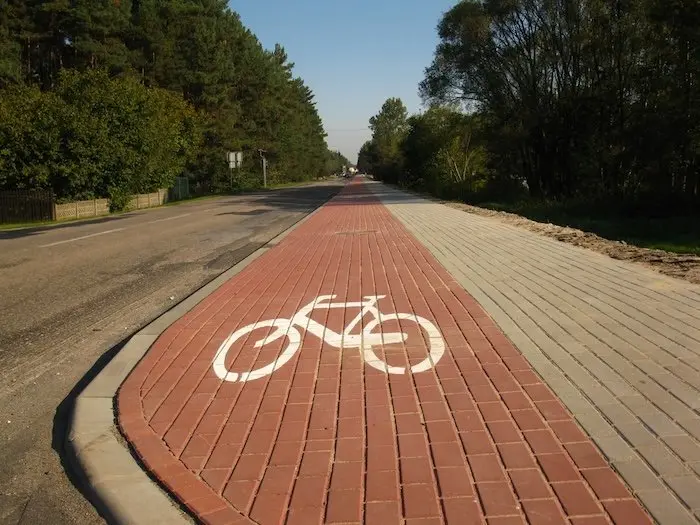
In France, the Highway Code defines a cycle path as a road exclusively reserved for two- or three-wheeled cycles and motorized personal mobility devices (EDPM) for users over 8 years old (article R110-2). These paths must be physically separated from the main roadway by a median, a curb, or a low wall, unlike cycle lanes, which are simply delimited by road markings on the roadway.
Are Cycle Paths Mandatory?
Since decree n° 98-828 of September 14, 1998, cycle paths are not systematically mandatory for cyclists in France. They are generally recommended, except in specific cases where their use is imposed by the competent authority (mayor or prefect) via specific signage.
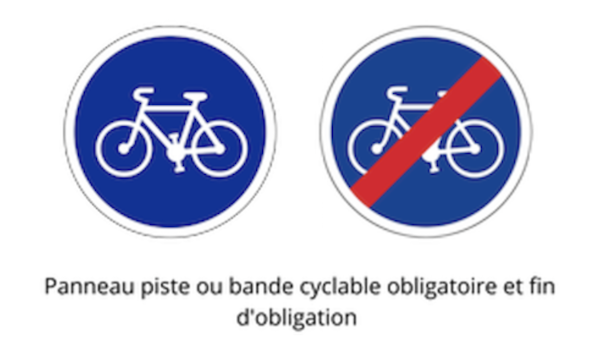
Mandatory sign: a round blue sign with a white bicycle (B22a) indicates that the use of the cycle path is mandatory. This sign may be supplemented by a panel authorizing, for example, mopeds or electric scooters.
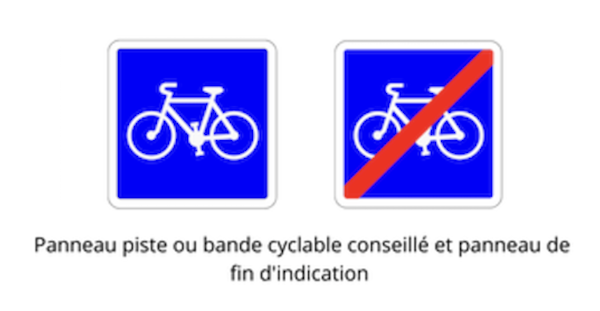
Recommendation sign: a square blue sign with a white bicycle (C113) indicates that the path is recommended but not mandatory.
What Percentage of Cycle Paths are Mandatory?
There are no precise national statistics indicating the exact percentage of mandatory cycle paths in France, as this depends on local decisions made by the competent authorities. However, mandatory paths are rare and generally limited to specific areas, such as roads with heavy traffic (speed exceeding 50 km/h) or dangerous areas (for example, near roundabouts or complex intersections). The majority of cycle paths, especially in urban areas, are indicated by square signs (C113), and are therefore not mandatory. It can be informally estimated that less than 10% of cycle paths in France are mandatory, but this figure varies depending on regions and local infrastructure.
Why Do Sport Cyclists Sometimes Avoid Cycle Paths?
Sport cyclists, often equipped with road bikes and riding at high speeds (sometimes exceeding 30 km/h), may prefer the roadway for several reasons:
- Path condition: degraded surface, gravel, or obstacles (bins, pedestrians, illegal parking) making the path impassable.
- Speed and fluidity: cycle paths, often frequented by slower cyclists or EDPMs, can hinder sport cyclists who seek to maintain a sustained pace.
- Safety: some paths, poorly designed or maintained, present risks (curb cuts, construction site exits, failure to yield).
In these cases, sport cyclists have the right to ride on the roadway, unless a round B22a sign imposes the use of the path.
Rules to Observe on Cycle Paths
When a cyclist uses a cycle path, whether mandatory or not, they must comply with several rules of the Highway Code:
- Mandatory equipment: the bicycle must be equipped with functional brakes, an audible warning device, and front and rear lights for night riding. Wearing a helmet is mandatory for children under 12 and strongly recommended for others.
- Respect for signage: cyclists must comply with traffic lights, priority signs, and road markings (e.g., indicated direction of travel).
- Priority to pedestrians: on cycle paths, pedestrians may be authorized to circulate in the absence of a sidewalk, but cyclists have priority, except in shared zones or pedestrian areas where they must ride at walking pace (6 km/h).
- Direction of travel: cyclists must respect the direction indicated on one-way paths. Riding against traffic is prohibited and dangerous. On two-way paths, specifically indicated, circulation in both directions is permitted.
Speed Limits for Cyclists
The Highway Code does not set a specific speed limit for cyclists on cycle paths, unlike EDPMs (electric scooters, for example), which are limited to 25 km/h. However, cyclists must adapt their speed to traffic conditions and general signage:
- In town: 50 km/h maximum, except in 30 km/h zones or shared zones (20 km/h).
- Greenways: no explicit limitation, but cyclists must adjust their speed so as not to hinder pedestrians or other users.
For sport cyclists, it is therefore crucial to moderate their speed on shared paths or in high-density user areas to avoid collisions.
Penalties for Cyclists
a) If the cycle path is mandatory
If a cyclist does not use a cycle path indicated by a round B22a sign, they face a 2nd class contravention (article R431-9 of the Highway Code), i.e., a fixed fine of 35 €. This penalty remains relatively light, but it can be applied if the authorities observe the infraction.
b) If the cycle path is not mandatory
If the path is simply recommended (square C113 sign), the cyclist is free to ride on the roadway without risk of penalty, as they are considered a legitimate user of the public road. However, they must respect the general rules of the Highway Code, such as staying to the right, signaling changes of direction, and respecting priorities.
Risks for Motorists
Motorists who behave dangerously towards cyclists, whether they are on a cycle path or on the roadway, face severe penalties. Here are the main infractions and their consequences:
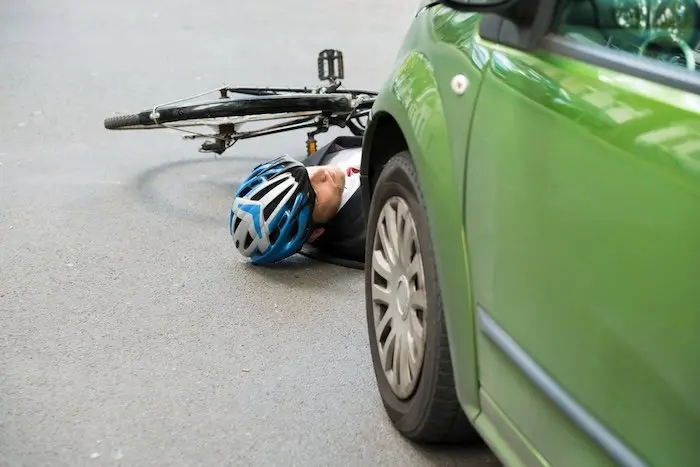
- Hitting a cyclist: in the event of a deliberate or negligent collision, the motorist may be prosecuted for involuntary injury (if the cyclist is injured) or involuntary manslaughter (in case of death), with penalties that may include up to 7 years in prison and a 100,000 € fine in cases of aggravation (for example, driving under the influence) (articles 221-6 and 222-19 of the Penal Code). Even without injury, an intentional collision can be classified as voluntary violence, punishable by criminal penalties.
- Threatening a cyclist: any verbal or physical threat (for example, intimidating a cyclist to use a non-mandatory path) can be considered a threat of violence (article 222-17 of the Penal Code), punishable by a fine of up to 7,500 € and a prison sentence in case of serious threat.
- Dangerous overtaking: the Highway Code imposes a minimum distance of 1 m in town and 1.5 m outside built-up areas when overtaking a cyclist (article R412-19). Overtaking too closely or at excessive speed is a 4th class infraction, punishable by a fine of 135 € and a possible deduction of 3 points from the driving license. In case of deliberate endangerment, the motorist risks a license suspension and prosecution for endangering others (article 223-1 of the Penal Code), with a penalty of up to 1 year in prison and a 15,000 € fine.
- Parking or driving on a cycle path: motorists who park or drive on a cycle path commit a 4th class infraction, punishable by a fine of 135 € (reduced to 90 € if paid quickly) and, in the case of obstructive parking, a deduction of 3 points from the driving license.
Tips for Harmonious Coexistence
For sport cyclists:
- Check the signage to know if the path is mandatory.
- Adapt your speed on shared paths, especially in the presence of pedestrians or other cyclists.
- Signal your intentions (changes of direction, overtaking) to avoid accidents.
For motorists:
- Respect safe distances when overtaking.
- Be patient with cyclists on the roadway, as they have the right to circulate there.
- Avoid any aggressive behavior, which can have serious legal consequences.
In France, cycle paths offer a safe alternative for cyclists, but they are only mandatory in rare cases, indicated by a round B22a sign. Sport cyclists, often seeking speed and fluidity, may prefer the roadway for practical or safety reasons, which is their right unless otherwise specified. Penalties for non-compliance with a mandatory path remain moderate (35 €), but motorists who threaten, hit, or dangerously overtake a cyclist face fines, license point deductions, or even prison sentences.
A better understanding of the rules and mutual respect between cyclists and motorists are essential to ensure peaceful coexistence on the road.
Sources:
Highway Code, articles R110-2, R431-9, R412-19, R415-3, R415-4
Road Safety: www.securite-routiere.gouv.fr
Lepermislibre: www.lepermislibre.fr
Lesbicycleurs: www.lesbicycleurs.com
Drivecase: www.drivecase.fr
Franceinfo: www.franceinfo.fr
CommeUnVelo: www.commeunvelo.com
Share the post "Bike paths: rules and penalties for sport cyclists"