Share the post "Riding by feel: good or bad idea?"
In the world of cycling, training approaches vary. Some swear by their power meter, others remain faithful to their heart rate monitor, and a few die-hards prefer to rely solely on their sensations. But is riding by feel enough to train effectively? Here’s an exploration of different methods to measure intensity and optimize performance, while keeping the human element at the center of the equation.
By Guillaume Judas – Photos: depositphotos.com
Modern tools: a revolution in training
In a quarter of a century, cycling has seen the emergence of a panoply of technological tools: heart rate sensors, cadence sensors, power meters, GPS bike computers, smart indoor trainers, and analysis applications. These tools allow you to measure, analyze, and track your activities in the smallest details. But this abundance of data can sometimes make you lose sight of the essential: knowing how to listen to your body.
Because, as precise as they may be, this data is only useful if you know how to interpret it. Electronic tools, though advanced, remain imperfect with their margins of error. And peak form is not just a succession of numbers: it is a fragile balance between optimizing energy systems, motivation, and personal feeling.
Sensations vs technology: the great debate
In contrast to cycling geeks who never ride without their connected gadgets, some prefer to rely exclusively on their body’s signals to manage their effort, training, and season. Between these two extremes, there is a happy medium. But one thing is certain: sensations must always remain at the heart of your practice.
Riding by feel does not mean training without a strategy. Many cyclists rely on their sensations to adjust their rides: muscle sensations, breathing, recovery after an effort, or ease on a reference climb. They adapt their training volume to their form, the weather, or the calendar, and do not hesitate to shorten or lengthen a ride depending on their state of fatigue or ease.
An intuitive and effective approach
Rather than following timed effort series, some choose routes based on their difficulty. They work on their pace by pushing each other with friends, sprint at town signs to boost their explosiveness, or join a peloton on Sunday to evaluate themselves against the competition. This approach, far from being disorganized, relies on self-knowledge and an ability to objectively self-assess.
This does not mean that technological tools should be rejected. Power meter data, such as CP5 or CP20 tests (power records over 5 or 20 minutes), are valuable indicators for evaluating your level and guiding your sessions. But they must be used in conjunction with sensations, not as a replacement.
Cross-referencing data for better progress
Power directly measures the effort provided, allowing you to push your limits in terms of intensity and duration. Heart rate, with its slight delay compared to effort, remains a reliable indicator of the energy systems being used. An unusual discrepancy between these two metrics can signal an improvement in your form or, conversely, abnormal fatigue.
Sensations, for their part, bring a subjective but essential dimension. Suppleness in the legs, shortness of breath, or muscle heaviness at a given intensity can say a lot about your state of form. By cross-referencing this information – power, heart rate, and sensations – you get a complete picture of your progress.
The RPE scale: an ally for structuring sensations
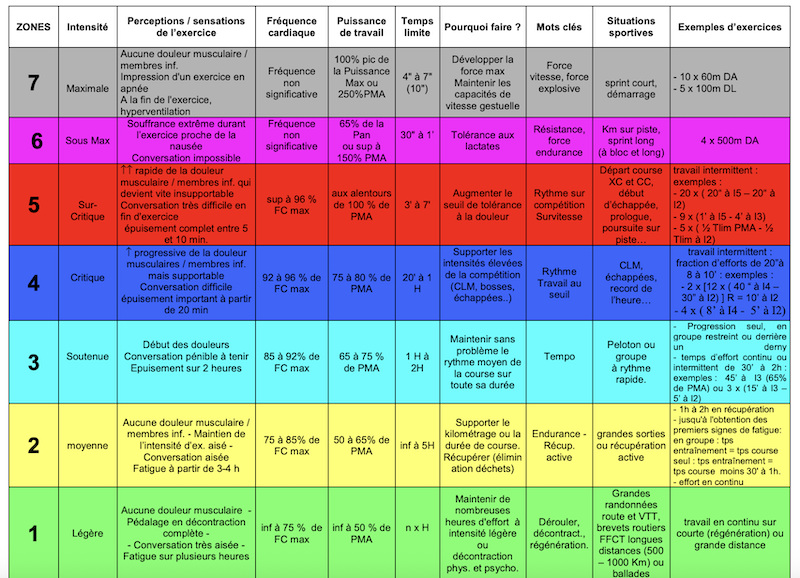
For a good twenty years, the Rate of Perceived Exertion (RPE) scale has helped cyclists structure their sensations. Divided into seven effort zones, it allows you to link the feeling to the intensity of the exercise and the energy systems being used. With a little experience, it is easy to correlate these sensations with sensor data to intelligently manage your effort.
RPE Scale => HERE
How to find the balance?
Training by feel does not mean riding blindly. It’s about combining intuition and data to adjust your rides, integrate recovery, and re-evaluate your program based on your form. Technological tools are allies, but they should not confine you. Forgetting your bike computer or sensor from time to time will not make you a worse cyclist.
In any case, never forget that sensations remain paramount for managing your activity and achieving your goals. Whether you are a gadget enthusiast or a purist of feeling, the essential is to find a balance that allows you to progress while enjoying yourself. So, ready to listen to your body and ride at your own pace?
Share the post "Riding by feel: good or bad idea?"