Share the post "Tour de France 2025: cherry juice, trendy drink or placebo effect?"
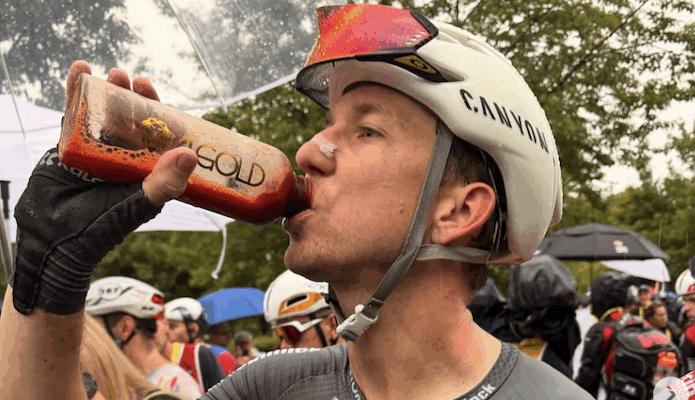
It’s no longer an anecdote: at the 2025 Tour de France, the small red or blue cherry-flavored packs are handed out at the finish line like bidons on a breakaway day. Tart cherry juice, Montmorency concentrate, miracle beverage… Call it what you want: all the riders use it. And while some grimace at the first sip, no one goes without it. But is it just peloton mimicry or truly useful? We investigated.
By Jeff TATARD – Photos: depositphotos.com, Instagram alpecindeceuninck
Not a revolution, but a (good) solution
It’s not the first superfood to win over the peloton, and it certainly won’t be the last. But this one ticks several boxes: it’s natural, easy to integrate into a recovery routine, and — above all — it looks pro. Enough to appeal to staff and riders alike. We’ve seen it at every mountain finish: EF, UAE, Visma, Ineos… not a single WorldTour team that doesn’t uncork its vial of cherry juice before heading to the indoor trainers to flush out lactic acid.
For José Lopez, a renowned performance coach and physical trainer, “tart cherry juice is a perfect recovery tool, but not a magic wand. What it provides is an accumulation of subtle effects: less inflammation, a little more glycogen recharged, better sleep. Nothing spectacular in itself, but it’s these kinds of details that, multiplied, count in the 3rd week of a Grand Tour.”

Cherry juice: what the science really says
Behind the hype, there is indeed solid but nuanced data. Polyphenols with anti-inflammatory properties, antioxidants that limit muscle micro-damage, melatonin to regulate sleep, and a significant carbohydrate intake in the post-effort phase (up to 35g of carbohydrates per 250ml).
But again, no superpower effect: it’s all about context, dosage, timing. And above all, recovery — because that’s where this juice plays its part, not on direct performance, unlike supplements like nitrate or caffeine.

Trend or mimicry?
If everyone drinks it, it’s also because everyone sees it. The peloton loves it: observe, copy, refine. As JC Savignoni, former European MTB champion, now a consultant on the Tour and director of the Gravel Festival, which will serve as the French championship this year, says:
“We’ve all seen trends come and go. But this one is smart because it’s based on concrete, subtle but proven effects. And when a team wins using it, half the peloton adopts it. It’s not a magic potion, but it becomes a recovery standard, like compression socks or air boots.”
The price of detail
The other side effect is… the price. The versions used in the peloton are not those found on supermarket shelves. We’re talking about concentrated juice, dosed to the nearest milliliter, sometimes with added L-theanine or melatonin depending on the range. Expect to pay between 15 and 30€ per liter, which is about ten euros per post-stage dose. Suffice it to say, it remains an “elite” product — for now.
But again, this is nothing new in cycling, where the slightest aerodynamic sock is priced at a premium and where recovery has become a battleground in its own right.
What we take away from it
• Yes, tart cherry juice has a real effect on recovery, especially through its anti-inflammatory and antioxidant properties.
• No, it’s not revolutionary, but it ticks all the boxes for marginal gains.
• Yes, its widespread adoption comes as much from science as from peloton conformity.
• No, it’s not a miracle cure. But in a sport where every detail counts, it’s another arrow in the modern rider’s quiver.
José Lopez concludes: “It’s a tool, not a solution. But used well, it allows you to push harder. And at this level, that’s what we’re looking for.”
In short, for 3bikes.fr, it remains to be seen whether this trend will pass or endure. But one thing is certain: as long as you drink it with a grimace, it probably means it’s doing you good…
Share the post "Tour de France 2025: cherry juice, trendy drink or placebo effect?"