Share the post "Why do riders get sick in the third week of the Tour?"
Every year, it returns like a metronome: that dip in form, that scratchy throat, that feverish look at the start of the 18th stage. The signs don’t lie. The third week of the Tour is often when bodies give out. Not always from effort, but from invisible resistance: that of immunity. And the question returns: why do they get sick so often at that moment?
By Jeff TATARD – Photos: Instagram gowift, Instagram tntsportcycling
Three Weeks of Gentle War
The Tour de France means 21 stages, mountain passes, wind, rain, heatwaves, crashes, emotions, fragmented nights, missed podiums, nocturnal transfers. In short, a mille-feuille of stress and energy expenditure. And while the body holds up on watts, the immune system takes a hit every day.
By constantly pushing the machine, it eventually gives way. Not with a snap of the fingers. But insidiously. As if the body were saying, “I held on for 17 days. You can’t ask me for 4 more.”
The Rest Day… or the Trap of Letting Go
The rest day is supposed to be a breath of fresh air, a buffer. But for the body, it’s often the opposite: the sudden relaxation of pace causes a disruption of balance. You no longer push, the nervous system relaxes, body temperature drops… and immune defenses falter.
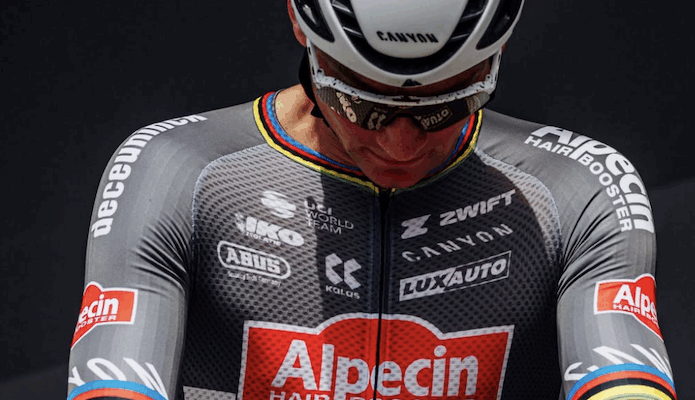
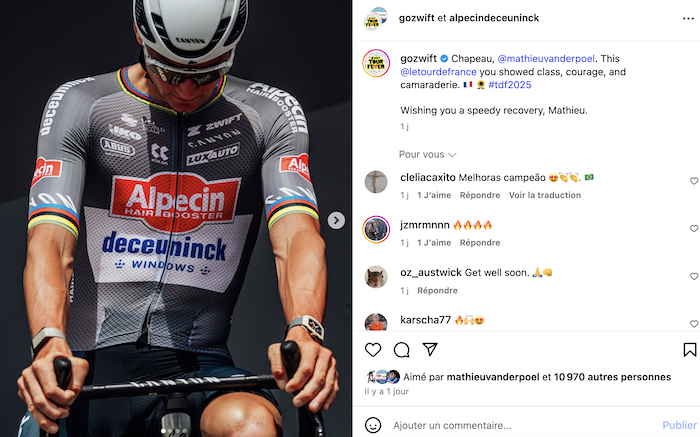
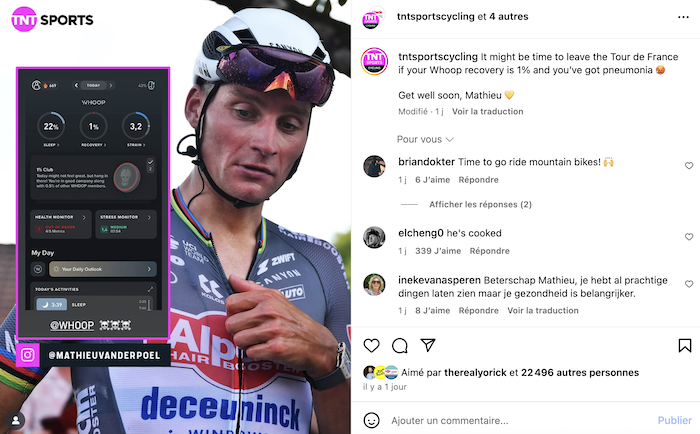
Proof of this year with Mathieu Van der Poel, forced to leave the race after the rest day, struck down by pneumonia declared overnight. We are talking about an extraordinary rider, carved from granite, capable of holding 260 km into a headwind… and yet brought down by an invisible virus, the day after a non-timed day.
Pogacar Tired, Alaphilippe Hoarse… the Signs Are There
Even Pogacar, with a closed face and drawn features, is starting to give the impression that the machine is no longer as smooth. No obvious drop in performance, but that little something in his attitude that betrays weariness. The kind of details you only see at that level.
And behind him, the others also feel the erosion. Julian Alaphilippe confided after his 3rd place in Carcassonne: his throat is sore, a little scratchy.
On the Vélo Club set, Thomas Voeckler didn’t hesitate: “Tonight, Julian, you go straight to the hotel, you cover up, you talk to no one. Otherwise, you’re done for.”
When Riders Keep Their Distance… Even from Microphones
The atmosphere in the peloton, for a few days now, has been almost like a hygienic convent. Masks put back on upon arrival, handshakes avoided, gel in the soigneurs’ pockets.
On Tuesday at Ventoux, a Cofidis rider even asked Céline Rousseaux to step back a little during the interview. Not out of arrogance. Just out of caution. Because at that point in the Tour, every droplet can be one too many.
Winning the Tour Also Means Surviving Its Microbes
The staff know it. The soigneurs too. You don’t win a Grand Tour without protecting your immune system. It has become a discipline in itself: calibrated nutrition, precise supplements, anti-infectious protocol, isolated room for leaders, and zero unnecessary contact.
Some riders, like the Ineos or UAE leaders, live almost in mobile quarantine. Others, less protected, fall one after another. Not from lack of form, but from an excess of microbes.
And Meanwhile…
… there’s the one who’s still pedaling, legs heavy but throat clear, eyes blurry but without fever. That one has won a small Tour within the Tour: the one of survival.
Share the post "Why do riders get sick in the third week of the Tour?"