Share the post "Review of the New Wahoo ELEMNT Roam V3 GPS Bike Computer"
Wahoo ELEMNT Roam V3: A Subtle Evolution Focused on Versatility
Wahoo continues to refine its line of GPS bike computers with the ELEMNT Roam V3, a model that succeeds the Roam V2 while positioning itself as a more compact alternative to the ELEMNT Ace—the brand’s top-of-the-line model—from which it borrows many features. We tested this new ELEMNT Roam V3 for several weeks.
By Guillaume Judas – Photos: ©3bikes.fr
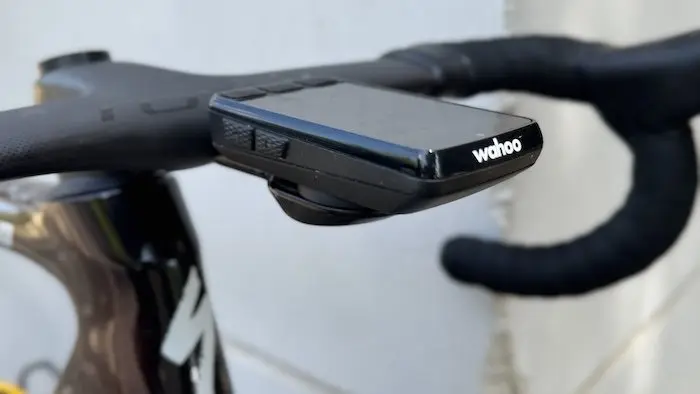
At the end of 2024, Wahoo rushed the launch of the ELEMNT Ace. This GPS bike computer marked a significant evolution in the American brand’s lineup, but it was unveiled ahead of schedule compared to its final version. As a result, the first units suffered from a few bugs, which were fixed via software updates—as was the case with the unit we received for testing.
With the new ELEMNT Roam launched in April, Wahoo took a more cautious approach, releasing a device that was fully polished at the time of its market launch. It’s a versatile GPS bike computer that incorporates most of the features of the ELEMNT Ace (except for the wind sensor, which we weren’t convinced was useful) in a more compact design, similar to the previous ELEMNT Roam.
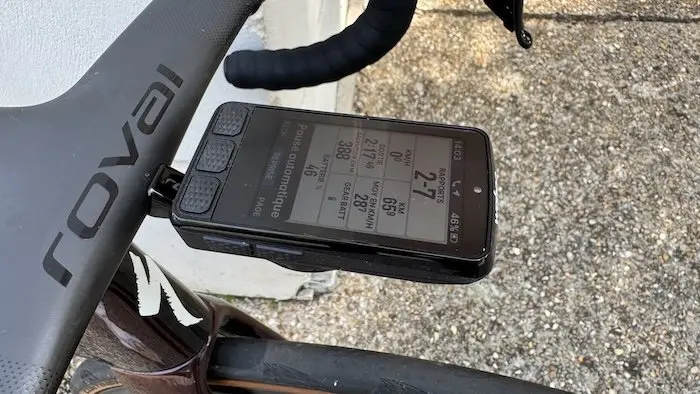
Within the Wahoo range, the ELEMNT Roam V3 slots in between the ELEMNT Bolt V3—which is slightly smaller and lighter but operates solely via buttons—and the ELEMNT Ace, whose larger dimensions are ideal for viewing GPS route tracking. Like the Ace, this new Roam features both touchscreen and button controls, and it now includes a built-in speaker for voice guidance while riding or for the bell function—a feature already popular on the Garmin Edge 1050.
=> Buy a Wahoo ELEMNT Bolt V3 GPS bike computer for €329
Key Features of the Wahoo ELEMNT Roam V3
Priced at €449.99, the Roam V3 positions itself as a versatile bike computer, ideal for those seeking a balance between advanced navigation, compact design, and battery life. In terms of size, it competes with the Garmin Edge 840. Here are its key features:
- Display—The 2.8-inch TFT touchscreen displays 16 million colors, with an anti-glare coating and adaptive brightness (four levels: High, Medium, Low, Off). The 320 × 480-pixel resolution provides good readability for maps and data.
- Navigation – Dual-band GPS (GPS, GLONASS, Galileo, BeiDou, QZSS) ensures accurate positioning. The Roam V3 offers voice alerts through a built-in speaker, turn-by-turn navigation, and features such as “Back on Track” (route recalculation) and “Retrace Route.” The maps include street names and points of interest (POIs).
- Battery life is rated at up to 25 hours, and it charges via USB-C.
- Connectivity—Bluetooth LE 5.0, ANT+ (FE-C), dual-band Wi-Fi (2.4/5 GHz) for syncing with sensors (heart rate, power, cadence) and apps like Strava, Komoot, or TrainingPeaks.
- Storage and Memory – 64 GB of storage and 2 GB of RAM for smooth navigation and plenty of space for maps.
- Features – The “Ready-to-Ride” dashboard speeds up startup, activity profiles (Road, Gravel, Indoor) personalize the experience, and the SUMMIT feature helps manage climbs. The Roam V3 also lets you control devices such as GoPros, lights, or bike radars.
- Design – It tips the scales at 110 g, measures 96 × 53 × 24 mm, is IPX7 waterproof (submersible up to 1 m for 30 min), and works in temperatures from -20 °C to +50 °C.
- App – The new Wahoo app replaces the old ELEMNT Companion for setting up the device and analysing data.
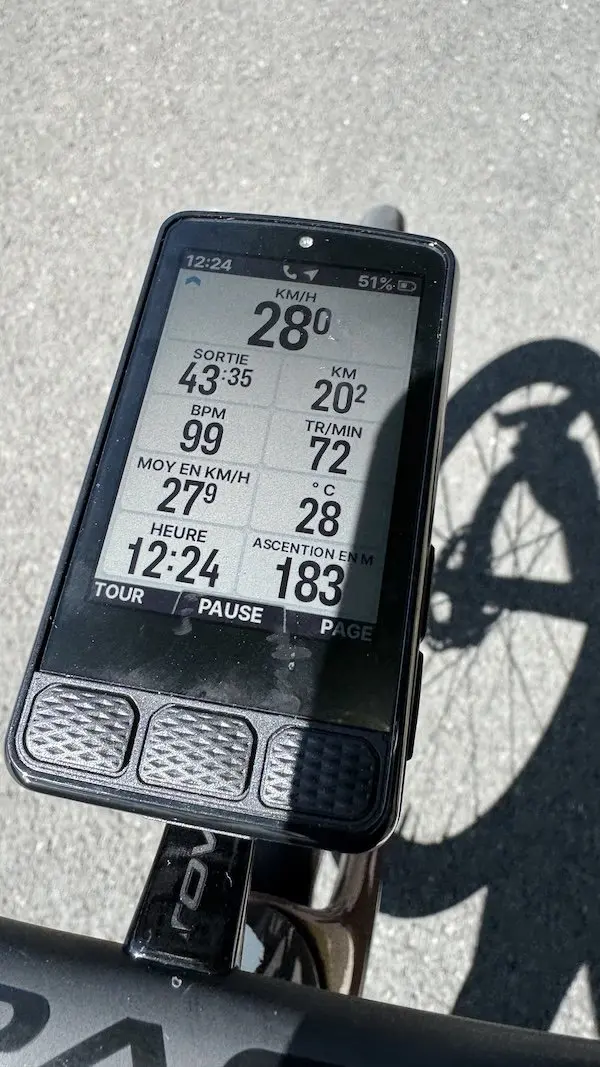 => Buy a Garmin Edge 840 GPS bike computer for €399
What’s New Compared to the ELEMNT Roam V2
The new ELEMNT Roam has evolved in terms of both its dimensions and features compared to the previous version, released in 2022. Here are the main differences between the previous and new ELEMNT Roam:
- Screen—The V3 features a 2.8-inch touchscreen (compared to the V2’s 2.7-inch non-touchscreen), with higher resolution and 16 million colors (compared to 64 colors).
- Removal of QuickLook LEDs – The Roam V2 had LEDs on the sides of the unit, which have been removed on the V3.
- Battery Life – The V3 offers 25 hours of battery life according to Wahoo, compared to 17 hours for the V2.
- Navigation—The V3 adds voice alerts and enhances maps with street names and POIs. Both models share features such as route recalculation, but the V3 runs more smoothly thanks to its 64 GB of storage (compared to 32 GB) and 2 GB of RAM.
- Design – The V3 is slightly heavier (110 g vs. 99 g) and larger (96 × 53 × 24 mm vs. 90.5 × 59.5 × 20.5 mm). It features an upgraded USB-C port and a design compatible with more third-party accessories.
- Price – At €449.99, the V3 is pricier than the V2 (€399.99).
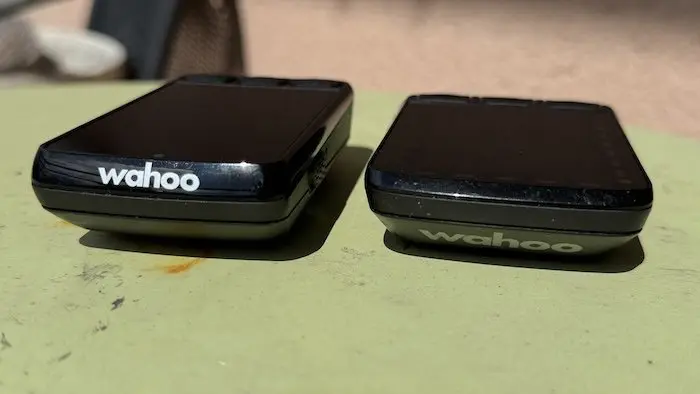
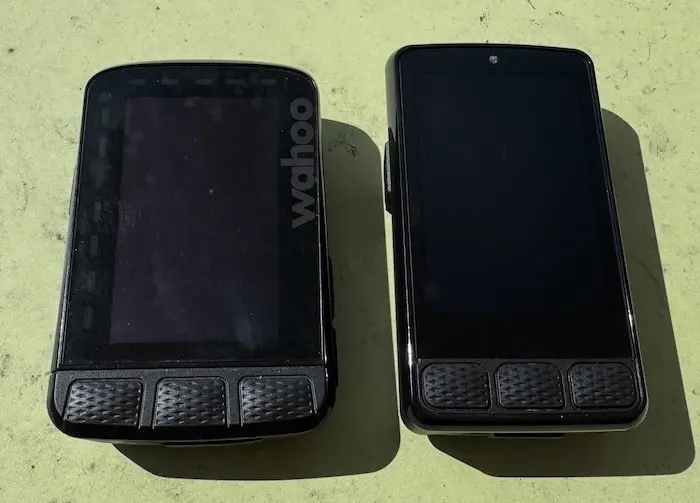
A smaller version of the ELEMNT Ace, really?
The ELEMNT Ace, with its generous dimensions, is geared more toward touring cyclists and fans of long adventures. The Roam V3 is more compact and versatile. Here’s how to tell the two computers apart:
- Weight and Dimensions – The Roam V3 is much lighter (110 g vs. 208 g) and more compact (96 × 53 × 24 mm vs. 125 × 71 × 20 mm).
- Display—The Roam V3 features a 2.8-inch TFT touchscreen, which is smaller than the Ace’s (3.8 inches).
- Battery life – The Roam V3 offers 25 hours, compared to 30 hours (theoretically) for the Ace.
- Wind sensor—The Roam V3 does not include a front-facing wind sensor, unlike the Ace.
- Price – At €449.99, the Roam V3 is cheaper than the Ace, which costs €599.99.
=> Buy a Wahoo ELEMNT ACE GPS bike computer for €517
Getting Started with the Wahoo ELEMNT Roam V3
As is typical with Wahoo devices, setting up the ELEMNT Roam V3 is relatively easy once you take it out of the box. The box contains a USB-C charging cable, a mount for round handlebars, and a mount that attaches with plastic cable ties—which are less convenient than the elastic straps used by Garmin (for quickly switching the mount from one bike to another, for example).
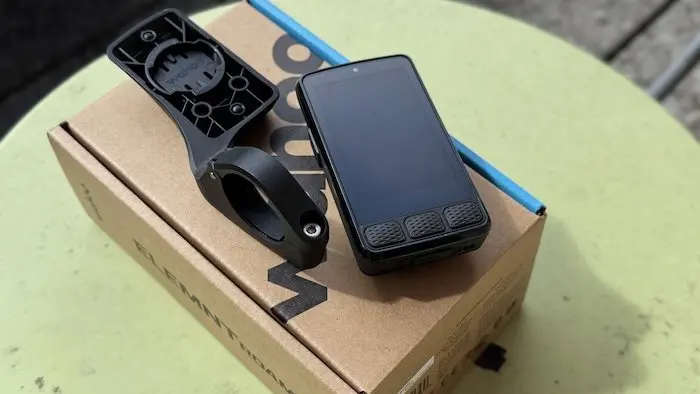
First, you need to download the Wahoo app onto your smartphone—which is different from the ELEMNT Companion app that worked with the Roam V2, but is the same as the one used with the ELEMNT Ace. In just a few seconds, the app recognizes the bike computer and lets you set up to five custom training pages, each with up to 11 data fields, in addition to pages dedicated to navigation, segments, climb data, and statistics. Changes made on the smartphone are transmitted to the bike computer almost instantly, allowing you to adjust settings without going through tedious procedures.
The bike computer can also be easily connected to various types of sensors—via ANT+ or Bluetooth—whether they’re heart rate, power, or cadence sensors, a radar, an electronic shifting system, or tire pressure sensors, regardless of the sensor’s brand. For example, we rode with a Polar heart rate belt, a Garmin cadence sensor, and a Shimano Di2 or SRAM AXS electronic shifting system without any issues whatsoever. The device-pairing process is also very simple, though it can sometimes take a while depending on how quickly the device connects to the bike computer.
Note that to change the bike computer’s menu pages or record split times using the additional buttons on Shimano, SRAM, or Campagnolo drivetrains, you’ll need to use each brand’s app to assign functions to those buttons. But this isn’t difficult at all either.
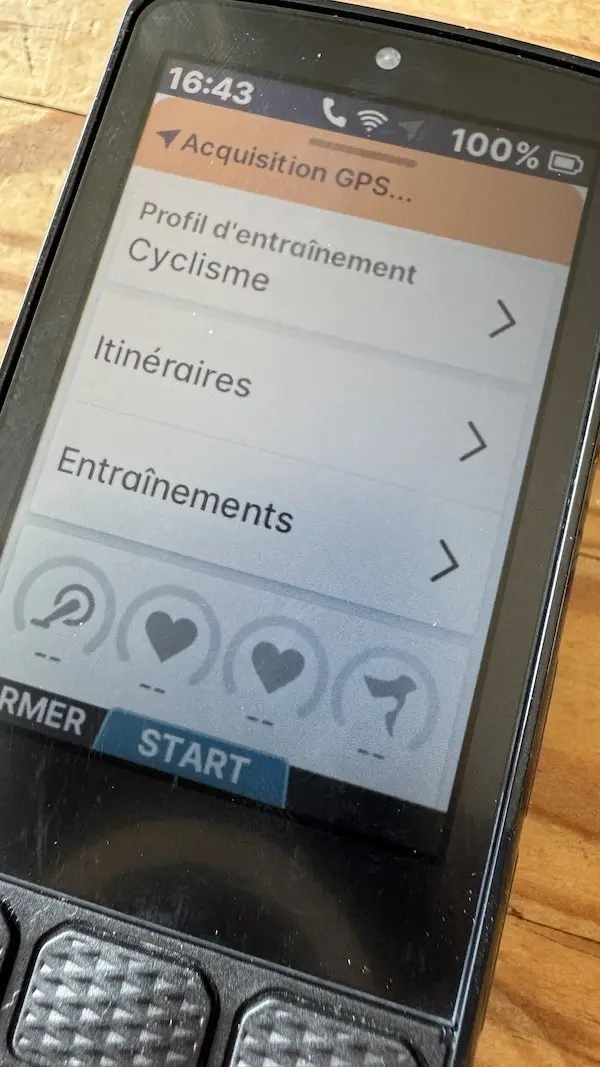
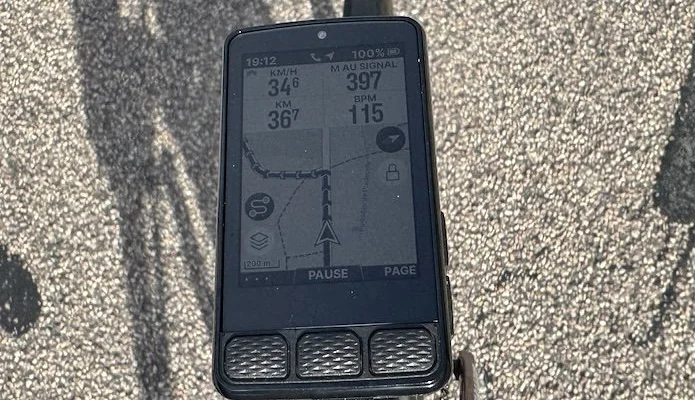
At the start of each ride, the ELEMNT Roam V3 opens to the Ready-to-Ride page, which lets you immediately see recognized third-party devices and choose the type of activity (road, gravel, indoor trainer). This page also lets you select a route to follow using GPS. If the Wahoo app is linked to your Strava account, you can quickly create and save a route, which will update directly on Wahoo—and thus on the bike computer. During a ride, you can return to this home screen and select, for example, “Return to Start” to find your way back or take a shortcut. Finally, we noted that satellite performance was at least as good as with the ELEMNT Ace. In the city, surrounded by buildings, the bike computer connects quickly to satellites regardless of cloud cover—unlike the Roam V2, which sometimes takes up to two or three minutes to become operational under the same conditions. The same is true when passing through a tunnel. If the bike computer eventually loses its satellite connection, it regains it a few dozen meters after exiting the tunnel, whereas with the V2 we sometimes had to wait two or three kilometers under the same conditions.
Performance is also very good in wooded areas
Whether on the road or on gravel, wooded areas didn’t cause any GPS tracking issues with the ELEMNT Roam V3, which remains very accurate and fast even under dense vegetation. We also tested the device… while running, holding it in our hand: conditions that are normally unfavorable for a bike computer, but which here produced flawless tracking, with only a few minor, inconsequential variations in speed display that don’t occur when riding a bike.
While riding gravel on narrow trails, the voice guidance (which can be turned off) proved particularly useful, with clear and concise messages such as “turn right” or “turn left,” allowing you to stay focused on your surroundings rather than on the map. If you stray from the route, the device quickly recalculates an alternative route to get you back on track.
A bell feature and touchscreen that still need improvement
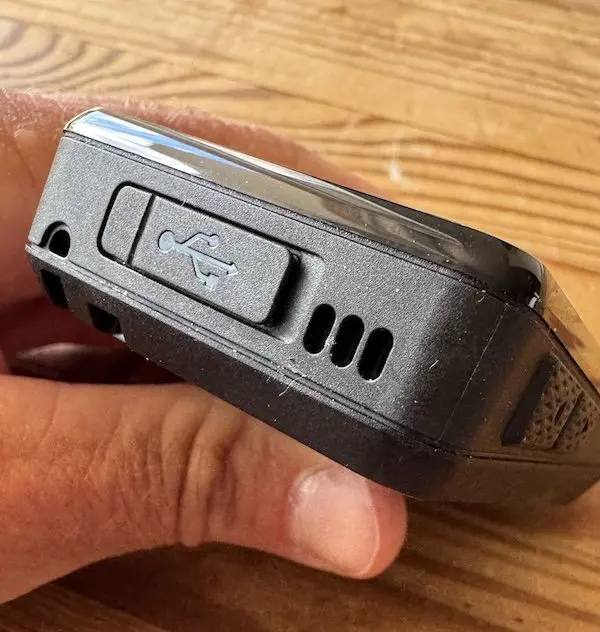
Like the Garmin Edge 1050 or the ELEMNT Ace, the ELEMNT Roam V3 features a built-in bell, which is handy for alerting other road users, whether on the road or on trails. To activate it, simply tap anywhere on the screen twice to hear a “ding-ding” sound—much more pleasant than raising your voice to make your presence known.
Unfortunately, the bell isn’t (yet) compatible with the additional buttons on Shimano, SRAM, and Campagnolo electronic shifting systems, as is the case with Garmin. That’s a shame, because it’s counterintuitive to have to take one hand off the handlebars to activate a warning device in case of danger—especially in a situation where you actually need full control of the bike.
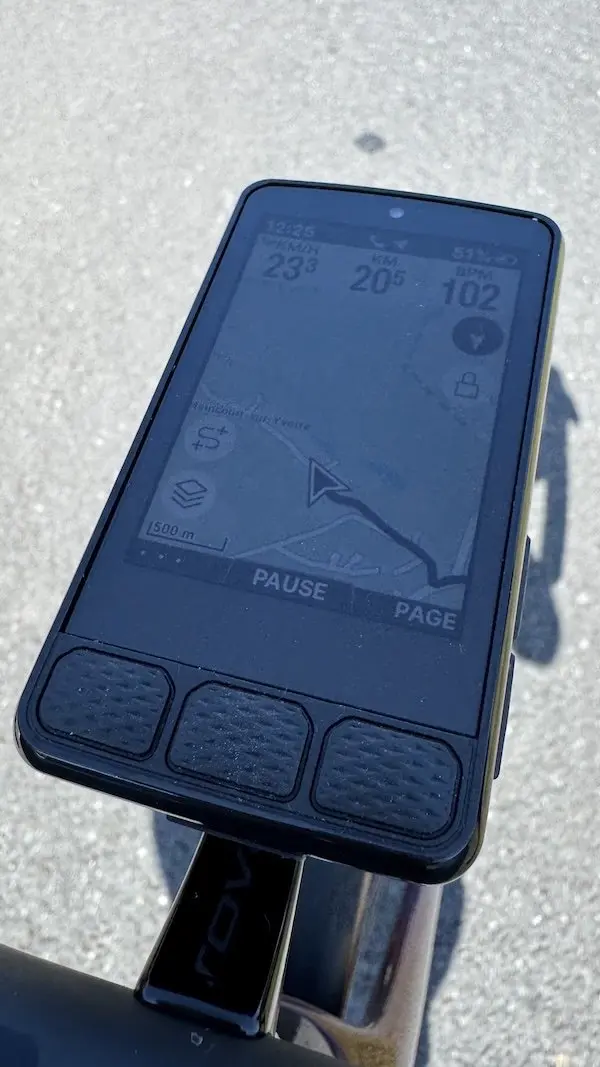
Although the bell’s sound may be slightly muffled in the rain, at least it works perfectly when you tap the screen. On the other hand, it’s difficult to actually use the touchscreen in the rain. It responds poorly or with a delay, which makes it impossible to swipe from one page to another this way. However, the device’s functions remain fully usable with the physical buttons—which Wahoo has thankfully retained—and with the Di2 buttons.
Verified Battery Life
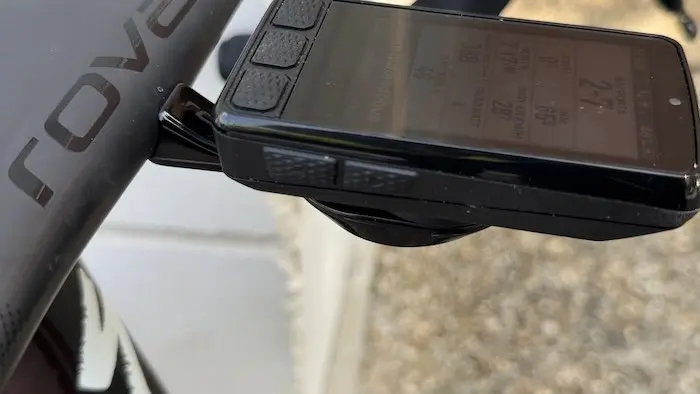
Wahoo claims a battery life of 25 hours for this ELEMNT Roam V3, compared to 17 hours for the Roam V2. The advertised and actual battery life of the ELEMNT Ace was the subject of much debate at the time of its release, with Wahoo claiming 30 hours, but several tests—including our own—showing it lasted barely 20 hours.
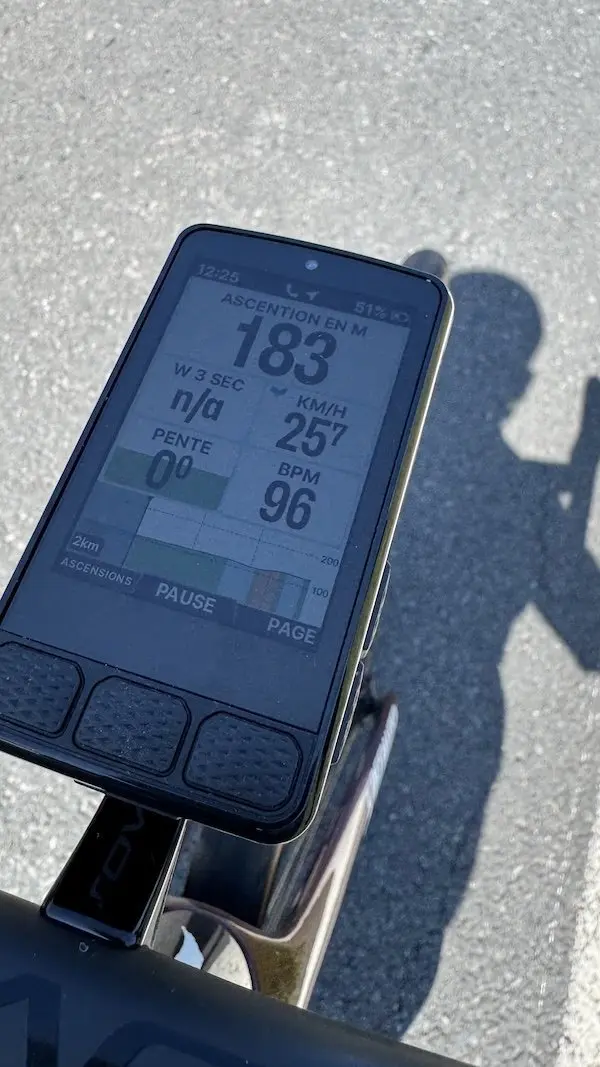
In contrast, with the ELEMNT Roam V3, the 25-hour battery life seems entirely realistic. We logged 20 hours and 30 minutes of training without recharging, with an electronic shifter, a heart rate sensor, and a cadence sensor connected, and while completing a route of about 45 minutes in guided mode. According to the head unit, there was still 30% battery life remaining.
A Good Balance
Ultimately, the Wahoo ELEMNT Roam V3 stands out for its versatility and improvements over the Roam V2, particularly the touchscreen, longer battery life, and voice alerts. Compared to the ELEMNT Ace, it remains more compact and affordable, while offering similar features for most cyclists.
The Roam V3 is a well-rounded choice, especially if size is a key consideration. Touring cyclists or those who prefer a large screen will opt for the ELEMNT Ace, while competitive riders or those on a tighter budget will turn to the lighter ELEMNT Bolt V3. With the ELEMNT Roam V3, Wahoo refines its lineup without revolutionizing it, but effectively meets the needs of a broad customer base.
=> Buy a Wahoo Elemnt Roam V3 GPS bike computer for €429.99
The WAHOO ELEMNT ROAM V3 bike computer/GPS at a glance…Pros: GPS accuracy, display, colors, readability, navigation, interface, bell, speaker Physical dimensions: 96 × 53 × 24 mm – Screen: touchscreen, 16 million colors – Screen size: 2.8-inch diagonal – Screen resolution (width by height): 320 × 480 pixels – GPS: dual-band – Sensors: barometric altimeter, accelerometer, ambient light sensor, compass, gyroscope, audio speaker – Battery type: lithium-ion, rechargeable – Battery life: up to 30 hours – Charging method: USB-C cable – Base maps: preloaded world maps; additional maps can be downloaded via Wi-Fi – Internal storage: 64 GB – Random Access Memory (RAM): 2 GB – Water resistance rating: IPX7 (1 m for 30 minutes) Connectivity: Bluetooth® 5.0, ANT+®, Wi-Fi® – Smartphone compatibility: iPhone®, Android™ – Weight: 110 g – Price: €449.99 – Contact: wahoofitness.com |
Share the post "Review of the New Wahoo ELEMNT Roam V3 GPS Bike Computer"