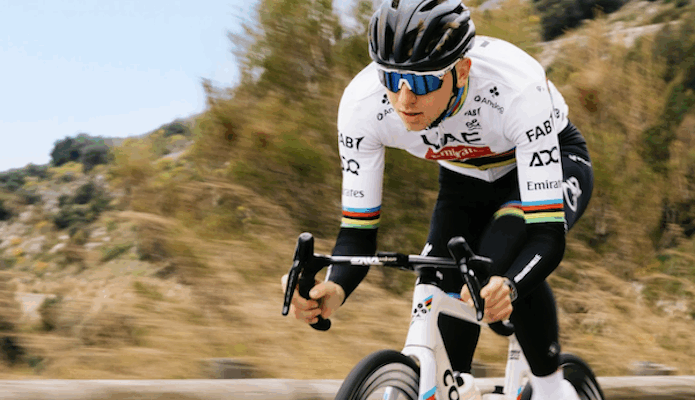
Share the post "Tadej Pogačar: When Poise Becomes Dominance"
The 2025 Tour de France enters its decisive third week tomorrow. The Mont Ventoux stage (Tuesday, July 22) will kick off a formidable final trio of stages, with two Alpine giants in the crosshairs: the Col de la Loze (Thursday, July 24) and La Plagne (Friday, July 25). The race will then conclude on a brand-new course through Paris, featuring a short, intense, and symbolic final stage via the Butte Montmartre, before a final run down the Champs-Élysées on Sunday, July 27. On the eve of this final stretch, Tadej Pogačar leads the general classification by 4’13” over Jonas Vingegaard. Solid in Luchon-Superbagnères (Stage 14) and composed in the Pyrenees, he continues to dictate the pace… all while staying seated in the saddle. Normal or not normal?
By Jeff Tatard – Photos: ©continental, ©depositphotos.com, DR
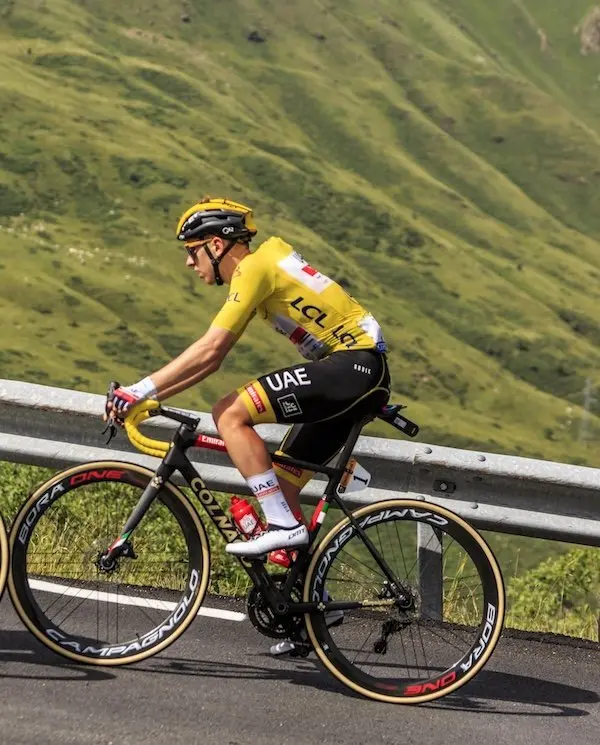
Because what’s just as fascinating as his stats is his riding style: Pogačar climbs while seated. Often. For long stretches. With great strength.
To understand this style that has become his trademark, 3bikes.fr gathered three complementary perspectives:
• Laurent Jalabert, former champion, now a consultant for France Télévisions
• Emmanuel Brunet, former performance manager at the FFC
• José Lopez, a biomechanics coach—discreet but well-known in circles focused on postural optimization
Posture: A Weapon of Domination
Laurent Jalabert, live on France TV, makes no secret of it: “Pogačar often climbs out of the saddle. Not because it’s easier, but because that’s his fighting style.”
A simple sentence, yet one heavy with meaning. Because in a peloton where standing up remains the instinctive reaction to steep gradients, the Slovenian stays planted, glued to his saddle as if on a rail. He doesn’t move—it’s the mountain that gives way.
Geometry and Position: Everything Is Calculated
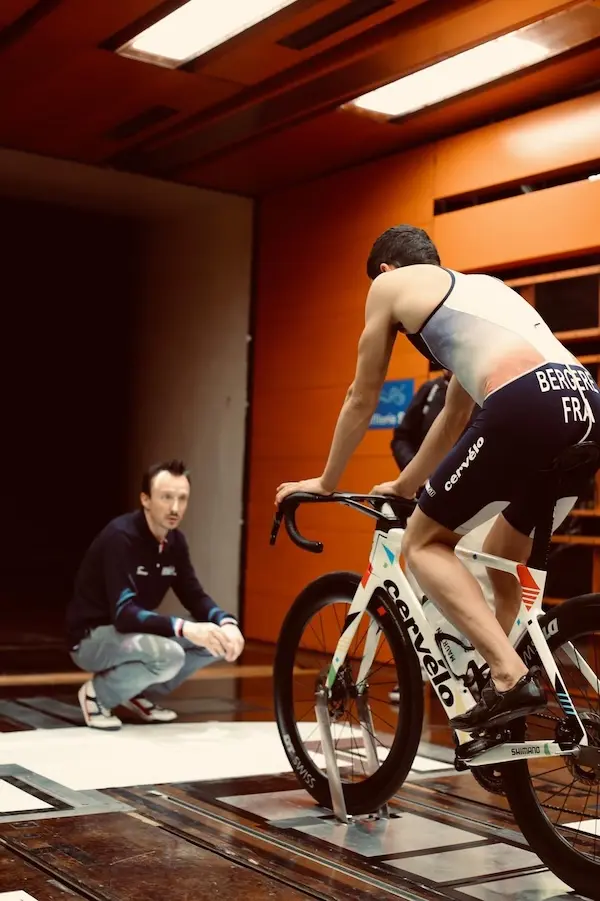
For Emmanuel Brunet, this posture is neither intuitive nor arbitrary. It is the result of a meticulously engineered design: “He sits very far forward on the saddle. His center of gravity is aligned with the bottom bracket axis, and the saddle is tilted slightly forward. All of this allows him to remain seated without losing efficiency, even at high intensity.”
This positioning allows for smooth, consistent pedaling without unnecessary oscillation. The hip-to-torso angle remains open, and abdominal breathing is maintained—even on climbs steeper than 10%.
The Tilted Saddle: That Little Detail That Makes All the Difference
José Lopez, an expert in cycling posture and technical coach, emphasizes a key detail: “This slight forward tilt relieves perineal pressure, stabilizes the pelvis, and most importantly… prevents unnecessary slipping. So he can stay seated without having to constantly readjust.”
A gain in comfort… but also a gain in watts. According to him, this precise adjustment is rare but incredibly effective among powerful climbers: “Some try it, but very few manage to maintain it with such consistency.”
Ventoux and the Alps: His Favorite Terrain
Ventoux on Tuesday (15.7 km at 7.4%) following Monday’s rest day promises to be hot, windy, and grueling. The transition to the Alps—and in particular the 5,500 m of elevation gain on the La Loze stage—will create the perfect setting to observe this style: seated power, without spikes, without letting up.
Where others must attack from a standing position, Pogačar rolls along, settled, compact, and impassive. It’s as much an energy choice as a mental one: stability becomes a threat.
Physical Advantage: A Combination of Genetics and Training
Finally, Brunet and Lopez agree
This allows him to sustain 400 to 420 watts while seated for extended periods without misalignment or mechanical loss.
Conclusion: The Pogačar style is all about efficiency while stationary
On the eve of the final week, it’s a safe bet that Pogačar won’t need to change his pace to dominate. He’ll stay in the saddle—and it’s the peloton that will falter around him.
On the slopes of Mont Ventoux, in the grueling Alpine passes, all the way to the final climb up Montmartre, it’s not just his power that will leave a lasting impression, but the consistency of his form: a locked-in center of gravity, a subtly tilted saddle, a body perfectly anchored… yet never frozen in its intent.
Share the post "Tadej Pogačar: When Poise Becomes Dominance"