Share the post "Work, ride, perform: these elites who thrive on their lunch break"
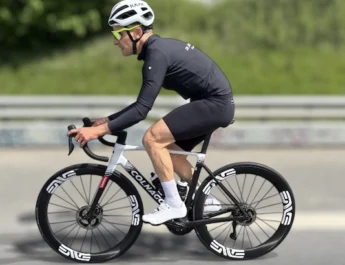
There are those who cheat with watts. And then there are those who cheat with time. Dany Maffeis belongs to this second category. Île-de-France elite champion in 2024, always placed in the biggest races on the amateur calendar, Dany is nevertheless far from being a full-time professional cyclist. He works, and not just a little. From 9:30 AM to 6:30 PM, he is a salesperson at Matériel Vélo. And between two pieces of advice on cassettes or shoes, he has to fit in his training… at noon, and that’s it.
By Jean-François Tatard – Photos: DR & Gérard BRIAND
Compressed Training, Hardcore Version
So he rides. Almost every day, on his lunch break, just like others go for a cigarette or order a bowl.
1h15 maximum. Sometimes in the rain. Sometimes in the cold. Always full gas.
And his bike computer sometimes shows an average of nearly 40 km/h. No Zone 2, no naps, no base training in the sun. Just a window of opportunity. And a sniper’s mentality.
« I have no choice », he says. « It’s the only solution. So I don’t overthink it. »
That’s where the whole paradox lies: how to continue performing at an elite amateur level, where one often trains 15 to 20 hours a week… with only 6 or 7 hours weekly, break already included?
The answer lies in two words: longevity and training intelligence . And perhaps a third: Obélix .
The Obélix Factor: Falling In and Staying In
We often talk about the Obélix effect in sports: the idea that some athletes who have long accumulated high training volumes possess a very solid physical foundation, almost etched for life. This capital of endurance, aerobic capacity, and resistance to effort does not completely disappear, even when the volume decreases.
In Dany Maffeis’s case, years of high-level training have left their mark. His body has learned. He knows how to absorb, how to react, how to perform, even with little.
It’s not magic. It’s muscular, physiological, mental memory.
But there’s also a strategic component: Dany doesn’t try to « compensate » for his low volume with cut-rate work. He puts everything into intensity, regularity, and the close link between racing and training.
Racing is no longer just a goal , it becomes the training .
And that’s something few cyclists truly accept.
Racing as a Catalyst
« I never give up, even when I’m in a tough spot. Because otherwise, I lose the only long ride of my week. »
This is perhaps one of the most powerful sentences in the interview. Dany races to last. He hangs on, not for a ranking, but for a time. Duration is the goal in itself.
A 3-hour race? It’s a godsend. Because beyond his midday intervals, that’s where he rebuilds some base training.
That said, this strategy has its limits. And he knows it himself.
The question that remains unanswered is: how long can it last?
How many seasons can one perform at a high level with 7 hours a week, without significant decline? Science doesn’t have a clear-cut answer, but the evidence converges: as long as the foundation is there, as long as the motivation is intact, as long as the intensity is right, it can last surprisingly long .
Another Vision of Performance
In an increasingly professional amateur world, where training sessions are ultra-calibrated, where plans are exported from TrainingPeaks to Zwift, and where sleep becomes a Strava data point, Dany’s case stands out as an exception.
He reminds us that high-level sport is not just about numbers , but also about context, experience, and character.
He shows that you can perform at a high level with a badge and a time clock , provided you think differently, make the most of every minute, maximize what you have instead of lamenting what you no longer have.
And above all, he invites a broader reflection on the place of sport in our lives. Because yes, you can be elite, and an employee, and happy.
Cycling is not a religion. It’s a commitment.
And sometimes, those who commit the most are those who have the least time to prove it.
Share the post "Work, ride, perform: these elites who thrive on their lunch break"