Share the post "Why can’t you replace a single cog on a bike cassette?"
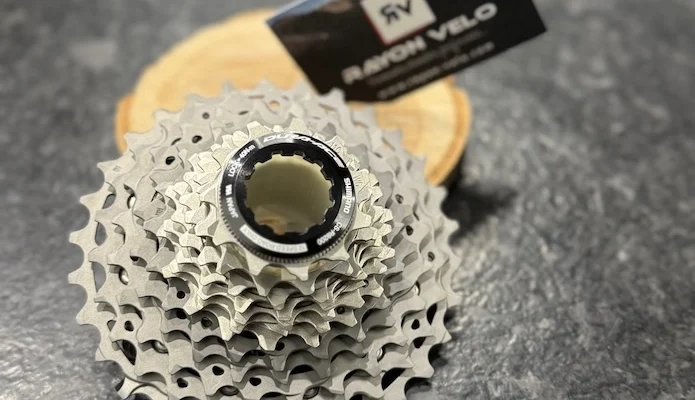
In the world of cycling, the rear wheel cassette is a key component of the drivetrain. Composed of several stacked cogs, it largely determines the range of available gear ratios and thus the ease or difficulty of pedaling. Yet, a question often arises: why, when one or more cogs are worn, can’t they simply be replaced one by one? Why must the entire cassette always be changed?
By Jeff Tatard – Photos: DR
This question reveals a complex technical reality linked to the modern design of cassettes, mechanical constraints, and interaction with the chain. Let’s analyze in detail the reasons that explain this impossibility, and why it is in fact a guarantee of performance and reliability.
To clarify, we called upon John Saccomandi, a former high-level cyclist who still races in Open 1, and also a seasoned mechanic. His explanations show that it’s not a manufacturer’s whim: it’s primarily a matter of performance, reliability… and, paradoxically, long-term economy.

The cassette: an integrated and calibrated system
“Current cassettes are not just a simple collection of independent cogs,” John explains to us. “They form a homogeneous unit, precisely designed to ensure perfect tooth alignment, spacing, and specific profiles.” This integration guarantees smooth, fast, and precise gear shifting.
Each cog is calibrated to fit perfectly with the others, often with asymmetrical tooth profiles and engagement ramps designed to facilitate gear changes. “Replacing a single cog means introducing an element that doesn’t perfectly integrate into this calibration,” adds the mechanic from Rayon Vélo in Domont, 95, thus risking choppy or noisy gear changes.
Wear and chain adaptation
The chain wears by adapting to the cassette teeth, which themselves will wear progressively and regularly. “If you replace a single new cog within a partially worn cassette, the chain may not engage correctly on that cog, which can lead to derailments or increased noise,” confirms his associate Marc Rebello.
Furthermore, a new chain combined with a worn cassette (or vice versa) can cause accelerated premature wear on one or both components. “Changing the entire cassette allows for synchronized wear and shape between the chain and cogs,” John further mentions, ensuring optimal operation and maximum durability.
Mechanical design and strength
Also, it should be noted that modern cassettes, especially 12 and 13-speed ones, often incorporate cogs riveted or mounted on a single body called a “spider” (light alloy body) to gain rigidity and lightness. This assembly does not allow for easy disassembly of a single cog.
This design guarantees the strength of the entire unit, prevents vibrations and deformations that could impair gear shifting, but makes individual cog replacement impossible.

An economical and practical choice
At first glance, replacing a single cog might seem more economical. In reality, “it would often be more expensive due to the risks of incompatibility and degraded performance,” Marc explains to us. Manufacturers therefore favor complete replacement to guarantee the best user experience.
Moreover, and this is what we at 3bikes say, but “changing the cassette and chain simultaneously optimizes the longevity of both components and avoids frequent visits to the mechanic” (But we won’t repeat it to John and Marc).
Conclusion
The inability to replace a single cog on a modern bicycle cassette is a technical constraint dictated by the pursuit of performance, reliability, and durability. This integrated design ensures precise gear changes, good mechanical behavior, and harmonious wear of components.
For the cyclist, it is therefore preferable to accept this reality and invest in a complete replacement of the cassette and chain when necessary. This guarantees a perfectly functioning bike, a durable drivetrain, and maximum enjoyment on the road.
Share the post "Why can’t you replace a single cog on a bike cassette?"