Share the post "Heat Acclimation: How Accurate Is the Garmin Indicator?"
Every year, the scenario repeats itself: the first heatwaves arrive, and despite solid training, the sensations are poor. You plateau faster, sweat profusely, and watts are harder to produce. This phenomenon, well-known to cyclists, is called heat acclimatization. But for some years now, Garmin GPS devices have displayed a heat acclimatization indicator. An intriguing piece of data: is it reliable? What does it correspond to? And most importantly, how long does it really take for our body to adapt to heat?
By Jeff Tatard – Photos: depositphotos.com, All rights reserved
To get a clearer picture, we spoke with José Lopez, a renowned and experienced coach who works with many amateur and professional athletes. His analysis nuances technological certainties.
Data integrated into the Garmin ecosystem
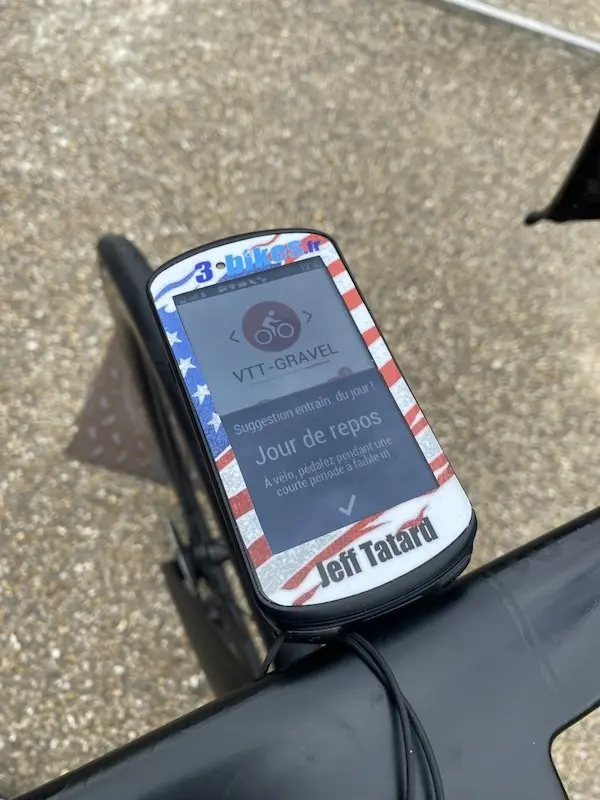
The heat acclimatization indicator is offered by Garmin GPS devices compatible with the Firstbeat platform. To function, several criteria must be met:
- Outdoor rides, with ambient temperature measurement via GPS.
- A temperature above 22 °C during the activity.
- Wearing a heart rate monitor, and ideally a power meter.
Based on this, Garmin displays an acclimatization rate supposed to reflect your current ability to handle heat.
But José Lopez tempers: « What Garmin measures is not a deep physiological adaptation; it’s your recent exposure to heat. It’s a good contextual indication, but it’s not a verdict on your form. »
How long does it really take to acclimatize?
According to scientific literature, complete heat acclimatization requires approximately 7 to 14 days of regular exposure. But it requires well-targeted efforts, performed in the heat, at an intensity sufficient to generate thermal stress. José specifies: « The first ride in 30 °C, even if well-trained, is always difficult. It takes about a week for the body to start reacting: more stable heart rate, more efficient sweating, less overheating. »
Physiologically, adaptation involves:
- An increase in plasma volume, which improves heat transport.
- Faster and less salty sweating, thus more efficient.
- A lowered heart rate at equivalent intensity.
- A progressively softer perception of effort.
This is why we often observe great difficulty with the first heat, a little less with the second, and a clear improvement after several close exposures.
What Garmin says (and doesn’t say)
Garmin does not directly measure this physiological adaptation, but bases it on your history of training in hot weather. The more you ride in high temperatures, the higher your score climbs. If you stay cool for a few days, it drops. José Lopez summarizes: « It’s not a measure of your potential, but a useful indication for adapting your current training. If your rate is low, there’s no point in seeking high intensities; you risk burning out. »

A relevant tool, but to be used with discernment
In practice, this indicator can be a decision-making tool:
- If your score is low, keep intensities moderate.
- If you are preparing for a summer race, gradually expose yourself to heat 10 to 15 days beforehand.
- Monitor your sensations, heart rate, and recovery.
Garmin can also encourage you to vary your ride times: « A training session at 28 °C is sometimes worth more than a threshold block at 20 °C when preparing for a heatwave race », insists José.
In conclusion
The heat acclimatization indicator offered by Garmin does not replace experience, but it can enrich it. It helps to contextualize a session, modulate intensity, or validate a thermal adaptation phase.
But as always, the athlete remains at the center of the game: « You can be at 100% on Garmin and still blow up on the road if you forget the essentials: drink, listen to your body, manage your effort. »
A tool, not an absolute truth — but a real path to train smarter when the thermometer climbs.
Share the post "Heat Acclimation: How Accurate Is the Garmin Indicator?"