Share the post "Emmanuel Brunet, the discreet alchemist of French cycling"
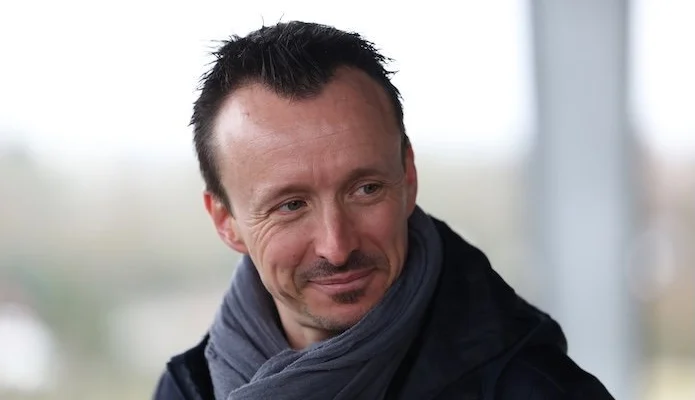
He opened his door to us directly, just as he is. Emmanuel Brunet is the kind of guy you listen to. Not because he’s imposing, but because he speaks truthfully. In his office, between piles of papers and souvenirs, one can discern his path: demanding, discreet, driven. We didn’t come to paint a flattering portrait. We came to understand. What it means to truly commit. To train, to transmit, to seek accuracy, always and forever. With a simple question: what do you leave behind when you’ve spent your life helping others grow?
By Jeff Tatard – Photos: FFC-Patrick Pichon / DR
The threshold of a house full of bikes
When Emmanuel Brunet turned the key in the lock to welcome us, the hallway immediately transformed into a living museum: an old Gazelle with polished mudguards, two track frames leaning against each other, a gravel bike covered in dry dust, a tubular tire hanging like a rosary. “Here, every bike has its story,” he says with a smile that conveys both pride and simplicity. He truly “opened his door” to us, literally and figuratively, and shared a bit of that intimacy that fuels his vision of performance: a composite vision, made of childhood, science, high demands, and a never-negotiable part of pleasure.
Childhood in free wheel: genesis of a passion
Before accumulating diplomas and sitting at the heart of the Federation, Emmanuel, like so many others, started by playing. In 1993, he and his brother Aymeric invented a daily Tour de France in their housing estate: they drew mountain passes with chalk, counted points for the best climber, and crossed imaginary finish lines. “I believe my passion was born from that freedom and the quest for adventure that cycling allowed when I was a child,” he recounts. The anecdote is not merely decorative: it explains his current obsession with creativity, his refusal of sterile routines, and the idea that “innovating” is — and will remain — his greatest challenge. Where others get stuck in protocols, Brunet remembers that you can still draw a hairpin turn on the ground and set off, just to see.

From rider-coach to FFC strategist
Emmanuel never truly left the field. At just 17, he already wore the dual hat of rider/coach at Cours-la-Ville Cyclisme. Very quickly, he earned his federal diplomas, fed his curiosity at the STAPS university, and spent countless weekends in courses. This first learning cycle concluded in 2005 when he passed the sports teacher exam and became Regional Technical Advisor in Burgundy. Eight years in the field, with “relatively primary means” and constant ingenuity: organizing an event, setting up a youth development center, convincing leaders, attracting young people, rallying educators. “You are constantly in action; you have to redouble your inventiveness to remain attractive,” he summarizes.
These years saw him as an artisan, but it was in 2014 that he donned the architect’s suit: General Director of Performance at the FFC. A delicate context: headquarters relocation, reorganization of departments. A stimulating context too: a nearly blank slate. Between two moving boxes, Brunet built a “Research & Performance unit” which, over the Olympiads, would become one of the secret levers of French success. He is credited with the rise of applied aerodynamics, the integration of PhD students who became doctors, and the creation of new analytical metrics. Yet, when pressed to give an assessment, he demurs: “The coaches and athletes would answer better than me. There are things they don’t see, those we activate in the shadows…“.

Leadership woven with tributes and gratitude
Humility is not a pose for Emmanuel; it is a reflex. Each time he recounts his journey, he invokes a gallery of inspirers: Jean-Paul Canet, his first club president (“He would be proud up there“), Régis Auclair, a sports director passionate “to the point of unreason,” Alain Pradier in Burgundy, Vincent Jacquet at the DTN, not to mention the national coaches, research colleagues, and athletes he has worked with — from Thomas Voeckler to Juliette Labous. For him, performance is essentially collective. “In a team, every player counts,” he insists. And if he prides himself on anything, it’s on having enabled “scientific athletes” to emerge: invisible catalysts between laboratory and track.
Science, field, and human demands: the daily equation
How do you make the rigor of a scientific protocol and the urgency of a rider who wants to win on Sunday dialogue, day after day? Emmanuel answers with a three-step process. First, based on the needs of the field: “Scientific questions must be performance challenges, not a researcher’s whim.” Then, write and defend projects by involving everyone, even if “the coach is always in a hurry.” Finally, plan as one plans a peak performance: clear objectives, precise, permanent monitoring. “This research has neither beginning nor end; it constantly feeds on our experiences and our conferences.” And when data becomes actionable, it changes the destiny of a sprinter in an Olympic final or a women’s pursuit team suddenly propelled to the fourth fastest time in the world.
This constant dialogue between research and the field, between data and intuition, between rigor and adaptation, strongly resonates with the proposals of several high-level experts. In this regard, the Cyclisme Performance Académie podcast offers fascinating insights into this delicate articulation between science and practice, often invisible to the general public but decisive in sporting success.

From medals to scars: learning from failure
Brunet doesn’t romanticize defeat; he dissects it. Doha 2016, Yorkshire 2019, Innsbruck 2018: so many “traumas” that forced him to reinvent himself. He then adopts the athlete’s lexicon: analyze, train, come back stronger. Perhaps this is where his proximity to champions lies: in this same intolerance to failure, a vector of progress. He again cites Thomas Voeckler: after Innsbruck, the two men spent hours restoring confidence, rewriting plans, refining details. Three years later, the results proved them right. “Like athletes, I learn from my failures,” he confides, adding that he prefers lucidity to the culture of alibis.

A philosophy of performance: complexity, movement, sharing
To question Emmanuel on the very definition of performance is to see him frown as if looking at the horizon : “I define it as complex and evolving.” Nothing is ever fixed; density constantly increases; you have to reinvent yourself or disappear. His cardinal values: listening, analyzing, studying, testing, working, all “in a spirit of sharing and collaboration.” Effective coaching? One that accepts complexity, that doesn’t hide behind “work well done” but asks if real progress has been made. A transversal, post-Fordist management, where each skill nourishes the other, where omitting the final objective — winning — would be nonsensical.
The call of the Games, the temptation of the UCI
After contributing to Tokyo 2020 and preparing Paris 2024, Emmanuel changes his setting: heading to the Union Cycliste Internationale, where he becomes Senior Manager of Equipment. The man of innovations joins the control tower of technical rules. “This involves regulating, homologating, controlling, but above all establishing permanent consultation.” The motivation? To stay in cycling, to remain as close as possible to the issues that have always fascinated him, and to take on a family challenge: moving with the whole tribe. At the UCI, he will no longer think every morning about the performance of a single athlete, but about the global framework that will allow everyone to perform without cheating or endangering themselves.
Think global, act local: two major global challenges
For the future, he identifies two threats. First, a Generation Z saturated with data and AI but poor in critical thinking: “We must move away from stereotypical practices.” Second, the frenzy of recruiting young talents by pro teams, which disrupts the harmonious development of riders and threatens the balance of amateur cycling. Here again, his response combines regulation, pedagogy, and collective responsibility. As for the “French model,” he refuses to make it a banner: each nation must concoct its own alchemy, provided it aligns research, resources, and a long-term vision.
Keeping cycling alive: an idea for young people
What would he pass on to the rising generation? “Cycling is a great adventure made up of many small adventures. Live them to the fullest, seek inner pleasure, and always think about your safety and that of others.” Behind the phrase is the man who, as a child, drew his stages with chalk; the scientist who ensures that aerodynamic optimization does not put a rider on the ground; the manager who refuses to sacrifice fairness on the altar of performance. In short, the same ethical consistency, from the sidewalk of Cours-la-Ville to high-tech laboratories, from the Saint-Quentin track to the corridors of the UCI.

Conclusion: under the helmet, wisdom
“Excellence.” If he had to sum up his years at the Federation in one word, Emmanuel Brunet would choose that one — not to brandish a trophy, but because he considers it a daily duty. Excellence of gesture, of reflection, of human relationships. He leaves us on the doorstep with that look one catches in chronic enthusiasts: already elsewhere, already tomorrow, already on to the next idea. His last piece of advice resonates like a mantra: innovate, yes, but never at the expense of the human.
As we close the door, we think back to those piled-up bikes, to those new tubulars mounted on a 70s frame, to that freedom that hasn’t aged. Emmanuel Brunet’s true secret may be there: a rare ability to combine past and future, childhood and expertise, play and research. To make every turn an opportunity to regain speed — and emerge a little wiser.
Share the post "Emmanuel Brunet, the discreet alchemist of French cycling"