Share the post "Review of the New 2025 SRAM Force AXS Groupset"
A little over a year after the release of the new SRAM Red AXS, the American brand is also updating its two other groupsets for road and gravel riding: the Force and Rival. Highly acclaimed in the mid-to-high-end segment, the SRAM Force AXS 12-speed groupset is already in its third iteration, barely two years after the launch of the previous version. It incorporates most of the features of the latest Red, including the ergonomic shift levers and high-quality braking, while also shedding weight. We were able to thoroughly test this groupset for a few weeks before its official release.
By Guillaume Judas – Photos ©3bikes.fr

With an official retail price ranging from approximately €2,000 to €2,500 depending on the store for the complete groupset (shifters, brakes, derailleurs, crankset, cassette, chain), the SRAM Force has been featured for several seasons on bikes priced around €6,000–7,000 (sometimes a little more). These are mid- to high-end road bikes that are already very high-performing and comparable to the lightest models.

As a direct competitor to the Shimano Ultegra Di2 on the market, the new SRAM Force AXS now features the same characteristics as the new high-end SRAM Red groupset, primarily:
- Completely redesigned brake/shift levers
- The addition of “bonus” buttons on the levers for shifting gears or controlling a compatible bike computer or GPS
- A new braking system
- A rear derailleur with oversized pulleys
- A single-chainring (1x) version with a solid chainring for aerodynamics
- An XPLR version for gravel riding with a single chainring and a 13-speed 10-46-tooth cassette
- 12-speed cassette options: 10-28, 10-30, 10-33, and 10-36
- Double chainring options: 46-33, 48-35, and 50-37
- A power meter option
All this for a total weight of 2,801 g—340 g more than the Red according to our measurements—and for an official price that’s just over €2,000 less.
Aside from slight differences in materials that affect the total weight, the color of the chainrings, and the placement of certain logos, the new Force looks almost identical to the Red AXS. In fact, during one of our test rides—while the groupset was still under embargo—only one of our riding companions noticed a difference, thinking it was a redesigned version of the Red.

Ergonomics and Braking: A Revolution
As with the Red, SRAM has redesigned the ergonomics of the grips and levers to accommodate all hand shapes, offering braking that is powerful, smooth, and accessible, regardless of hand position on the handlebars. The only difference from the Red is the pattern on the grip rubber, which is unique to the Force and even different on the new Rival, which also benefits from this new ergonomics.


In addition, the independent adjustment of reach and contact point allows for precise customization of the grip and brake lever operation. As for shifting, the two shift levers located behind the brake levers are customizable, as are the two additional buttons positioned at thumb level on the upper part of the handlebar. By default, the right shift lever shifts down one sprocket on the cassette, and the left shifts up one. A prolonged press cycles through the entire cassette, and a simultaneous press changes the chainring. But other combinations are possible.
These new shifters are very comfortable, especially when it comes to braking—which is easily accessible, powerful, and modulable, whether you’re holding the lower part of the shifters or the bottom of the handlebars—thanks to the shape of the levers and stiffer calipers. The calipers leave more space for the rotors, and rubbing is very rare, limited to just a few dozen meters after hard braking. It’s worth noting that the brakes are also remarkably quiet, even on wet roads.
The only downside: as with the Red, there’s a slightly sharp edge under the grip that can be a bit uncomfortable depending on how you position your fingers. Additionally, the extra buttons seem overly sensitive. Depending on where your thumb is on the handle, you might press them accidentally. This isn’t a big deal when they’re used to navigate through menu pages on the speedometer, but it’s a bit more annoying when they’re set to shift gears.


But overall, the improvements in ergonomics and braking are significant compared to the previous version of the Force.
Force AXS Handlebar/Brake SystemPros: redesigned and comfortable ergonomics; accessible, powerful, and modulable braking; no unwanted noise
|


Smooth and quiet shifting
The Force rear derailleur, the centerpiece of the AXS ecosystem, is compatible with single- and double-chainring drivetrains. It works with all four available cassette options, ranging from 10-28 to 10-36. The lower pulley has been increased from 12 to 14 teeth, reducing chain tension for a smoother and more efficient drivetrain. This prevents chain rattling and ensures quiet, reliable operation, even on rough road surfaces.

The front derailleur, meanwhile, is significantly faster and more efficient than the previous version. Honestly, it’s very difficult to tell the difference on the road compared to the SRAM Red.
Overall, the drivetrain impresses with its quiet operation, smooth shifting, and precision, regardless of the gear selected. On the small 10-tooth cog, the chain wrap seems even better controlled than on the first SRAM groupsets with this type of cassette, even though efficiency remains lower than with the larger cogs.
As for chain crossings, we didn’t notice any noise or friction with the large chainring/large sprocket combination. However, the reverse combination isn’t possible because it’s electronically limited. With 12 sprockets on the cassette and two chainrings, we therefore have 23 gear combinations, not 24.

Through the AXS app, sequential and semi-sequential shifting modes can also be configured. For example, although rarely used, we configured the chainring shift to trigger an automatic shift of two sprockets each time the chainring changes, thereby compensating for the gear ratio difference. Simple and intuitive, the app significantly enhances the electronic drivetrain experience.
In terms of battery life, the rear derailleur battery lasted about 1,000 km, though it should be noted that it was not 100% charged when the bike was first put into service. The system sends a charging alert via the app or the connected computer. The front and rear batteries are interchangeable, offering a practical solution in case of a breakdown on the road, which enhances the system’s reliability.
Force AXS Rear Derailleur
Pros: smooth shifting, precision, battery interchangeable with the front
Force AXS front derailleur
Pros: Increased efficiency and precision; battery interchangeable with the rear derailleur
|


Sleeker cranks
Aesthetically, the crankset has evolved slightly, with cranks that are a bit wider when viewed from the side but also a bit thinner when viewed from above. The weight of the crankset with 172.5 mm cranks and 48-35 chainrings has changed very little, at 704 g compared to 708 g for the previous version.

This model is still available as a double chainring with three chainring combination options (46-33, 48-35, and 50-37) and crank lengths of 160, 165, 170, 172.5, and 175 mm. Note that the chainrings are only available in pairs, and it is not possible to separate them to maintain the 13-tooth difference required by the system.
Most importantly, the Force AXS crankset is available in different configurations: as a double crankset, as in this test, with a Quarq power meter (+€400), as a single-chainring setup (with a solid chainring ranging from 44 to 50 teeth), as a single-chainring setup with a power meter, or in the XPLR version (single chainring ranging from 38 to 46 teeth).
Paired with the DUB bottom bracket for BSA threads, the crankset showed no issues with play, creaking, or lack of smoothness throughout this test. However, as with all other SRAM cranksets, we found that the shape of the cranks interfered with the heel of our shoes. Nothing serious, just cosmetic damage that could have been worse with winter shoe covers.

Force AXS Crankset
Pros: streamlined cranks, stiffness
|

Still a 10-tooth cassette starter
SRAM continues to use its X-Range technology, designed to expand the gear range on the cassette and introduced when the brand began offering its 12-speed groupsets. Just like with the Red and Rival groupsets, all four Force cassettes feature a 10-tooth first sprocket and ensure a one-tooth spacing across the first five sprockets—at least for the 10-28, 10-30, and 10-33 cassettes. The 10-28 cassette even has the first seven sprockets in sequence (10 to 17), whereas the 10-36 cassette only has the first four. This is the trade-off for the extreme versatility offered by such a wide gap between the smallest and largest sprockets. These cassettes are still designed to be mounted on a specific SRAM XDR cassette body.

As was the case with the long-term test of the SRAM Red groupset, we were unable to use the new Force AXS 10-28 cassette for this test; instead, we used a 10-30 cassette with 48-35 chainrings. In other words, for riding in a region that’s only moderately hilly but particularly windy, only the first nine or ten cogs were used, and there was no need for the small chainring. And since we often rode in a group at speeds around 32 km/h, the lack of a 16-tooth sprocket was once again a nuisance.
Paradoxically, the increase in the number of sprockets (11, 12, or even 13 speeds) is accompanied by cassettes with wider tooth spacing. By widening the gear range—with lower minimum and higher maximum gear ratios—manufacturers often neglect the intermediate range, which is essential for maintaining a comfortable cadence on flat terrain at a sustained speed.

With a matte nickel-chrome plating, the Force cassette moves upmarket, both in terms of finish and to ensure quiet, durable operation. No unwanted noise was detected during this test covering several hundred kilometers, and gear shifts were consistently smooth, precise, and fast.
Force AXS Cassette
Pros: finish, quiet operation, and speed
|

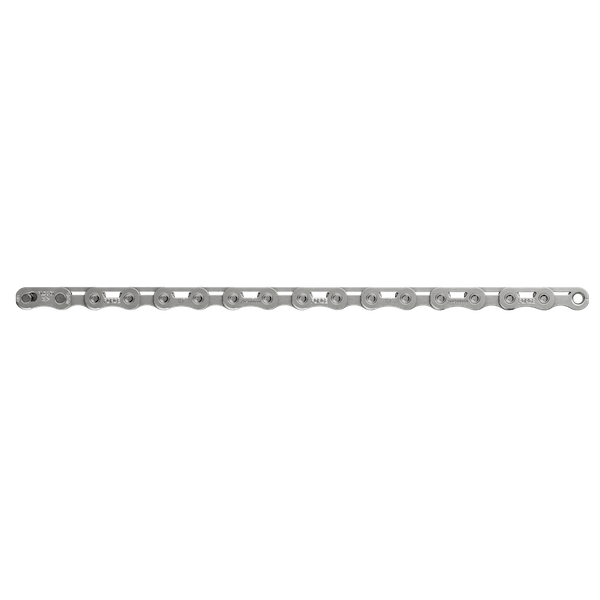
A 12- and 13-speed compatible chain
The Force chain features Flattop technology, just like the Red chain, to reduce its width, promote quiet operation, and improve its strength and durability. It is compatible with both 2×12 drivetrains—as in this test—and the Force XPLR drivetrain with a single chainring and 13-speed rear cassette. The inner links and rollers have a Hard Chrome coating to reduce wear and increase the chain’s lifespan.

During our long-term test of the SRAM Red, we found that the chain was very durable and showed virtually no wear after more than 4,000 km. It’s hard to be quite so definitive about the Force since we haven’t ridden it that much yet, but since the design is identical, it’s possible that its performance will be just as good—at least for road use. It’s worth noting, however, that the Force chain is slightly heavier than the Red chain—and, more importantly, nearly half the price.
This is an important detail, given that all SRAM 12-speed components are compatible with one another—across different product tiers and even between different generations. This allows you, for example, to upgrade an older Force groupset with a next-generation Force AXS upgrade kit, consisting of shift levers, brake calipers, and a Hammerhead Karoo computer.
Force AXS Chain
Pros: durability
|

Verdict: Top-tier performance and finish for the new SRAM Force AXS
While the new SRAM Force groupset saves a few dozen grams compared to the previous generation, according to our measurements, that’s not where it really stands out.
With redesigned lever ergonomics, powerful and responsive braking, and a smooth, quiet drivetrain, this groupset positions itself as a serious competitor to the Shimano Ultegra Di2 in the mid-to-high-end segment. Despite a few minor flaws, such as the sensitivity of the bonus buttons or a slight rough spot under the grips, its overall performance, customization via the AXS app, and the versatility of its options (double chainring, single chainring, XPLR gravel) make it a top-tier choice for discerning cyclists.
Priced at around €2,400, the SRAM Force AXS offers remarkable value for money, combining cutting-edge technology, reliability, and a high-quality finish for road or gravel bikes seeking excellence without the cost of a top-of-the-line groupset.
Summary of weights and prices for components in the new SRAM Force AXS groupset
| Weight | Price (total price may vary depending on various options) | |
| Complete groupset | 2,801 g | 2,409 € |
| Combination levers + brakes + rotors + brake lines | 996 g | 760 + 120 € |
| Front derailleur | 160 g + 28 g (battery) | 265 + 63 € |
| Rear derailleur | 288 g + 28 g (battery) | 370 + 63 € |
| Crankset | 704 + 74 g | 455 + 38 € |
| Cassette | 251 g | 215 € |
| Chain | 272 g | 60 € |
Power meter: +40 g +400 €
Share the post "Review of the New 2025 SRAM Force AXS Groupset"