Share the post "Cinelli Pressure II Review: Versatile, But With Some Limitations"
The Italian brand Cinelli is renowned for its artistic creations, the result of collaborations with prestigious designers. Since 2020, it has offered a race-style frame, the Pressure, which evolved last year into the Pressure II, a model that combines aesthetics and performance. We tested it for you. By Bruno Cavelier – Photos: Michèle Calvi

Nearly four years ago, we tested the Pressure, a true racing beast—resolutely aerodynamic, with advanced integration and extreme stiffness thanks to its T800 carbon monocoque frame. This bike was part of the trend toward high-performance models, while retaining Cinelli’s distinctive touch, both in terms of aesthetics and technical expertise. Highly aerodynamic, it boasted remarkable stiffness, but proved limited in high-altitude mountain terrain and too demanding for a rider out of shape. Having enjoyed this model, we wanted to check out its successor, the Pressure II.
While the geometry remains unchanged and the frame is still a monocoque carbon design, the mold has been redesigned, particularly around the seat tube. The seat tube on the original Pressure followed the curve of the rear wheel to optimize aerodynamics; the one on the Pressure II is straight and tapered. The seatpost, clamping mechanism, and cable routing have also been revised, reducing the frame’s weight by more than 100 g compared to its predecessor.

Available with several groupset options—Shimano Di2 (Dura-Ace, Ultegra, 105) or SRAM Red eTap AXS, but no longer Campagnolo or mechanical groupsets—the Ultegra model comes in two versions: with Fulcrum 600 wheels for €6,500, or Fulcrum Wind wheels for €7,500. With a frame kit priced at €4,100, these prices remain attractive, depending on whether you already own a good set of wheels or not.
Upgrade
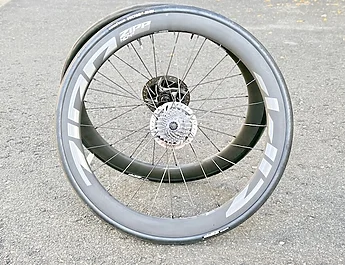
We tested the version equipped with the entry-level Fulcrum 600 wheelset, but to match the frame’s performance level, we swapped them for Prymahl Orion C50 Pro Disc Evo wheelset, set up tubeless with 28-mm Pirelli P Zero Race tyres. The frame accommodates tyres up to 32 mm in width.

We also swapped out the saddle—not because of any quality issues, as the Selle Italia Novus Boost Evo Superflow, in the special Cinelli edition, is an excellent option—but to use our well-broken-in Fizik Vento Antares R1 Carbon.
With Look Keo Blade Ceramic TI pedals and two Elite Custom Race Plus bottle cages, the bike weighs 7.530 kg in size S. In white, accented with light grey at the rear and signature Cinelli details (such as a smiley face on the back of the head tube), its design is striking. The frame is also available in dark green with a pink rear—less to our taste—and in a much bolder Team version.
What’s New
Switching from one model to its successor allows you to appreciate the changes. The seatpost clamp has been modified: previously secured by a screw at the top of the tube, it’s now a more traditional design at the front of the seatpost. While more practical, this system uses a rubber cover that seems fragile over the long term.

The seatpost has also been updated: the old system, which could be adapted to any rail set using stop screws, sometimes caused creaking noises. Cinelli has opted for a traditional clamp, supplied with two clamps (for carbon or standard rails), which we prefer.

In terms of aerodynamics, the wheel axles are concealed by the carbon fork—a neat aesthetic detail, but one that requires axles of precise length in case of replacement.

Finally, the handlebars: the new, sleeker cockpit ditches the custom Vision Metron computer mount in favor of a standard model. The problem is that the standard mount points upward, which isn’t suitable for a racing position. We had a 3D-printed part made to align the computer horizontally.


On the Road
The monocoque frame, designed with optimized carbon fiber, offers greater lightness and versatility. The tubes are shaped for maximum aerodynamics, with lowered seat stays, but the seat tube no longer hugs the rear wheel. The head tube features a distinctive shape where it meets the down tube. Everything is integrated, from the cockpit to the cables, and the frame is designed exclusively for electronic groupsets. The smiley face on the back of the fork seems to share our enthusiasm for hopping on this bike.

On our usual 40-km route—which includes varied roads, straightaways, turns, slight inclines, and a climb with a gradient of over 10%—the bike more than holds its own. With geometry identical to the previous model, it feels familiar right away. From the very first pedal strokes, the stiffness is evident, but the Pressure II feels more agile during accelerations, encouraging you to stay out of the saddle.
The Pressure II is a frame cut from the same cloth as those currently used by professional cyclists: aerodynamic yet versatile—provided you’re in top shape.
At speeds over 40 km/h on the flat, its aerodynamic profile really shines, making you want to accelerate. The rear end pushes, the front end steers, and nothing wobbles. When tackling corners at high speed, the bike is responsive and more versatile than its predecessor.

On climbs, such as a 2-km stretch with a 4–5% gradient, the frame’s stiffness allows you to maintain momentum without straining. The winding descent confirms impeccable handling, enhanced by 28-mm tires inflated to 4.5 bars. On a steeper 4-km climb with sections exceeding 7% gradient, spinning at a steady, relaxed pace (80 rpm on the small chainring), the bike stays responsive. A final test on a 400-meter wall with a 10% grade shows that it handles it smoothly, but its performance on long mountain passes remains to be evaluated during the season.
A true race bike
Ridden by the Italian UCI Continental team MBH Ballan CSB Colpack, the Pressure II follows in the tradition of frames designed for professional cyclists: aerodynamic, yet versatile enough for seasoned riders. It is not designed for comfort or for touring. Comfort depends solely on a properly adjusted riding position, with a balanced weight distribution between the saddle, handlebars, and pedals. It’s a specialized bike, in a way, but one that quickly becomes addictive once you’ve mastered it.
The CINELLI PRESSURE II at a glance…Pros: stiffness, responsiveness, groupset, value for money, design and finish. Cons: entry-level wheelset and tyres, computer mount position needs adjustment, not suitable for recreational riding. Frame: Cinelli Pressure II |
Share the post "Cinelli Pressure II Review: Versatile, But With Some Limitations"