Share the post "Review of the New Zipp 353 NSW Wheels with Pressure Sensor"
The new Zipp 353 NSW wheels have rims that are slightly lower than the previous model and feature a revolutionary pressure sensor
Zipp has just unveiled a new version of its 353 NSW wheels, a high-end model designed for both road riding and rough, rugged terrain. With advanced technologies such as the AXS pressure monitoring system, hookless rims, and ceramic bearings, these wheels combine light weight, aerodynamics, and durability. But are they worth their very high price tag? We’ve already tested them over several hundred kilometers.
By Guillaume Judas – Photos: ©3bikes.fr

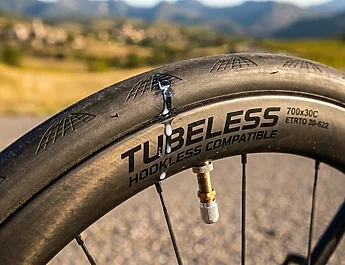
The 2025 Zipp 353 NSWs retain a very distinct family resemblance to the previous model, which we tested in 2023, featuring the famous “Sawtooth” profile inspired by humpback whale fins. However, they now feature a rim height ranging from 35 to 40 mm, down from the previous 42 to 46 mm. This “wave”-shaped profile, pioneered by Zipp, has now been adopted by many manufacturers, as seen in the Fulcrum Sharq, the Sonic Ultra, and the SH Race Aero Wave. This design is intended to improve aerodynamics and stability in crosswinds, in combination with specific patterns on the rims, protrusions called Hyperfoil, and dimples known as HexFin ABLC.
By reducing the rim height on these new 353 NSW wheels, Zipp sought to increase their versatility while more clearly differentiating them from the 454 NSW, which feature a rim height of 53/58 mm. While this lower profile visually gives the bike a sleeker look, the hookless rim still has an internal width of 25 mm, making it ideally compatible with tubeless tires ranging from 29 to 35 mm. With 30-mm Goodyear VectorR Z30 NSW tires used in this test, the setup is perfectly balanced and does not create a “balloon” effect that would negatively impact the aerodynamic drag coefficient.

We’re familiar with the pros and cons of the rimless system: weight savings, but limited tire compatibility and, most importantly, a maximum allowed pressure of 5 bar—which, however, offers better comfort and reduced rolling resistance under certain conditions. We’ll come back to this later in the article.
Measured Lightweight
Among the new features introduced on the 353 NSW, Zipp announces a new carbon fiber layout that is said to increase impact resistance by 16%, thereby enhancing their durability. But be warned: the 353 NSW is not certified for gravel riding.
They feature a new ZR1 SL hub, which is 30 g lighter than its predecessor and (finally!) offers ceramic bearings and 66 engagement points for increased responsiveness. It’s also worth noting that the Axial Clutch V2 mechanism reduces freewheel friction, further improving efficiency.
Weighing 1,307 g, including the AXS sensor, rim strips, and valves, the 353 NSW are Zipp’s lightest tubeless wheels. Their weight is nearly identical to the previous model, but they incorporate the famous pressure sensor, which alone weighs about 20 grams.
However, it’s important to put this stated weight into perspective by considering the weight of the 30-mm tubeless tires and the sealant. The Goodyear tires weigh a little over 300 g, and you need to account for about 50 grams for the sealant injected into the tire. So, I was able to compare the weight of the mounted wheel set, with cassette and rotors (SRAM Force), with a pair of first-generation Roval Rapide CLX clincher wheels, complete with cassette and rotors (Shimano Ultegra 11-speed), previously mounted on the same bike. Despite weighing 100 g more on the scale as bare wheels, the Roval clincher wheels ultimately weigh nearly 30 g less when used with an inner tube system.
A pressure sensor: a first
The 353 NSW features a tire pressure monitoring system integrated directly into the rim—a first of its kind in the bicycle industry. Connected via Bluetooth to the SRAM AXS app and/or compatible bike computers (Garmin, Wahoo, Hammerhead), this sensor provides real-time pressure data. Powered by a CR2032 battery offering over 400 days of battery life, it enables precise monitoring without an external device.


The sensor works like the tire pressure monitoring system in modern cars, but here the user sets the tolerance limits via the app. Using the pressure guide provided by the brand, you can choose your ideal pressure, as well as the upper and lower limits for inflation gain or loss that trigger the LED light on the rim to change from green (correct pressure) to a slow red flash (pressure too low) or a fast red flash (pressure too high). And always within the limits you’ve chosen. For example, 0.4 bar (plus or minus) in my case.

The concept is all the more interesting because it’s paired with hookless rims, which have a maximum allowed pressure of 5 bar to prevent the tire from coming off the rim. I realized that the pressure gauge on my foot pump was slightly conservative. So, when I inflated to 4.9 bar according to my pump (just below the limit), I actually measured a pressure of 5.2 bar. So I set an “ideal” pressure of 4.5 bar on the SRAM AXS app, with an alert threshold of 0.4 bar. I also noticed that, over the course of several days, the VectorR Z30 tires on the 353 NSW rims lost very little pressure, which is a big plus.

What should we make of the recommended low pressures?
According to Zipp, based on my weight and the weight of my complete bike, I should normally inflate the rear and front tires to 3.8 and 3.5 bar, respectively, in dry conditions, and to 3.4 and 3.2 bar in wet conditions. That’s a far cry from the 7 to 8 bar we were still using about ten years ago with 23 mm-wide tires.
Many riders praise these lower pressures, especially for riding long distances on varied surfaces. Lower tire pressure provides greater comfort with better vibration absorption, better traction, and less tread wear—as we’ve observed in recent months by comparing, for example, 25-mm tires with 28- or 30-mm versions of the same tire models, which are naturally used at lower pressures.
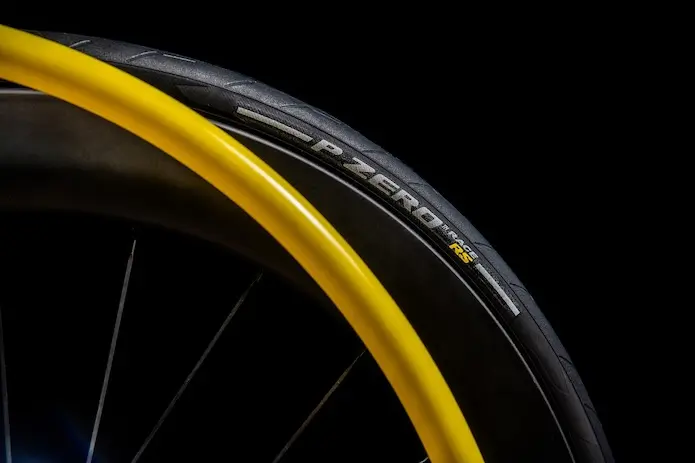
Regarding pure performance, Zipp highlights its TSE (Total System Efficiency) concept, which evaluates the balance between wind resistance, weight, rolling resistance, and vibration losses. Wider rims and lower tire pressures reduce fatigue and result in energy savings that, according to the brand, could reach up to 50 watts on very rough roads, allowing for a smoother ride.
That said, for more competitive riding on generally good roads, I’m not (yet) convinced of the benefits of low tire pressures, even though I’ve obviously lowered them over the years by switching to wider tire profiles. On the leading website bicyclerollingresistance.com, all performance tests show that low tire pressure increases pure rolling resistance. Furthermore, during accelerations, frequent changes in cornering angles, and when riding out of the saddle, tire pressure that’s too low creates a vague feeling and causes the bike to “float” slightly from side to side, making it less responsive due to the tire sidewalls collapsing. I noticed, after a front-tire puncture (sealed with sealant) and a drop in pressure to about 3 bar, that the bike’s steering felt much “sticky.”
What’s the ideal pressure?
I tested the wheels at the inflation pressure recommended by Zipp, the maximum pressure allowed by the hookless system, and an intermediate pressure. I was able to observe clear differences in handling:
- With the recommended inflation pressure (around 3.5 bar), the bike’s ride comfort is significantly better than usual, especially in the city on small cobblestones, concrete surfaces, or when going over speed bumps. It feels like riding on a soft carpet, with the added benefit of greater safety because the bike bounces much less, resulting in much better traction. On the other hand, during accelerations and when riding out of the saddle, the wheels seem to lose some of their lateral stiffness. When shifting weight, the bike is less responsive and less nimble. For me, it’s a bit like the feeling I get when I ride with my shoes not laced tightly.
- At a medium inflation pressure (4 bar), the wheels remain comfortable but are only slightly more responsive. On flat terrain, when riding fast in a high gear, you don’t get the efficiency you’d expect from these top-of-the-line wheels.
- With a “maximum” tire pressure (4.9 bar), I finally got back the familiar feel of my bike, especially during demanding 15/15 intervals (alternating 15 seconds of all-out sprints with 15 seconds of recovery), without feeling too compromised in terms of comfort. On the other hand, on the notorious concrete stretch of road mentioned earlier, the bike tends to bounce around much more.
Whether or not to use low tire pressures should therefore depend on your riding style, the terrain, and your habits. But in my opinion, it’s by no means a miracle solution.
Wheels that are still very smooth
The new Zipp 353 NSW wheels feature a slightly less pronounced profile than the previous model, resulting in slightly less inertia on flat terrain once you’ve reached a good cruising speed. This is noticeable around 40 km/h, where you need to work a little harder than with taller rims to maintain your pace.

That said, this lower profile also offers less wind resistance. This is a significant advantage in many situations, further enhanced here by the “wavy” shape of the rims. The 353s are versatile, agile, reassuring, and very precise to ride.
What really stands out, however, is the sense of fluidity they provide, especially when coasting. Compared to other wheels, I noticed this most when approaching roundabouts. When I stopped pedaling as usual, I sometimes had to apply the brakes slightly to slow down—even in situations where that’s normally not necessary—which proves that the 353s “roll” perfectly. The bearings in the hubs and freewheel seem to be working well, even after several hundred kilometers, including a few rides in the rain.

Finally, on bumps, the 353s perform as you’d expect from such lightweight wheels. When climbing in a group, they’re effective—as the time trial results show—though they don’t feel completely weightless. First, because tubeless tires aren’t that light, and second, because the wheels aren’t extremely stiff, especially at this inflation pressure.
Overall, they stand out more for their smooth ride than for their sharp handling. This seems to be a characteristic intentionally designed by the brand when the wheels were developed.
Are they worth the price?
The Zipp 353 NSW 2025, priced at €3,900, comes with a lifetime warranty for standard use and is compatible with SRAM XDR, Shimano HG, and Campagnolo (optional) cassette bodies.
Designed for cyclists seeking lightweight, versatile, and state-of-the-art wheels, they impress with their comfort, handling, and apparent durability.

However, their innovative pressure sensor—useful in many situations—is also featured on the new Zipp 303 SW, a 25-mm-internal-width rimless wheel set that is slightly less aerodynamic, features standard bearings, and weighs 100 g more, but is priced €2,000 lower.
As such, the 353 NSW is primarily aimed at discerning enthusiasts who are willing to invest in the latest technological advancements to optimize their performance over long distances.
The ZIPP 353 NSW 2025 at a glance… Pros: versatility, smooth and fluid ride, comfort, handling, stability Rim material: carbon – Tire compatibility: tubeless – Brake compatibility: disc – Internal rim width: 25 mm – Rim profile: 35/40 mm – Rim finish: unidirectional fibers, aerodynamic dimples – Spoke nut material: aluminum – Spoke type: Sapim CX-Ray – Number of spokes: 24 – Cassette body type: SRAM XDR, SRAM / Shimano Road – Hubs: Zipp ZR1 SL – Bearings: ceramic – Weight: 1307 g with AXS pressure sensor, rim tapes, and tubeless valves – Price: €3900 Contact: Zipp.com |
Share the post "Review of the New Zipp 353 NSW Wheels with Pressure Sensor"