Share the post "Pre-Race Unlock: Instructions for Use"
The final training ride is traditionally the last ride before a race or a cyclosportive. Usually done the day before the event, it serves the delicate purpose of preparing the rider for the intense effort of the following day without causing fatigue. Finding the right balance isn’t always easy, especially since it varies from rider to rider, but there are some general guidelines that help minimize risks as much as possible… before you can choose your own method.
Text: Olivier Dulaurent – Photos: depositphotos.com
The Real Key
A muscle contracts more easily and effectively if it has already been stimulated. This is the principle behind a muscle warm-up. On a larger scale, this is the role of the warm-up ride: by going on a short ride the day before the race—at a relatively low overall intensity (endurance-based) but engaging all energy systems—you’ll get your legs moving, and your performance the next day will be all the better for it.
You’ve all had this experience: when you haven’t ridden the day before, your legs feel a bit “like lead”—but just riding a few kilometers is all it takes to get things back on track. You also feel less tired after your training session. That’s exactly what you’re aiming for with this “warm-up” ride. When the race starts, your legs need to respond immediately—especially since the first few kilometers are often among the fastest, regardless of the race format.

Exploring Different Zones
As a general rule, it’s accepted that a “warm-up” run is designed to “cover” the entire spectrum of intensities associated with energy systems, without causing fatigue. There are seven such intensities, as defined by Frédéric Grappe (a sports science researcher), whose table serves as a reference.
To put these intensities into words, let’s look at I1 (or Zone 1), which corresponds to the recovery zone—the one that allows you to ride for hours without fatigue; I2, which is sometimes the racing pace perfectly hidden in the draft on major roads; I3, which is typically the tempo pace (in a breakaway or more exposed to the wind); I4 (the threshold, climbing hills during a race); I5 for intense bursts lasting from a few tens of seconds to a few short minutes, but also sometimes during a breakaway when taking a turn at the front, I6 for accelerations, or even I7 when it’s very intense to catch up to the peloton after a moment of coasting.

In practice, since cyclists will naturally ride at a relaxed pace on the eve of a race, they’ll mainly be in Zone 1. But to prepare for the next day’s efforts, it is strongly recommended to ride at a high endurance pace, generally between the upper end of Zone 2 and the lower end of Zone 3—for example, in two 10-minute segments, preferably on flat terrain—to simulate the “demanding” nature of this pace in the absence of an uphill gradient. In practical terms, this means riding at 65% of one’s Maximum Aerobic Power (MAP; see F. Grappe’s table above). This method helps avoid most mistakes associated with warming up that is either too intense or not intense enough, and it should suit many cyclists.
But since this pre-race session is ultimately quite individual, some will feel better with a more intense session, while others will be more comfortable with the session described above; it’s normal to experiment to find what works best.

This extreme level of personalization was the vision of former professional Yoann Offredo, who, based on his own experience, preferred to ride 200 km three days before the race and then rest completely for two days—that is, without even getting on his bike! But this approach—which is entirely personal and likely unique—is hardly common practice today; moreover, at the very highest levels, the trend is for coaches to “dictate” the training sessions, provided, of course, that they are understood and approved by the rider himself.
On the other end of the “spectrum,” some riders will be in their best form on race day when they’ve already completed a race the day before! For them, the warm-up needs to be fairly intense.
But without going so far as to run a race the day before—or even do a very intense workout—it’s often more effective to add a few elements to the “two sets of 10 minutes at Zone 2/Zone 3 pace” mentioned above, including a number of higher-intensity segments.

Instructions
How you structure this pre-race session will also depend on your fitness level: the duration can range from 45 minutes to two hours.
This warm-up session will therefore provide stimulation, which your body will have overcompensated for the next day. It will also engage the fast-twitch muscle fibers, which will respond more effectively on race day.
In practice, you should ride primarily at an endurance pace but also incorporate the following efforts in the order listed (depending on the cyclist’s level):
– 2 sets of 6 to 10 minutes at intensity level I2 (60% of maximum aerobic power), which is very slightly lower than the intensity recommended if you were to do only this exercise, as suggested above
– 4 to 8 sets (25 sec at intensity level I5 – 35 sec at intensity level I1)
– 4 to 8 minutes at intensity level I4
– 4 to 8 10-second sprints, alternating between riding out of the saddle and in the saddle, and varying the cadence.
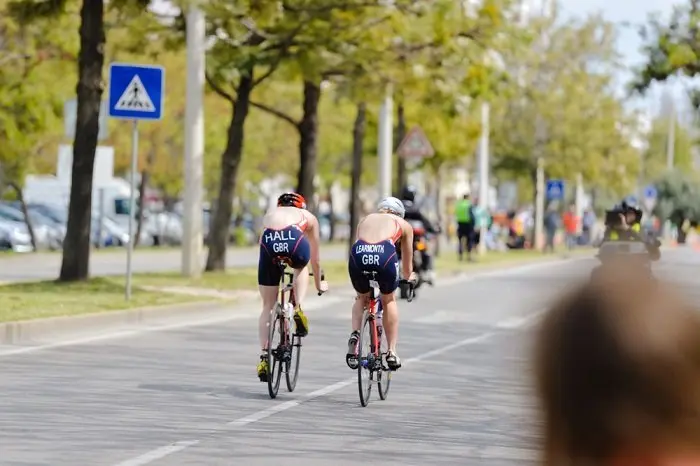
Finally, since the actual effectiveness of the recovery session varies significantly from person to person, it is strongly recommended to try several different approaches by adjusting certain parameters such as the duration of the session itself, the number and length of repetitions, and the chosen intensities. The result is then determined by how you feel the next day, and it is these feelings that should guide you in determining the “right” way to perform the recovery session.
Share the post "Pre-Race Unlock: Instructions for Use"