Share the post "Knowing when to stop, or Caleb Ewan’s lesson in courage"
A day comes when what made the heart beat, what animated every awakening, every pedal stroke, no longer resonates. The bike, that road companion, becomes silent. Not for lack of legs, nor from physical wear. But because the flame, the inner one, flickers and then dies out…
By Jeff Tatard – Photos : dall-efree.com
This is what just happened to Caleb Ewan. At 29, the Australian sprinter decided to turn the page, without a last stand or final laps. He stopped abruptly, honestly, lucidly. The motivation is no longer there. What yesterday still gave meaning to everything, no longer does today. And he is not the first. Peter Sagan, before him, had already put words to this invisible erosion: this pleasure that disappears, this sport that has become a constraint.
Among professionals as well as amateurs, this shift is more frequent than one might think. It marks a pivotal, intimate moment, often passed over in silence: the moment when one loses the flame. The subject is delicate, but essential. For it touches the very heart of what drives a man or a woman to push their limits… or to let go.

A Weariness of the Soul
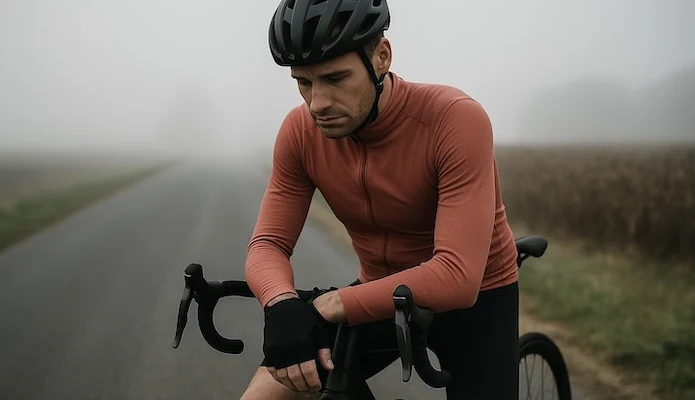
In high-level sport, we talk a lot about watts, VO2 max, marginal gains. We rarely talk about emptiness. About this fatigue that cannot be measured. The one that takes hold of you in the morning when you wake up, when getting on your bike no longer makes your heart beat. The one that transforms familiar roads into repeated chores.
Caleb Ewan, like Sagan, like Tom Dumoulin or Taylor Phinney before him, didn’t just end a career. He put words to a fracture that thousands of amateur riders also experience, far from the cameras.
For this ailment is not reserved for the elite. It also affects the 35-year-old engineer who got up every morning for ten years to ride at dawn, the super talented junior who feels nothing anymore at the start line, or the former amateur cyclist who turned pro too quickly, burned out by the demands.
The Sacred Fire Is Not Eternal
We enter sport out of passion. But we often stay out of habit, out of identity. Cycling, like other disciplines, gives structure to existence. It channels, paces, guides. It almost becomes a backbone. But what happens when the energy that fueled it disappears?
For pros, it’s the infernal pace of the calendar, the expectations, the fear of no longer winning, injuries. For amateurs, it’s sometimes the self-imposed pressure, the obsession with performance, constant comparison. Strava turned into stress. Pleasure turned into a race against oneself.
And then there’s age. Responsibilities. The body getting tired. Changing priorities. The feeling of racing to tick boxes, not to feel alive.
Knowing When to Stop, an Act of Courage
It’s difficult to admit that you no longer want to. It seems shameful, almost guilty. As if the love of sport should be unalterable. As if one should always be hungry. And yet, knowing when to put the bike down is perhaps one of the most dignified gestures there is. Because it says: « I gave. I loved. But I respect myself enough not to force myself. »
Caleb Ewan had this lucidity. It is worth as much as any Grand Tour victory. It shows that an athlete is not defined solely by their results, but by their ability to listen to what they feel — even when it pushes them to say stop.

An Invitation to Rethink Our Relationship with Sport
What if this weariness wasn’t a failure, but a signal? A chance to take stock. To find another way to practice. Less competitive, more free. More organic. Riding for the scenery, for oneself, without pressure. Perhaps the flame never completely dies. It transforms. It burns elsewhere.
In clubs, among young people, in coaching structures, it’s time to talk about it. To teach not only performance, but also balance. To learn to preserve oneself, to listen to oneself. To say no, too, when necessary. It’s not betraying the sport. It’s loving it differently.
Because Deep Down…
The hardest part isn’t having given everything. The hardest part is having been happy on the bike… and no longer being so. So to those who, today, like Caleb Ewan, like Sagan, like so many others, feel the flame fading: it’s not a surrender. It’s not a failure. It might be the beginning of something else. A return to the essential. A return to oneself.
Share the post "Knowing when to stop, or Caleb Ewan’s lesson in courage"