Share the post "How to intelligently lighten your bike"
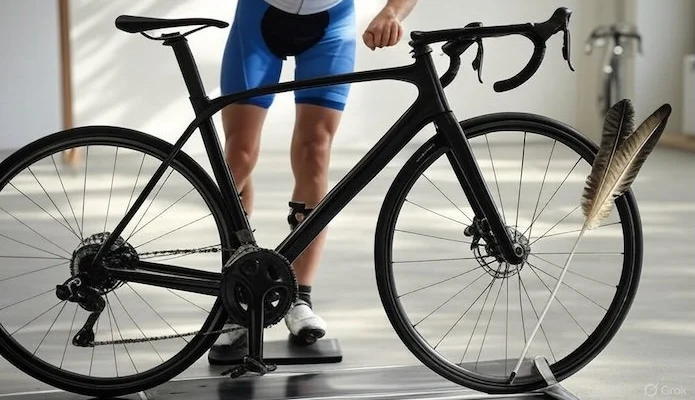
Weight reduction is one of the keys to improving performance and enjoyment, whether for the cyclist or their equipment. The lightest bikes are often the most expensive, as the last grams are gained at the cost of hundreds of euros. Without going that far, because we need to remain reasonable, let’s see how to lighten your ride intelligently, without modifying the fundamental characteristics of a bike, namely efficiency, comfort, and safety, and without emptying your wallet.
By Guillaume Judas – Photos: Grok/depositphotos.com
At the base of a bike, you naturally find the frame and fork assembly, which in a way represents its “soul” and is the most expensive part to replace. In other words, it’s often not worth changing a frame kit just to save weight. You might as well change the entire bike. And then, between a very light frame and a “heavy” frame, there’s a maximum difference of 700 to 800 g, and that’s for two frames made of different materials. That’s a lot but not prohibitive if you’re only looking to improve the machine’s overall performance.
As for the fork, the maximum difference is only 150 g between a light fork and a heavy fork. We strongly advise against separating this assembly, which is designed to work together, whether in terms of geometry or behavior (stiffness, comfort, handling). It’s therefore better to focus on other components first.
Tires
In the entry and mid-range, manufacturers often cut corners on the rolling gear. This is where there is the most to gain, and not just in terms of weight, by the way. Between a basic inner tube and a light inner tube (butyl or latex), there’s a difference of 40 to 50 g. For a TPU inner tube, the gain can even reach up to 70 g. Multiply by two and understand that this is the first item to address, especially since a lightweight inner tube costs between 10 and 15 € (up to 30 € for a TPU tube). It just requires careful installation to avoid pinch flats. But the difference in handling is truly noticeable.
Regarding tires, it’s also possible to save up to 70-80 g between a basic model and a high-end model, while maintaining a classic tire width of 28 mm. High-end tires retail for between 60 and 90 € each, and are in any case superior in terms of efficiency and grip. That’s expensive for a piece of rubber, but it remains one of the least expensive and most interesting parts of the bike to replace.
Price: between 140 and 240 € for tires and tubes
Gain: between 160 and 280 g for the entire bike
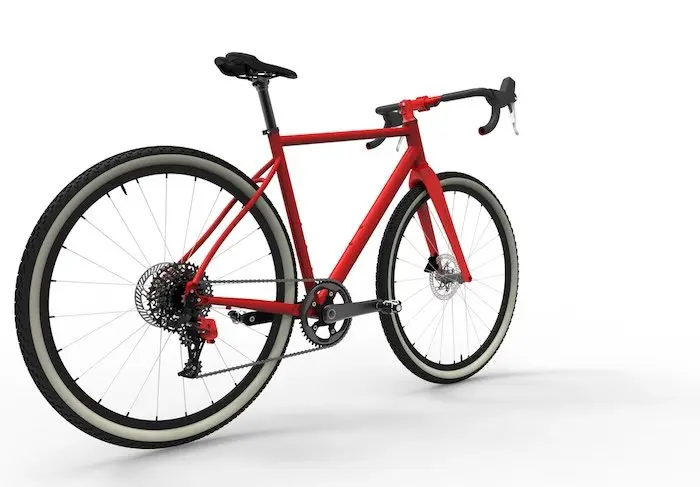
Wheels
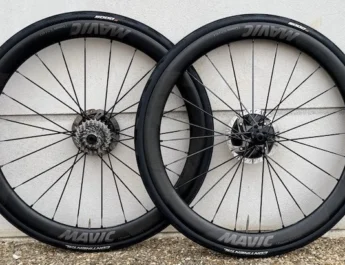
Here, it’s obviously more expensive, but it’s not necessarily useful to look for the lightest possible wheels to improve a bike’s performance. Between basic wheels around 1800 to 1900 g per pair and good high-end wheels, the difference is 350 to 400 g, which is already a lot, for an investment of around 1500 to 2500 €. You can save even more by opting for exclusive wheels whose weight drops below 1200 g per pair. That’s 600 to 700 g less than a pair of entry-level wheels. But prices soar, often exceeding 3000 €, or even approaching 4000 €.
You also need to consider how you intend to use your wheels. Wheels that are too light are not necessarily the most efficient on flat courses, for example.
Price: between 1000 and 4000 €
Gain: between 200 and 700 g
Groupset
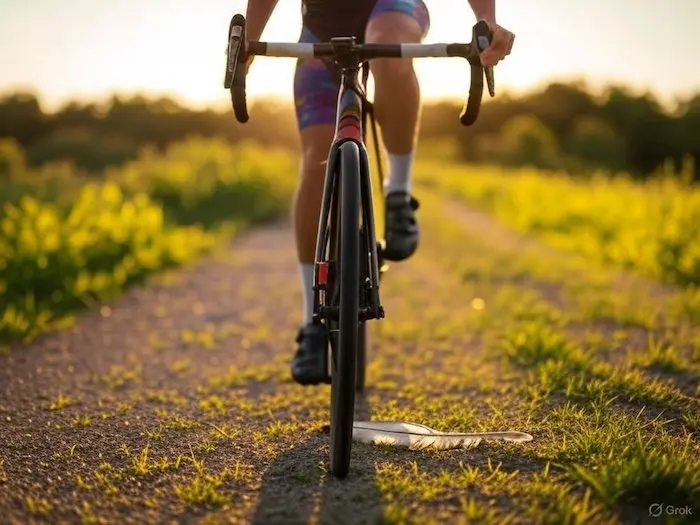
Replacing the groupset may not be worth it compared to the price of the bike. Expect a difference of about 700 g between the lightest groupsets (Sram Red AXS and Shimano Dura-Ace Di2) and a Shimano 105 Disc, which already works very well. A high-end groupset costs between 3500 and 5000 €, and is mounted on already expensive frames. However, it can be very interesting to change a few parts.
First, the crankset. Expect up to 300 g difference between an entry/mid-range model and a truly lightweight crankset. The price is obviously commensurate, as you’ll need to spend around 500 € to get a high-end crankset from a not-too-exotic brand. The cassette is also a heavy component, with an expected gain of 120 to 150 g, for equivalent gearing. Expect to pay between 250 and 500 € for this component.
For the rest, you can save a little weight on the rotors (up to 60 g for the pair, for 120 to 150 €), but generally brakes, derailleurs, and levers are in line with the rest of the groupset: each part works in correlation with the others, and for each level of range, there is a “small” weight difference that accumulates in the end. But in terms of investment, it’s not always worthwhile. It’s therefore better to limit yourself to changing the crankset and cassette.
Price: between 250 and 1000 €
Gain: between 80 and 400 g (for crankset and cassette)
Saddle
To stay reasonable, we advise you not to change your saddle model, especially if it suits you and you ride long distances. Nevertheless, the same model is often available in several rail and chassis options from a manufacturer. So there’s a way to save about a hundred grams, for an investment of 200 to 300 €, while maintaining the same contact points. Be careful, however, with the firmness or density of the shell and padding, which affect your comfort.
Price: between 200 and 300 €
Gain: between 50 and 100 g
Components
The case of a seatpost is a bit unique, as it is often supplied with the frame kit. There are several types of shapes or diameters, which makes replacing this part problematic. However, there are alternative solutions that allow you to save about 80 g compared to an already high-end carbon seatpost (for example, with Darimo). But you’ll need to spend more than 360 €.
The cockpit is, however, easier to upgrade, unless you are already equipped with a monocoque handlebar supplied with the frame. You can save about fifty grams on the stem for only 60 €. For the handlebar, the gain can be 50, 100, or even 150 g, but for a price of 100 to 300 €. Be careful, however, to preserve the integrity of this part, both in terms of clamping (with the stem) and stiffness.
For pedals, and sticking to the standard you are used to, expect a maximum gain of 80 g, for a price of 200 to over 400 €.
Price: between 60 and 800 €
Gain: between 50 and 280 g
From simple to triple
As we can see, upgrading a bike can cost from double to triple (between 1650 and +6000 €), for a weight saving of between 550 and 1750 g approximately. This is without compromising the machine’s integrity, safety, or even fitting components that are too out of sync with a mid-range bike, for example.
Obviously, any investment requires a trade-off, but certain “wear and tear” items can be upgraded when a mandatory replacement occurs. This is the case for tires, inner tubes, the cassette, or the saddle, for example. Ultimately, the price to spend to lighten the bike only represents the difference with the basic components.
As for the most expensive item, which is the wheels, it is also the one that will most change your perception of your machine. The initial pair of wheels can always be used for training or during the winter period. This will ultimately increase the lifespan of your beautiful wheels.
Share the post "How to intelligently lighten your bike"