Share the post "Long-Term Test of Fulcrum Sharq Wheels"
In June 2024, Fulcrum unveiled a highly anticipated new product: the Sharq wheelset. Billed as the brand’s first all-road wheelset, they aim to redefine performance standards on mixed terrain, from smooth asphalt to rougher gravel trails. With their innovative design and advanced technical features, the Fulcrum Sharq wheelset is aimed at both competitive riders and demanding enthusiasts seeking versatility and speed. But how do they really perform in real-world use? Find out after a test ride covering just over 1,500 km. By Guillaume Judas – Photos: ©3bikes.fr/DR

Launched after more than 4,000 hours of research and development, the Sharq wheels were field-tested by riders such as Mattia De Marchi, who finished 5th at the 2024 Unbound Gravel race using a prototype. The launch coincides with Fulcrum’s 20th anniversary—a brand that, although part of the Campagnolo family, maintains its own distinct identity.

Entirely designed in Italy and assembled in Europe, these wheels embody meticulous craftsmanship and a drive to push the boundaries of innovation, even though the pursuit of versatility takes center stage here.
 => Buy the Fulcrum Sharq for €2,099 instead of €2,460
The 2-Wave Rim
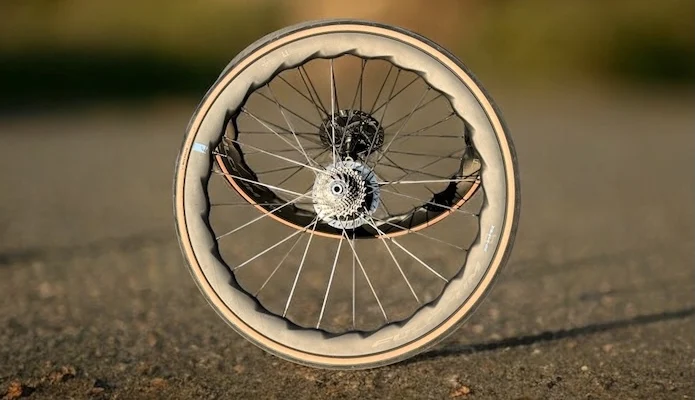
The most striking feature of the Fulcrum Sharq at first glance is its unique rim profile, called the 2-Wave Rim. This design combines a symmetrical wave near the spokes with an asymmetrical wave on the sides, creating a rim height ranging from 42 to 47 mm. This isn’t just for show: Fulcrum says the shape cuts crosswind-induced instability by 21% at 0–10° and up to 30% at 10–20° compared with a traditional rim of the same height.

These figures, derived from wind-tunnel tests, position the Sharq as a solution to the aerodynamic challenges of varied terrain, with the goal of offering greater stability without sacrificing speed.
Made of carbon with an exclusive blend of FF100 fibers and resins, the rims are considered lightweight and responsive, despite an internal width of 25 mm. They are compatible with tires ranging from 30 to 65 mm, significantly expanding their range of use—from traditional roads suited for endurance riding to the roughest gravel trails.

Fulcrum also continues its tradition with a non-drilled rim (MoMag technology), enabling native tubeless setup and eliminating the need for rim tape, while incorporating mini-hooks for optimal safety with or without an inner tube.

A3RO spokes: an aerodynamic innovation
To complement this rim profile, Fulcrum has developed the A3RO spokes, a new addition to its lineup. These flat stainless steel spokes, measuring 3 mm wide and 0.8 mm thick, are designed to optimize aerodynamics. Their attachment to the hub has been redesigned with a specialized interface: two additional notches and a flattened base prevent any rotation, ensuring consistent alignment.

With 24 spokes per wheel, arranged in a 2:1 pattern (more spokes on the side subjected to the highest stresses), the Sharq wheels prevent any contact between spokes—a feature that maintains tension over the long term and reduces maintenance needs.
High-end hubs for exemplary smoothness
The Sharq hubs follow suit. Fulcrum has opted for its cone-and-cup system equipped with USB ceramic bearings, renowned for their smoothness and precision. This choice, carried over from the brand’s other high-end models, allows for fine-tuning of preload and ensures increased durability, even on demanding terrain. The aluminum hubs, compatible with Centerlock standards for disc brakes, are available with several freehub body options: Shimano HG, Microspline, SRAM XDR, or Campagnolo N3W.

Lightweight and Versatile
Weighing 1,460 g per pair, the Sharq wheels fall within the average weight range for carbon wheels in this category, but they stand out for their versatility. Rated ASTM Category 2, they’re built to shrug off impacts while soaking up rough terrain—a crucial trait for gravel adventures or beat-up roads.
 But when it comes to versatility, compromises are inevitable. The wide rim demands a wide tyre (30 mm in this case), and in the tubeless version, the Michelin Pro 5 still tips the scales at 325 g. To that weight, you have to add the weight of the sealant. This brings the total weight of the wheel-and-tire setup to about 365 g. Compared to the 45-mm Mavic Cosmic Carbon SLR wheels with Continental tubed tyres that were previously on my bike, the weight increase is about 100 g for the wheelset, all other things being equal. And for a comparable price.

This translates to a bit less responsiveness during accelerations and changes of pace. On typical routes, it’s noticeable. Fortunately, the Fulcrum Sharq wheelset is stiff enough that the bike still handles as expected. Powering up a climb or sprinting hard never causes the slightest issue with handling. But the Sharq wheels aren’t too stiff either, and they remain dynamic enough that you don’t feel like you’re running into the bike’s stiffness.
Comfort, yes, but…
This tire setup is normally intended for endurance riding. And when you think of endurance, you think of tire durability and comfort for the rider. In both cases, I wasn’t entirely convinced. First, because of several flats (see here), and second, because I never found the necessary responsiveness at the inflation pressure normally recommended for this type of tire. So I had to inflate them a bit more to feel any responsiveness, while losing quite a bit of comfort in the process.
In short, I was expecting a smooth, responsive feel on the road, like with tires that have cotton sidewalls, and in the end, I was disappointed in that regard. The Fulcrum Sharq wheelset undoubtedly deserves better on the road—at least to compete in terms of performance with carbon wheels in this price range.

Of course, their stability in crosswinds—superior to that of many wheels with this rim height—raises the bar. Wheels that are more stable and less susceptible to gusts reduce fatigue toward the end of a ride and ultimately improve the overall feeling of comfort.
Add to that the quality of the bearings, the smoothness of the freewheel, and the complete absence of noise, and we can conclude that, overall, the experience in this area is positive.
Off the Beaten Path
Once off the road, the Sharq wheels really come into their own. For wheels that can be used on rough trails with large tyres inflated to around 2 bars, their weight becomes an asset. Few wheelsets specifically designed for gravel are this light, especially with this rim profile. It’s a profile that works well on fast-rolling trails but doesn’t hinder the Sharq too much at slower speeds.

Riding on somewhat technical singletracks littered with roots, I didn’t notice any significant difference in inertia compared to the 32-mm-high rims I usually use for gravel riding. On the other hand, it seemed to me that on the fast sections, I was picking up more speed—and, more importantly, I could maintain it more easily. But honestly, I can’t say whether the aerodynamic efficiency with a 40-mm-wide knobby tire really lives up to expectations.
Despite a few hard rides, the wheels held up well. They confirm their versatility, even though—on gravel more so than on the road—it’s often the tire that makes the difference.
Price and Availability
The Fulcrum Sharq is available for €2,460, a price that places it in the premium segment, competing with models like the Zipp 353 NSW. They come with tubeless valves and carrying bags, ready to be mounted on any bike—road or gravel… or both.

Promise Kept?
With the Sharq, Fulcrum has made a remarkable entry into the category of wavy-profile wheels, joining pioneers like Zipp and Princeton CarbonWorks. Their stability in windy conditions, meticulous construction, and versatility make them an attractive option for cyclists seeking versatile, high-performance gear. This is an intriguing pair of high-end wheels for those who refuse to choose between pavement and trails.
But these wheels also have the downside of their strengths. Good across the board, they aren’t exceptional in any single area—except for their ability to switch from one terrain to another without batting an eye. In the same price range, you can find wheels that are lighter, more aerodynamic, and more responsive. Their solid performance, regardless of the terrain, will also depend on choosing the right tires. On the road, at any rate, they deserve lightweight, high-end tires to deliver maximum riding enjoyment.

=> Buy the Fulcrum Sharq for €2,099 instead of €2,460
The Fulcrum Sharq at a glance…Pros: versatility, bearings, durability, stability, tire compatibility Cons: not exclusive enough Discipline: Road/Gravel ASTM Category 2. Recommended tire width: 30 to 65 mm. |
Share the post "Long-Term Test of Fulcrum Sharq Wheels"