Share the post "Long-Term Test of the Coros Dura Bike Computer/GPS"
The Coros Dura is the first bike computer from Coros, a brand well known for its GPS watches designed for running and ultra-trail racing. Drawing on its experience with high-performance sports devices, the brand has decided to enter the bike computer market with a device that prioritises battery life, ease of use, and an attractive price. But after 3,000 km of real-world testing, can the Coros Dura truly compete with giants like Garmin and Wahoo? Find out in this in-depth review. By David Polveroni – Photos: ©3bikes.fr

Battery Life: A True Feat
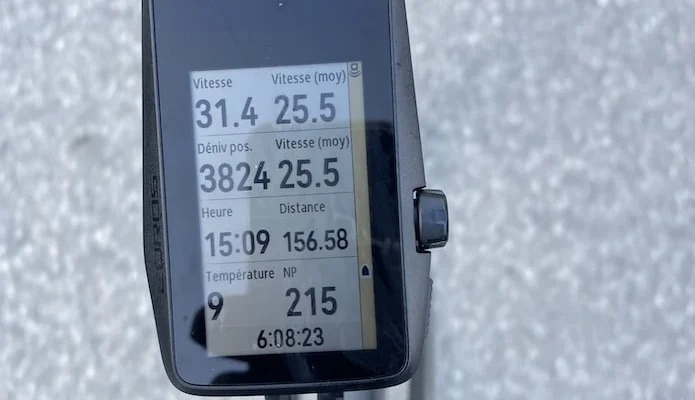
The Coros Dura first impresses with its battery life, an area where it clearly outperforms its competitors. With a claimed battery life of 70 hours, the bike computer delivers remarkable performance. In practice, it lives up to that promise—and even exceeds it. Depending on usage (GPS, Bluetooth, sun exposure), real-world battery life ranges from 60 to 90 hours—a figure well above that of its direct competitors. Comparison with the competition:
- Garmin Edge 1040 Solar: 45 hours (with solar charging)
- Wahoo Elemnt Roam v2: 20 hours
- Hammerhead Karoo 2: 12 hours
- Wahoo Elemnt ACE: 15 hours
This makes the Coros a top choice for long-distance cyclists and those who go on bikepacking trips, where battery life plays a crucial role. In practice, a single charge lasts for several weeks without having to worry about the battery, unlike most other devices that require recharging along the way. It’s also a relief in everyday life for those who ride a lot—one less thing to worry about. Although you might almost forget to charge it!  => Buy the Coros Dura bike computer/GPS for €289
Design and Ergonomics: Lightweight Yet Sturdy
From an aesthetic standpoint, the Coros Dura features an angular and rugged design that certainly stands out. However, once you hold it in your hand, you’ll appreciate how light it is: at just 101 g, it’s lighter than many competitors, such as the Garmin Edge 1040 (133 g) and the Hammerhead Karoo 2 (131 g). This featherweight, combined with a comfortable grip, makes it easy to carry and handle. It features a button, as well as a scroll wheel/button that can be used as an alternative to the touchscreen. Innovative.

The Coros Dura is equipped with a 2.7-inch color transflective display, offering good readability in direct sunlight while consuming little power. I really liked it—it reminds me of the small Garmin 130.
This type of screen, while less bright than AMOLED displays, is an excellent choice for maximizing battery life.
- Pros: lightweight, well-designed, good outdoor readability.
- Cons: the design is a bit too angular; it doesn’t have a high-end finish compared to more premium models like the Garmin 1040.
Ease of use: a minimalist yet intuitive device
The Coros Dura features a simple interface that prioritizes efficiency over complexity. Unlike other devices, customizing profiles and data screens is done exclusively through the Coros app, similar to Wahoo. This may confuse some users who prefer to configure settings directly on the device, but once set up, the device runs smoothly and is easy to use.
 The touchscreen is responsive and works well, even when wearing gloves in the winter. The side button and scroll wheel also make navigation easy, even in challenging conditions. Although personally, I’m not a fan because it lacks the precision of a simple button click, and scrolling while on the road can be imprecise.
Syncing with the Coros app is fast; no issues there—data has always transferred smoothly to Strava, for example.

Compatibility: Room for Improvement
In terms of connectivity, the Coros Dura supports ANT+ and Bluetooth sensors, including cadence and power sensors, as well as Garmin radars. However, I’ve never been able to connect an SRM PM7 to it, despite contacting customer service.
The bike computer supports Wi-Fi connectivity, which is convenient for syncing data and downloading updates.
- Pros: Support for standard sensors (heart rate, cadence, power, etc.), stable connection via Bluetooth and ANT+.
- Cons: a few unresolved compatibility issues with my SRM; lack of advanced controls with Di2—so far, you can only scroll through pages; I would have liked at least the option to trigger laps, which is more convenient for training.
Mapping and Navigation: Functional but Basic
The Coros Dura offers preloaded maps and turn-by-turn navigation. However, these features remain basic, and the maps lack detail (points of interest, stores, etc.). The ClimbPro mode, which displays the elevation profile and gradient distribution, is not available and does not detect climbs—unless you’ve reloaded the route, in which case each climb will be listed and detailed. The interface is still less modern than the competition’s, but it has all the essentials! 
- Pros: smooth navigation with clear directions, easy import of GPX tracks via the Coros app, integration with platforms like Komoot or Strava Routes.
- Cons: Maps are too simplistic and lack detail; no audio alerts for direction changes; no automatic climb detection (Climb Pro).
GPS and Performance: Very Good but Not Perfect
The Coros Dura uses a multi-band chip to receive signals from the GPS, GLONASS, Galileo, and Beidou systems, ensuring greater accuracy, even in urban or mountainous environments. During testing, accuracy was excellent on open roads and in the mountains, though slightly less responsive than on models like the Garmin Edge 1040. Real-world test compared to the Garmin Edge 1040:
- Open roads: very good accuracy.
- Forests and mountains: solid GPS tracking with a few minor glitches.
- Dense urban areas: a few positioning errors, but generally reliable.
Value for the money: battery life above all
The Coros Dura is clearly positioned as an entry-level device, priced between €250 and €300 (€289 retail price), well below premium models like the Garmin Edge 1040 or the Hammerhead Karoo 2. For cyclists looking for a reliable, long-lasting, and affordable bike computer, the Dura is an excellent choice.
However, those seeking more advanced features—particularly in terms of mapping or performance analysis—might prefer models like the Garmin Edge 540 or the Hammerhead Karoo 2. There’s no doubt that these features will be added gradually…

Conclusion: A Promising Bike Computer, But Still Needs Some Fine-Tuning
The Coros Dura stands out for its exceptional battery life, lightweight design, and simple, intuitive interface. It’s a perfect fit for long-distance cyclists and bikepackers who prioritize simplicity and battery life.
However, it still has some notable shortcomings: overly basic mapping, a lack of certain advanced features, and compatibility issues with some sensors. These factors may limit its appeal to cyclists who are particular about performance data and navigation.
But then again, is that really necessary? Overall, I found the Coros to be extremely promising—it has all the basic functions without too many bells and whistles…

Who is the Coros Dura for?
•✅ Ideal for ultra-cyclists and bikepackers looking for a bike computer with maximum battery life. •✅ Perfect for recreational cyclists who want a simple, reliable bike computer at a competitive price.
•❌ Not ideal for competitive cyclists or those who need advanced analytics features (such as Training Peaks) •❌ Not recommended for those who need detailed mapping and advanced navigation (though this is subjective)
In summary, if you’re looking for a reliable, durable, and easy-to-use bike computer, the Coros Dura is an excellent choice. => Buy the Coros Dura bike computer/GPS for €289
The COROS DURA at a glance…Pros: battery life, weight, price, basic features Cons: overly basic mapping, lack of advanced features, some compatibility issues Price: €289 Weight: 101 g Contact: fr.coros.com |
Share the post "Long-Term Test of the Coros Dura Bike Computer/GPS"