Share the post "Why sprint more often to improve"
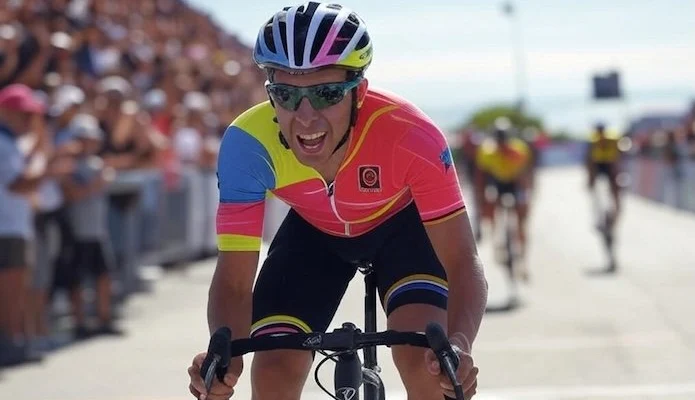
What connection can there be between sprints and progress in racing or even for long sportive rides? The simple act of sprinting can not only lead to a victorious finish in an event, but also, and above all, to progress, if one takes the trouble to practice regularly in training.
By Guillaume Judas – Photos: depositphotos.com, Grok
Sprinting is a common term for several actions on a bike. But this general term actually describes physiological processes that lead to different effects on the body, or that depend on several types of fuel. In short, we talk about sprinting when it comes to describing finishing qualities, when the goal is to cross the finish line first, or when it comes to pitting a sprint to close a gap, or attacking at the top of a climb.
Even if we are not talking about the same sprint, it is clear that no progress is possible in these critical phases of a race or event, without work, or even simple maintenance of the necessary qualities in training.
And yet. How many cyclists do we still see who never participate in the town signs battles during group rides, or even get out of the saddle to shake themselves up and wake up all those dormant fibers?
Even the pure and hard sportive rider, who enjoys long courses where endurance and effort management are paramount – two notions that are a priori antithetical to the very idea of maximal effort over a very short distance – has everything to gain by practicing this type of exercise.

Bare Minimum
In addition to traditional steady pace sessions on hilly courses, a few small unexpected accelerations on climbs during group rides – which still satisfies three-quarters of riders in terms of their training – sprint work should be the minimum to impose on oneself when one wants to progress and achieve the goals one has set.
Why? First and foremost, to awaken and maintain the so-called fast muscle fibers, and to avoid the famous diesel effect, when one feels a lack of rhythm despite very good physical condition. Secondly, working on sprinting, even for a non-sprinter, allows one to improve their own maximum speed, as well as all the associated gestural and muscular coordination.
This same maximum speed consequently affects the cyclist’s base speed. In addition to improving your base speed, working on sprinting can also present interesting tactical aspects, which notably help to progress in terms of positioning during any event.
Finally, sprinting, or rather a succession of sprints, allows one to work at very high intensity to improve the body’s overcompensation capacities, while testing its ability to resist lactic acid. It is thanks to this type of exercise that one becomes aware of the notion of energy reservoir, as well as our disposition to manage more or less this or that type of effort, depending on the length of the sprint and how it is approached.
Setup
Sprints are mainly worked on in two ways.
The first consists of playing with training partners and sprinting at the town signs symbolizing the entrance signs to villages or towns; however, be careful of traffic! This type of sprint, in addition to the fun aspect, develops a sense of positioning and tactical awareness. Moreover, it is the best way to test one’s preferred distance relative to the sign and the effort required. To get to know oneself, in a way.
The second, much less fun, consists of chaining series of sprints, with incomplete recovery between efforts. With this type of exercise, the body gets used to accumulating lactic acid in the leg and arm muscles, and above all, to progressing in this area.
A good way to boost progress
During certain events, this will allow the sportive rider to know how to manage and recover faster from moments when they are in the red.
For the racer, the interest is more than obvious, knowing that a competition is not played out over distance, but over a succession of accelerations and surges that allow one to catch the right group or break away from it.
When chaining sprints in this way, it is unnecessary to specify that the last in the series has little to do with a sprint as such, and that the expression pedaling with your ears takes on its full meaning at that moment.
Well-placed in the week, a session of this type empties glycogen energy reserves – the high-performance muscle fuel – as much as a very long ride at a very sustained pace. After appropriate recovery and nutrition, the body strengthens and is ready, on the day of the event, to undergo a greater aggression. This is the now well-known principle of overcompensation.

Exercise Examples
Of course, we are all limited in the field of sprinting, if only by genetic factors. Muscle power, explosiveness, spring, and velocity cannot be developed at will. However, many practitioners use this excuse never to work on this critical phase.
Yet, there are many varieties of exercises. Besides sprinting at town signs during group rides, it is always possible to practice more regularly by interspersing traditional rides (even solo) with spaced sprints, for example every 30 or 40 minutes.
Several options are available to you when launching a sprint, even alone. Aim for a distant sign as a fictitious finish line, refer to the stopwatch and aim for a sprint of 10, 15, 20, or even 30 seconds, start the sprint with everything to the right, or on the contrary, downshift gear by gear, force yourself to do everything in hyper-velocity, etc.
In short, the exercise variations are numerous, always with the same goal: to progress in reaction speed, punch, and/or maximum top speed. Over time, you also learn to manage the sprint, depending on the distance separating you from its end. A more or less abrupt start leaves less fuel at the end of the sprint, especially if it is quite long.
Tactical Aspect
Will the length gained on the opponent in the first three seconds of the sprint be sufficient after 300m, especially if the opponent, on the contrary, sprints with continuous acceleration? In short, you can quickly get a taste for the specific exercise of sprinting, provided you gain something from it each time, tactically and in terms of self-knowledge and your own abilities.
You can quickly get a taste for the specific exercise of sprinting, provided you gain something from it each time, tactically and in terms of self-knowledge and your own capacities.
For sprint series, effort management is a little different, since the goal is in any case to finish exhausted and empty energy reserves. The interest is therefore to give everything on the number of sprints or series you have determined. Depending on the starting level and/or the state of progress, you can consider 15-second sprints, interspersed with 30 seconds of recovery, or a shorter recovery (equal to the work time). A good series of five to eight times 15”/15” is already quite calming.
Then, depending on the weaknesses to improve or the strengths to preserve, you can vary the length of each sprint. Rather 10”/10” if you want to progress on the start itself, or 30”/30” at a very high level, when you want to work on your ability to resist lactic acid.
Do not believe, however, that the shorter the exercises, the easier they are, because in fact, the recovery time, if it is equal to the work time, is also a component to take into account. Depending on the progression, it is possible to split the exercises into two, three or four series of several repetitions.
On climbs or on the flat, you can vary the pleasures. It is even possible to insist on a specific gear ratio on these same series, depending on whether you are looking for punch and tonicity, or raw strength.
The Right Programming
When to schedule training with sprints? For isolated sprints or sprints at town signs, there is no rule. It’s possible all year round, depending on your desire and the playful nature of the ride. For specific sprint series, as mentioned above, you need to be much more cautious…
Firstly, because you have to take into account the physical demands of this type of exercise. You must not risk an imbalance between aerobic-dominant rides, competitions, and lactic work, which should only cap it all off. It is therefore advisable to do this type of exercise only as objectives approach.
And, secondly, you have to think about the mental difficulty of this voluntary self-induced state of shock, during sessions where you often find yourself alone with yourself.
Ultimately, like any element that contributes to progress, sprinting is always a question of measure, patience, and management.
Share the post "Why sprint more often to improve"