Share the post "Psychological Preparation, the Key to Success in Triathlon"
When we think of triathlon, our minds fill with images of swimmers cutting through the water, cyclists devouring kilometers, and runners crossing the finish line with their last drop of energy. However, a crucial factor distinguishes the best triathletes from the rest: psychological preparation. Beyond physical training, the mind plays a decisive role in an athlete’s performance and experience, regardless of their level. Join us on this journey through the psychological strategies that can make all the difference on race day.
By Carlos Felipe DEL VALLE, Sports Psychologist
vallesch@yahoo.com – sports-psychologist.wixsite.com/sports-psychologist
Photos: depositphotos.com
Pre-race stress: how to master it
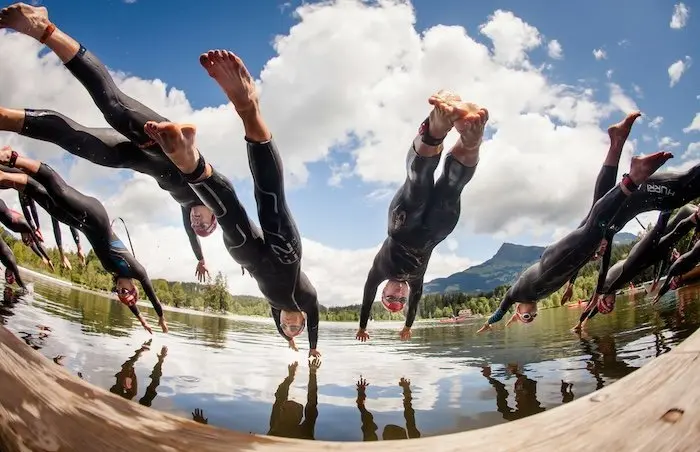
As the competition approaches, anxiety can become a constant shadow. The body is ready, but the mind begins to doubt. What if something goes wrong? What if I don’t perform as expected? To counter these thoughts, it is essential to implement stress management techniques:
• Relaxation routines: deep breathing, meditation, and mindfulness help reduce tension and keep the mind anchored in the present.
• Positive self-talk: instead of feeding fear with phrases like “I’m not ready,” reinforce your confidence with thoughts such as “I’ve trained for this, I am ready.”
• Planning and control: having clear strategies for nutrition, rest, and race logistics reduces uncertainty and provides security.
Visualization: running the race before living it
The mind does not distinguish between what is real and what is imagined. This is why visualization is such a powerful tool. Take time in the days leading up to the race to close your eyes and mentally go through the course:
• Imagine yourself swimming fluidly, exiting the water full of energy, and making an efficient transition.
• Visualize key moments, such as the first climb on the bike or the last kilometers of the run.
• Feel the fatigue, but also the determination to overcome it. This mental exercise not only builds confidence but also trains the brain to react automatically to challenges.
Transitions: small details, big impact
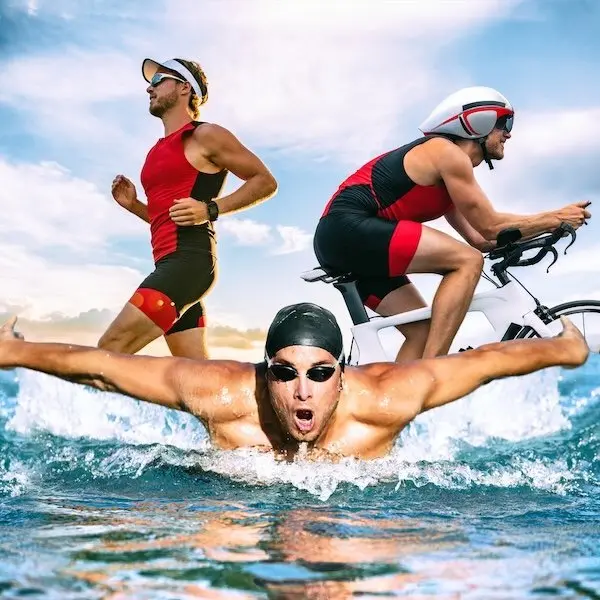
Transitions are critical moments in triathlon. It’s not enough to practice them physically; it’s essential to have a mental strategy:
• Create a mantra for each transition, such as “fast and efficient” or “fluidity and focus.”
• Break down the transition into specific steps and mentally review them before the race.
• Stay calm. A common mistake is to rush and make errors that can cost time and energy.
Clear goals: your mind’s GPS
Having well-defined goals helps maintain focus and motivation at every stage of the race:
• For training: set specific goals, such as improving your swimming technique, increasing your cycling power, or working on mental endurance during the run.
• For race day: set flexible goals: a performance goal (e.g., finishing in a certain time), a process goal (e.g., maintaining a consistent pace on the bike), and an experience goal (e.g., enjoying the event and learning from it).
Self-talk: your best ally in difficult moments
The race is long, and fatigue is inevitable. When your mind starts to doubt, self-talk can make all the difference:
• Replace negative thoughts like “I can’t go on” with phrases like “one more step, just a little more.”
• Use keywords to motivate yourself at each stage, such as “endurance,” “fluidity,” or “power.”
• Remember why you are there. Keeping your personal motivation in mind will give you an extra boost in critical moments.
What to do if negative thoughts arise?
It’s not about avoiding them, but about managing them. Here are some effective strategies:
• Acceptance and redirection: instead of fighting the thought, acknowledge it (“Yes, I’m tired, but I can keep going“) and refocus on your pace and technique.
• Anchoring techniques: use a gesture, a word, or a mental image to return to a state of concentration.
• Divide the race into segments: thinking about the entire competition can be overwhelming. Focus on the next buoy, the next turn, or the next kilometer.
Conclusion: the mind, the fourth segment of triathlon
Triathlon is not just about swimming, cycling, and running. It’s also about thinking, visualizing, planning, and managing pressure. Psychological preparation is not a luxury reserved for professionals; it is a tool that every triathlete, regardless of their level, can and should use to optimize their performance and fully enjoy this exciting sport. Are you ready to train your mind too?
Share the post "Psychological Preparation, the Key to Success in Triathlon"