Share the post "Review of the Specialized Allez Sprint, the King of Aluminum"
In the world of road cycling, where carbon fiber often reigns supreme, Specialized proves with the Allez Sprint that an aluminum bike can compete with the best—and at a lower price. Billed as the “world’s first super alloy bike,” it’s not just a budget-friendly alternative. So, what makes the Allez Sprint so special? Let’s dive into its features and its engaging ride quality with a review of a frame kit that holds its own against many carbon competitors in terms of performance.
By Guillaume Judas – Photos: ©3bikes.fr

First launched in 2015, the Allez Sprint quickly became a cult classic among riders competing in ultra-fast criteriums in the United States. With its aerodynamic tubes, rigid frame, aggressive geometry, and affordable price, this model was quickly regarded as the ultimate racing machine.
Specialized appears to have toned down the handling of this second version, released in 2022. The Allez Sprint is slightly less extreme in every way, offering a bit more stability and making it more versatile on a wider variety of courses than just tight, twisting city streets.

A design inspired by the Tarmac SL7
To design it, Specialized engineers literally dissected their flagship carbon model at the time of its launch—the Tarmac SL7—to try to reinterpret it in aluminum. The geometry is therefore exactly the same. It’s also the same as that of the Tarmac SL8, which has since been released, with only a slightly less sloping top tube. The lines are aerodynamic and wind-tunnel-tested, with fully integrated cables and complex tube shapes achieved through hydroforming.

Aluminum bike frames have seen some major innovations over the years, and hydroforming is one of the most striking examples. This process involves applying hydraulic pressure to the inside of the tubes to shape them in order to achieve the desired performance and weight. We’ve come a long way from the aluminum frame manufacturing methods some people experienced 25 or 30 years ago.

Finally, the Allez Sprint features the same Fact carbon fork as the Tarmac SL7, as well as a carbon seatpost derived directly from that model.

Affordable Price
Only one version of the Allez Sprint is available as a complete bike, equipped with a Shimano 105 groupset and DT Swiss R470 aluminum wheels, priced at €2,900. Not to be confused with the basic Allez, Specialized’s entry-level road bike.
The Allez Sprint is also available as a frame kit for €1,650, allowing you to let your imagination run wild with a custom build that stays true to the bike’s original spirit.

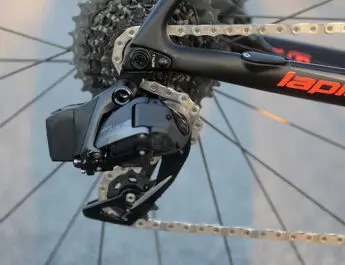
So this review focuses on the frame kit. The build is custom, featuring an 11-speed Shimano Dura-Ace Di2 groupset, medium/high-profile carbon wheels (several wheel sets were tested with this frame), a Roval Rapide cockpit, and a Power Mirror saddle.
It’s difficult to put an exact price on the bike, since the groupset is five years old and has tens of thousands of kilometers on it. But as we’ll see later, its performance is more than on par with most carbon bikes—and all of this starts with a reasonably priced frame.

The Magic of Smartweld Technology
At the heart of the Allez Sprint lies D’Aluisio Smartweld technology, an innovative welding method. By moving the welds away from critical stress areas, such as the head tube and bottom bracket shell, Specialized achieves a frame that is both stiffer and more durable.

The head tube was cut from a single piece of alloy and then mechanically formed to create a more aerodynamic shape with consistent wall thickness. The down tube and bottom bracket shell, hydroformed from a single piece, are designed to provide high stability.

The welds are very visible. This is a drawback for some, especially when comparing the Allez Sprint to carbon frames or bikes in the same price range, which have a cleaner aesthetic due to the different manufacturing processes associated with the material.

But from my perspective, the only real criticism one could level at the Allez Sprint in terms of overall harmony concerns the junction between the top of the headset and the stem mount.

The frame can be built with any stem or one-piece combo, as shown here, without requiring any special cable routing. It is compatible with both electronic and mechanical drivetrains. It is, however, a shame that Specialized does not offer a head tube cover that integrates better with the Roval Rapide cockpit.
Increased Weight
As surprising as it may seem, the Allez Sprint frame weighs more than the original 2015 version. In size 52, including paint, the seat clamp, derailleur hangers, and bottle cage screws, the frame weighs 1,500 g—about 300 g more than the previous version. By way of comparison, that’s nearly 800 g more than an S-Works Tarmac SL8 weighed under the same conditions.

The integrated cable routing, the switch to disc brakes, the bottom bracket standard (BSA rather than BB30), and compatibility with tires up to 32 mm explain this increase in weight compared to the first Allez Sprint. These features, however, enhance performance and versatility.
I weighed the complete bike at 7.95 kg as it was set up for the occasion, including power meter pedals, a bottle cage, and a computer mount. It would still be possible to easily shave off 200 g without much effort. The Allez Sprint can thus compete in this regard with many carbon bikes priced between €6,000 and €7,000—while, in my opinion, showing more personality.

A Thrill Accelerator
From the very first pedal strokes, the Allez Sprint sets the tone. The frame offers excellent stiffness, rivaling the very best on the market. Every watt produced seems to translate into immediate forward momentum, especially on flat terrain. During sprints, the response is crisp: no unwanted flex, just clean acceleration.
But I also don’t find the completely uncompromising feel of the aluminum frames I used in competition 25 years ago. Those bikes were very effective under certain conditions, but you could quickly hit a wall on them if your legs weren’t up to the task.

The Allez Sprint is very responsive. It reacts instantly to the slightest input. When riding out of the saddle, you don’t feel any part of the frame flex. But thanks to the angle and offset of the front end and the fork, the steering is sharp, allowing for very tight turns and, above all, small adjustments with the front wheel to avoid feeling restricted by the frame’s stiffness.
In fact, that stiffness is well dampened with a setup featuring 28-mm tires on fairly wide rims. With tire pressure between 4 and 5 bar, the bike is not only a bit more comfortable—enough to help handle rough patches of asphalt—but it’s also slightly less harsh in terms of its lateral stiffness.
And while the wider tires slightly soften the impression of stiffness it gives off, a setup with 25 mm tires, on the other hand, results in a drier feel on the road surface, with more resonance and more vibrations. The bike is also a bit sharper during changes in pace, but it’s also more tiring over time.
Like it’s on rails
With its responsive steering and ultra-precise carbon fork, the Allez Sprint cuts through tight turns like a scalpel. At 60 km/h on a downhill stretch of winding road, there’s no hesitation: it holds its line, brakes hard, and inspires confidence.
Whereas the Tarmac SL7, with its identical geometry, can sometimes feel a bit too playful with very twitchy steering—especially when there’s a crosswind—the Allez Sprint seems to benefit from slightly greater front-end stiffness, which gives it more stability at high speeds. And ultimately, it offers more comfort, as this handling encourages you to relax a bit more, which ultimately leads to less fatigue at the end of a ride.
When shifting down to the 11-tooth sprocket to sprint, I don’t feel any difference in performance compared to an S-Works Tarmac SL7 or SL8
I experienced this same stability on the flat while pushing hard in a high gear. The bike doesn’t seem to lose its composure even when riding hard in the 53/13 or 12 gear (with a tailwind!), and when I shift down to the 11-tooth sprocket to sprint, I don’t feel any difference in performance compared to an S-Works Tarmac SL7 or SL8.
A Decent Climber
On climbs, the Allez Sprint can’t work miracles against bikes with frames that weigh half as much. While its slight extra weight is negligible on short, one-kilometer climbs at 6 or 7%, it does lag a bit behind when up against top-of-the-line bikes on steep gradients, where it feels just a touch less nimble.
But a bike isn’t just about raw frame weight figures. The high-end build partially compensates for the Allez Sprint’s slight bulk. Fully assembled and ready to ride, the bike weighs barely 8 kg. The handlebars and brake levers are very light, which further enhances the feeling of maneuverability. The Roval, Mavic, and Fulcrum wheels tested on the bike are all high-end models, offering a stiff and responsive ride. And the Continental tires fitted for this test are also among the best in terms of rolling resistance.
As I mentioned earlier, the weight of the Allez Sprint with this setup rivals that of many bikes on the market priced between €6,000 and €7,000. You can do better with a little creativity. Or achieve the same level of performance at a more reasonable price by carefully selecting each component. Not to mention that a frame’s weight is, of course, not the only factor to consider.

Not Such a Difficult Choice
If I had to choose between an S-Works Tarmac SL8 equipped with Shimano 105 and small, basic carbon wheels, and this Allez Sprint with Dura-Ace (11-speed) and good carbon wheels with a medium profile, what would I do? Of course, I know that an S-Works with 105 doesn’t exist—or is almost nonexistent—but just for the sake of the exercise, let’s assume the weight and price of both options would be equivalent.
To be honest, I felt much less of a difference between a Tarmac and an Allez Sprint than between a Dura-Ace groupset and a 105. The same goes for the wheels and the handlebar setup. The weight savings are found at every level, even in components that are more or less distant from the bike’s center of gravity—components that can ultimately alter how you perceive the bike as a whole. In this case, I’d choose the Allez Sprint without hesitation.
A racing beast without breaking the bank
Although significantly heavier than a high-end carbon frame, the Allez Sprint frame is laterally stiff, has perfect geometry in my opinion, and its handling is virtually unmatched. I even wonder if its slight extra weight doesn’t actually give it an edge when it comes to stability at high speeds. As for comfort, while not exceptional, it benefits greatly from the increased tire width. Besides, are there really any truly uncomfortable bikes left on the market now that almost everyone rides 28 or wider tires?
In short, I love this Allez Sprint frame, despite the few minor aesthetic flaws one might find (welds, the junction between the head tube and the stem…). Its handling is much livelier and more responsive than the weight listed on the spec sheet might suggest. Above all, this frame kit proves that a savvy competitive cyclist can build a great racing bike without paying the very high (and often criticized) price of top-of-the-line models—and with a touch of personalization to boot.
The Specialized ALLEZ SPRINT (frame kit) at a glance…Frame: Specialized E5 Premium Aluminum Disc, D’Aluisio Smartweld technology, hydroformed tubes – Fork: Fact Carbon – Seatpost: S-Works Tarmac 2021 – Frame weight only: 1,500 g in size 52 – Number of sizes: 6 Build details: Handlebar: Roval Rapide
Contact: specialized.com |


Share the post "Review of the Specialized Allez Sprint, the King of Aluminum"