Share the post "Pushing Your Limits on the Bike: The Sherpa Method"
The endless indoor trainer sessions, or long rides or runs, are as much a physical challenge as a mental one. Often, it’s not even the intensity that holds us back, but… the duration. Boredom, weariness, or discouragement creep in along the way and erode our motivation. How, then, can we master prolonged effort without enduring it? By drawing inspiration from the Sherpas, those Himalayan guides who accompany alpinists to the world’s highest peaks, we can transform our long rides into a controlled adventure, where boredom disappears and every kilometer becomes a victory.
By Jeff Tatard – Photos: depositphotos.com / All rights reserved
1. Think big, but move small
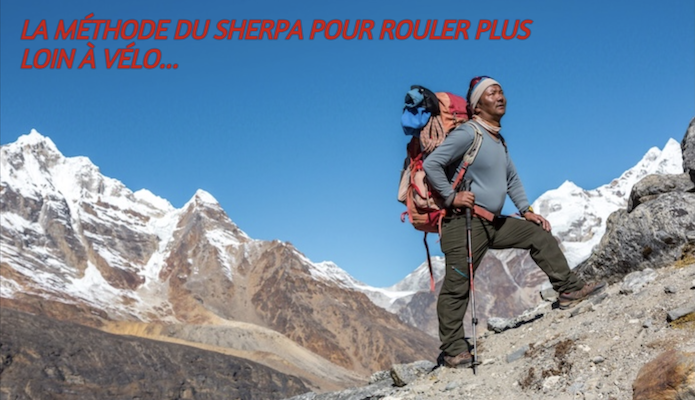
A Sherpa never tells a tired alpinist: “There are 2000 meters left.” They prefer to set intermediate stages: “Let’s reach this rock, and then we’ll see.” It is precisely this approach that allows us to push our limits without being overwhelmed by the scale of the challenge.
In practice:
• Break down your ride into 10 to 20 km segments or 30-minute chunks.
• Set concrete intermediate goals: “Until this village,” “until this climb,” “until the next aid station.”
• Associate each section with an intention: cadence, breathing, pedaling fluidity.
Thus, you advance without thinking about the entire course, but by stringing together small successes that keep your motivation intact.
2. Entering the Flow State
The alpinist who constantly looks at the summit gets discouraged. In contrast, the one who is absorbed by each step, each hold, enters a state where effort becomes almost natural. This is Flow, that state of total concentration described by psychologist Mihaly Csikszentmihalyi.
On the bike, coach Jose Lopez, whom we interviewed for this article, tells us that we access it by finding a perfect balance between effort and pleasure. To do this:
• Adjust your intensity so that it is stimulating but sustainable.
• Focus on the movement, on the sensation of the wheels gliding, on your breathing.
• Incorporate positive distractions: a podcast, a motivating playlist, a mental game (“How many turns before the summit?“).
The goal is to fully immerse yourself in your ride, to the point of forgetting the time.
3. Outsmarting Boredom with Mental Strategies
Coach Lopez explains that ultra-endurance cyclists use techniques to divert their minds from fatigue and monotony. According to him, here are the three most effective approaches:
• Cognitive dissociation: divert your attention by mentally narrating your ride as if you were reporting on it. Imagine you are in a big race and comment on your progress.
• Positive association: transform each element of the landscape into a mental landmark. A difficult climb? Imagine it recharges your energy. A headwind? Take it as an ally to work on your power.
• Active meditation: focus solely on your breathing, on the sound of the tires, on the sensation of muscles in motion. This approach eliminates anxiety and promotes mental endurance.
4. Becoming Your Own Sherpa
According to 3bikes, a good guide anticipates difficulties and constantly adjusts their approach. Do the same with yourself:
• Regular checkpoints: evaluate your state every 30 minutes. Are you hungry? Cold? Do you need to adjust your position?
• Personal mantra: find a motivational phrase to repeat to yourself in case of an energy dip (“Every pedal stroke brings me closer to the summit“).
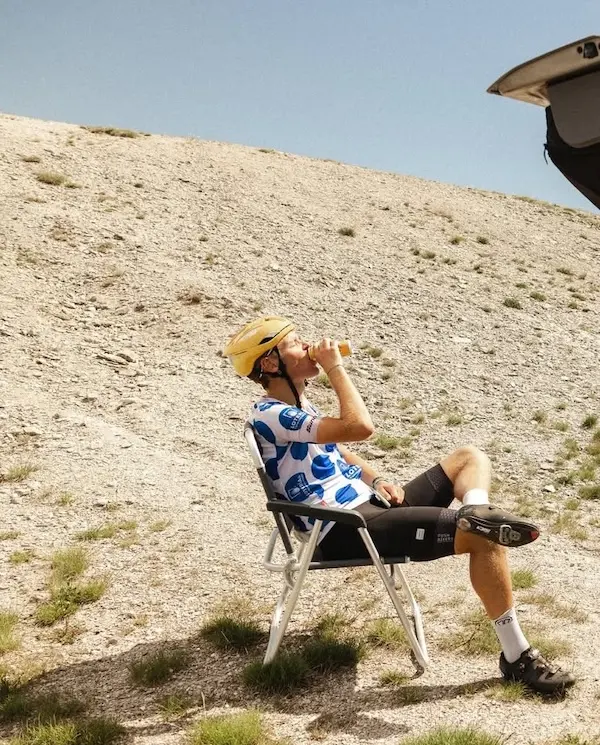
• Mini-rewards: allow yourself a sip of a sugary drink, an energy bar, or a change of pace after sustained effort.
By adopting this mindset, you take control of your ride instead of enduring it.

5. Mental Training, Key to Progress
A Sherpa does not become an expert in a day. He becomes seasoned over time, learning to manage altitude, fatigue, and the unexpected. For you, the same goes: mental endurance is built gradually.
• Increase your rides by 10-15% each week to accustom your brain to prolonged effort.
• Revisit your previous victories: “I’ve already lasted 4 hours; today, 4h30 is possible.”
• De-dramatize fatigue: it is normal, but it doesn’t define your ride. See it as a signal to listen to, not an insurmountable obstacle.
6. Refining the Formulation of Your Thoughts
It’s a detail that seems trivial, but it makes a huge difference to your mental state. The brain does not process negative formulations in the same way as an affirmative command. Saying “I don’t want to give up” unconsciously sends the message “give up.”
Our friend Baptiste Chassagne, second at UTMB in 2024 and who also loves cycling, explains it well to us: he trains this mechanism outside of competition so that it becomes natural during a race. At every moment, he positively reframes his thoughts.
Concrete examples on the bike:
« I don’t want to slow down » → « I maintain a good cadence »
« I must not tense up » → « I relax my shoulders »
« I don’t want to crack » → « I hold my pace »
This daily work on inner language prevents self-sabotaging one’s mental state during a ride. Effort becomes a controlled progression rather than a struggle against oneself.
Conclusion: the long ride, an inner journey
By applying these strategies, we make you a promise on 3bikes: that a long ride will never again be a constraint but a journey, a controlled challenge where boredom disappears in favor of progress and discovery.
Whether on a mythical pass or an endless plain, adopt the Sherpa mindset: advance step by step, stay in the moment, adapt to the terrain, and transform each pedal stroke into a new step towards your personal summit.
Share the post "Pushing Your Limits on the Bike: The Sherpa Method"