Share the post "Julian Lino: a name, a story, a destiny, or when the past illuminates the present"
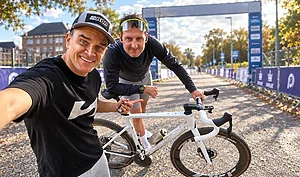
Julian Lino opened his door to share with us his journey, his choices, and his vision of cycling today. Son of Pascal Lino, yellow jersey wearer of the Tour de France for eleven days and winner of the Tour de l’Avenir, he grew up in the shadow of a father with an impressive track record. A source of pride, certainly, but also a lot of pressure.
By Jean-François Tatard – Photos: All rights reserved
“Honestly, I’m proud to bear the Lino name. It’s not always easy when, on a podium, you’re introduced as ‘the son of‘. But it pushed me to try and make a name for myself. My father gave me a lot of advice, and sharing this passion remains a pleasure!”
From his early years, Julian was immersed in the world of cycling. He competed with Valentin Madouas, now an Olympic silver medalist, and measured himself against the best. “It was hard to compete with Valentin, he always won everything! But he was also the one who pushed all of us to excel. He remains a model of humility and success today.”

He recounts his first strong racing memories with emotion: “I would say my first track race that I won, the 100 laps of Vannes. I told myself that after all, I wasn’t bad!”
Another key moment of his youth was his eighth place at the French junior time trial championships, on a bike far from the standards of the time. “I was on David Millar’s 2001 MBK from Cofidis! It wasn’t the best bike, but I told myself I could still ride fast!”
A career of highs and lows
From VC Loudéac to Bike Aid, via UC Nantes and Nice Métropole, Julian evolved in varied structures, each bringing him its share of experiences. “Without hesitation, my time at Bike Aid was the most significant. After failing by seven seconds to take second place at the French ITT championships, I was offered this opportunity at the higher level. It was an incredible human experience.”
But high-level cycling is unforgiving. Did he exploit his full potential? In hindsight, Julian points to a key element he might have lacked: “I would have liked to have more support for the time trial and aero aspect, but in Continental, resources are limited. I kept the same bike from 2014 to 2023… I think I lost a lot because of that.”

Another obstacle stood in his way: Basedow’s disease, a thyroid dysfunction. “It wasn’t easy to manage at a high level. I had a lot of ups and downs, but I’m proud to have been a racer with a gland that is still difficult to control today.”
And regrets? “Aside from the time trial part where I would have liked a top 10 at the French pro championship, I have no regrets. If I had to change one thing, it might be to have done cyclo-cross when I was young, for agility and explosiveness!”
The most difficult moment of his career? “Tough question… There were quite a few! But I would say my 2017 season at VCP Loudéac. Nothing went well, apart from one or two time trial victories.”
Making a name for himself after a legendary father
Bearing a recognized name is both a privilege and a challenge. “It’s a mix of both! It’s not easy to carry, but it allowed me to get advice from other big names in cycling.” And the constant comparison with his father? “Let’s just say few people can finish fifth in the Tour de France… so we almost always do less well!”

The gravel turn: a new freedom
Today, Julian has traded asphalt for trails, finding new life in gravel. “The gravel atmosphere and spirit, clearly. We don’t overthink it, but we race hard. We cross the finish line, eat a cake, and drink a beer! It breaks some of the road cycling codes.”
Gravel competitions have also allowed him to travel and discover new horizons. “I’ve been to the USA, Denmark, Scotland, Belgium, Italy, Spain… It allows you to discover nice places and broaden your mind.”
In parallel, he found a key role at DAGG Distribution, where he is a network animator and responsible for ambassadors and partners. “I like what I do and I was quickly given trust.”
A clear-sighted vision of current cycling
Has cycling evolved in the right direction? Julian is mixed: “It’s more elitist, it’s no longer just a popular sport. The price of equipment, everything is more expensive today and that creates a barrier to entry. Saying whether it’s a positive or negative evolution remains complex. Let’s just say everything is more professional: you have to calculate everything, watts, food, sleep…”
His advice to young people who dream of turning pro? “Develop technical and physical qualities young, by doing cyclo-cross for example, and gradually increase volume. But above all, have fun without taking it too seriously in the young categories. Make efforts in the form of challenges so as not to get fed up and avoid burnout later.”
The future: more professional than cycling
Julian has found a balance between professional life and his passion for cycling. Based in Nice, he works from home and travels a lot for events. “I try to maintain a good sports rhythm for my figure! I’m lucky enough to ride a Factor, so I go in the morning or during my lunch break. But we’re not really talking about training anymore, I don’t have a program. I just try to let off steam and enjoy myself.”
His future? “A big position at DAGG Distribution!” he says, laughing. “My projects are more on the professional and family side. Cycling will remain my way of clearing my head and staying in shape. It’s part of my balance.”
Julian Lino may not have had the career of his father, but he has forged his own path, with humility and determination. A journey rich in lessons, marked by strong choices and an intact passion for cycling, in all its forms.
And if there’s one lesson to be learned from his story, it’s this: the name we bear does not define our destiny; it’s what we make of it that counts.
Share the post "Julian Lino: a name, a story, a destiny, or when the past illuminates the present"