Share the post "Review of the Cervélo Caledonia 5"
With its Caledonia 5 model, Cervélo aims to tap into a niche that’s somewhat overlooked by its competitors but that nevertheless aligns with most cyclists’ actual riding habits: from leisurely spins on small roads that aren’t always well paved to all-day epics that leave you never wanting to stop—all without sacrificing performance, as it can handle a cyclosportive or even a race when needed. In short, is it the ultimate all-purpose road bike? This two-month test set out to answer that very question. Text: Olivier Dulaurent – Photos: 3bikes.fr, Cervélo
Cervélo presents the Caledonia as a bike designed to push its riders to their absolute limits—both physically and in terms of the bike’s capabilities—regardless of the ride’s duration and, if possible, while riding as fast as possible. Cervélo calls these “Big Stupid Rides.”
The idea behind this challenge is to set out on a three-digit ride where you tell yourself you were foolish to get swept up in it at the time, but which, once finished, makes you want to do it all over again. The Caledonia 5 was therefore designed with this in mind—or for long-distance rides—with a geometry focused on comfort while retaining the feel and pursuit of performance that have made Cervélo’s reputation.
Aerodynamics
All Cervélo bikes are aerodynamic. As expected, the cables are routed entirely internally, and the frame’s aerodynamic shapes work together to combat the cyclist’s main enemy: the wind! 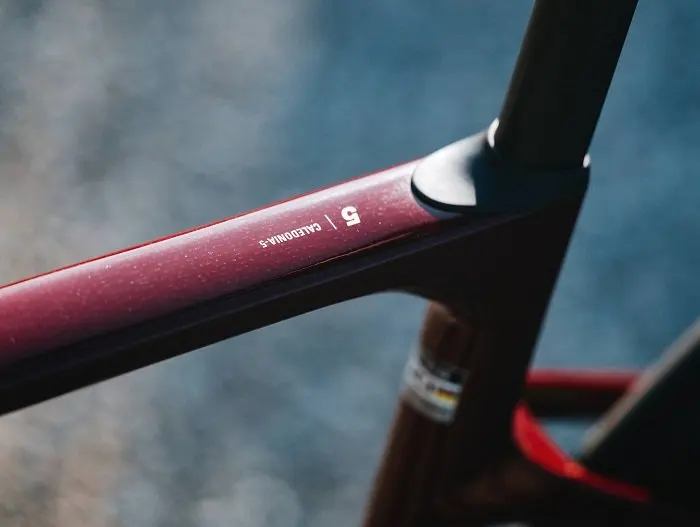

Internal Storage
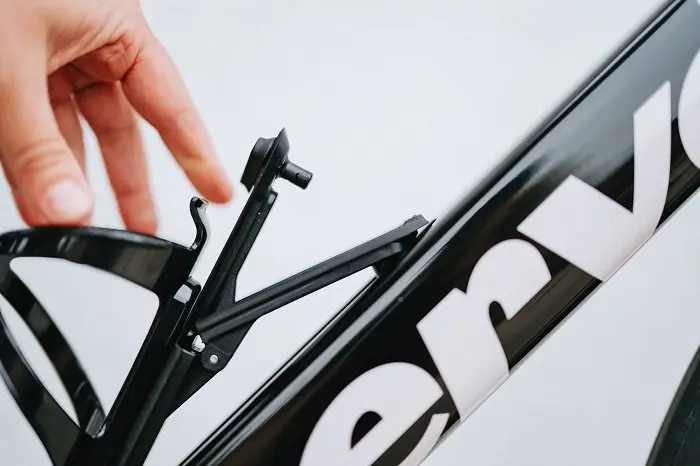
New to the latest version of this model, the frame storage compartment is designed to hold an inner tube, a small multi-tool, and a CO2 cartridge. The access panel is easy to remove, even while wearing gloves—simply flip the locking lever and pull. 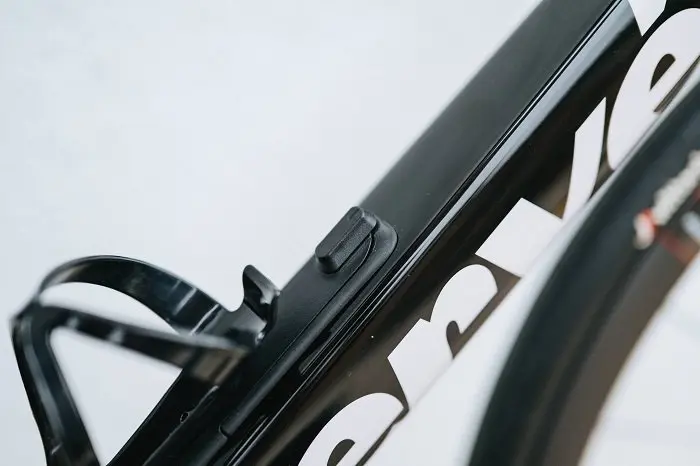
Refining and Improving
The Caledonia-5 was also designed to perform well on roads where the pavement isn’t ideal—in a way, it’s the road bike for “rough roads.” The brand has retained the core features of the previous Caledonia 5 and refined the small details, such as this new upper headset cover, designed to allow you to adjust its height without having to take everything apart.
Another aspect has also been revised: the seatstays have been lowered and the frame made more sloping to take comfort to the next level. 

Reserve 42|49
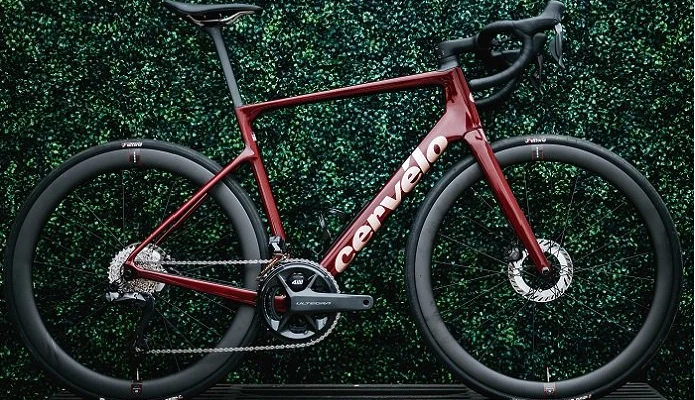
The test bike, the Caledonia 5 equipped with Shimano Ultegra Di2, features Reserve 42|49 wheels. Developed using Turbulent Aero technology, they are designed for all types of rides, capable of adapting to any terrain while maintaining aerodynamic performance. This is, in fact, exactly what the Caledonia 5 is all about… Note that the brand offers a lifetime warranty on this product. 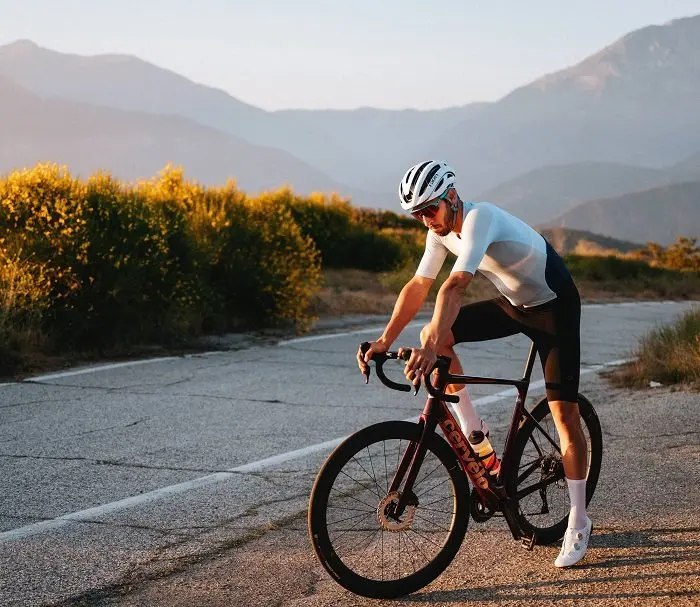

On the Road
Given the bike’s intended purpose and expected performance, we covered a wide variety of rides: we even revisited some sections that had fallen into disrepair due to lack of maintenance or had been reclassified as forest roads. Under these conditions, the bike performed exceptionally well.

Between the 30 mm Vittoria Tubeless tyres inflated to 4 bar (front) and 4.5 bar (rear) and the frame’s just-right flexibility, it was almost a pleasure to be able to aim for the potholes again rather than avoid them.
Once out of these sections, the performance lived up to expectations: no harmful flex, but rather a perfectly balanced compromise between responsiveness and stiffness. 

 So much so that the bike felt perfectly balanced, particularly in terms of its overall stiffness distribution between the front, middle, and rear. Probably even better than the Cervélo R5 I tested 18 months ago, whose front-end stiffness sometimes seemed almost too high compared to what I felt at the bottom bracket.


So, while one might have expected a heavy, clunky bike, the opposite is true. Admittedly, the Caledonia isn’t as lively and responsive as a bike designed purely for performance. However, it holds its own perfectly and, above all, isn’t demanding, suggesting that it’s suitable for a wide range of cyclists, from the leisurely Sunday rider to the competitive cyclist looking to mix up their training routes by seeking out quiet backroads—and even for light gravel riding.

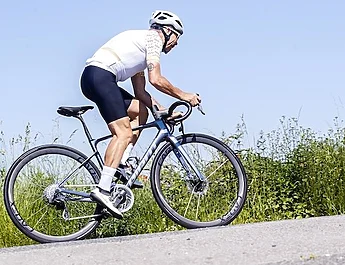
On climbs, the bike seems to handle a wide range of cadences perfectly, even when pushing it to the extremes (in terms of power or speed). It’s really only during sudden changes in pace and/or gradient that the bike might seem to lag behind a machine designed purely for competition. But in reality, cyclists who specifically seek out these qualities are rare.
On the contrary, for most of us, the best results on climbs are achieved when the effort is as smooth as possible—which suits the Caledonia 5 perfectly.
When the slope levels off, stability is excellent, aided by nearly 60 mm of trail and the bike’s weight distribution. Once again, the bike as a whole feels more reassuring than its big brother, the R5. Of course, the tyres play a part in this, as does the stability felt in the wheels—which, incidentally, are not very sensitive to crosswinds—justifying the brand’s extensive research on this topic.

Although this is a difficult area to assess without specific data, the aerodynamics seem quite effective; there’s no sense of hitting a wall at the 40 km/h threshold, as was the case with a rim-brake bike that was used alternately during the test.


The entire groupset is well-known, with the Shimano Ultegra performing flawlessly, offering powerful yet easily modulated braking, smooth shifting, and quiet drivetrain operation.


In conclusion
At the start of this article, we asked whether the Cervélo Caledonia 5 was the ultimate all-round road bike. After two months of testing, the answer is a resounding yes—this bike is the very definition of versatility. At ease when riding fast into the wind, comfortable on rough roads and over long distances, it proved to be a particularly enjoyable riding companion.
Of course, riders chasing the absolute pinnacle of performance—down to the last watt—will opt for the R5 or S5 from the same brand, but for the vast majority of cyclists, the bikes ridden by Jonas Vingegaard or Wout Van Aert are probably less suitable than this Caledonia 5. Now the challenge is to get the word out—and that’s not the easiest task for the California-based brand, whose flagship models shine in World Tour races and are inevitably a more “prestigious” purchase for buyers.

The Cervélo Caledonia 5 at a glance… Pros: versatility, comfort, stability, suitable for a wide range of riders and uses Cons: less responsive than a true race bike when changing pace Frame: Cervélo All-Carbon – Fork: Cervélo All-Carbon, Tapered Caledonia-5 Fork – Handlebar and stem: Cervélo ST32 Alloy and Cervélo HB13 Carbon, 31.8mm clamp – Brakes: Shimano Ultegra – Front derailleur: Shimano Ultegra Di2 12-speed – Rear Derailleur: Shimano Ultegra Di2 12-speed – Shifters: Shimano Ultegra Di2 12-speed – Cassette: Shimano Ultegra 12-speed – Chain: Shimano Ultegra 12-speed – Crankset: Shimano Ultegra 52/36, 4iiii Precision Pro, GEN3+ Dual Sided 12-speed – Wheelset: Reserve 42/49 (lifetime warranties) – Tires: Vittoria Tubeless Corsa N.EXT TLR G2.0 700×30 – Saddle: Selle Italia NOVUS BOOST EVO SuperFlow Ti – Seatpost: Cervélo SP24 Carbon – Sizes available: 6 – Price: €7,999 (frame kit for €4,799) |

Share the post "Review of the Cervélo Caledonia 5"