Share the post "Burn to Shine: Heat Training, Cyclists’ Ultimate Weapon"
Elite cycling has never been so demanding. Gaps are shrinking, strategies are being fine-tuned, and the smallest physiological improvement can make the difference between a win on the Champs-Élysées and a place of honour. In this context, heat training is revolutionising the preparation of the world’s best cyclists. A radical, punishing but devilishly effective method, adopted by the greatest to push back their limits.
By Jean-François TATARD – Photos: Grok / DR
Heat training relies on very specific physiological mechanisms:
- Increased plasma volume, improving oxygen delivery to the muscles and delaying fatigue.
- Improved thermoregulation, essential to avoid heat stroke in summer races.
- Optimised sweating, allowing the body to cool more efficiently.
- An “altitude-like” effect, with stimulated EPO production and a higher red blood cell count.
- Boosted endurance, thanks to better tolerance of prolonged effort.
And these are not just hypotheses: many athletes have already validated this approach.
Pogačar, Campenaerts and the others: why they are betting on heat training
If a team or a rider wants to dominate in July, they must be ready to face the extreme conditions of the Tour de France. Tadej Pogačar, two-time winner of the Grande Boucle, has understood this well. His coach and his UAE Team Emirates squad have made Heat Training a pillar of his preparation.
As AS.com explains, “it is a central element in Pogačar’s rise in power, a way of simulating extreme conditions and maximising his capacity to adapt.”
Victor Campenaerts, former Hour Record holder, is also a fervent follower of the heat. He used this method to improve his heat tolerance and optimise his performances, particularly in long and intense events.
As he confided to The Sun, “it is an approach that pushes you to your limits, but gives you a decisive advantage in the race.”

Tanguy Turgis: from the end of a career to a fresh start with PCO
But heat training is not only for World Tour riders. It is also making its way into the most ambitious amateur structures, notably thanks to visionary sports directors such as Tanguy Turgis.
A former professional rider, Tanguy Turgis saw his career abruptly halted in 2018 because of heart problems, when he was one of the greatest French hopes. A clean break, a shock, but also a turning point.
Rather than moving away from cycling, he chose to put his experience at the service of others. Today, he is sports director of Paris Cycliste Olympique (PCO), the largest amateur structure in the Île-de-France region, and he leaves nothing to chance in the preparation of his athletes.
Convinced of the benefits of Heat Training, he now integrates it into the training plans of the riders who trust him. “It is a method that, used well, can really take athletes to the next level,” he explains. Among amateurs too, races are won on details, and heat adaptation can be a game changer.
Thanks to his expertise and his sharp eye for performance, Turgis applies the same principles as the World Tour teams to his elite group. With a structured training programme based mainly on indoor trainer sessions in hot and humid conditions. An innovative approach that is already bearing fruit.

The coaches at the forefront of this method
Heat Training is not a passing fad, but a major optimisation tool for top-level coaches. Carles Tur, coach at Q36.5, has built this method into his training plans. His goal? “To maximise the riders’ adaptation to extreme climatic conditions and improve their haemoglobin mass.”
The Bora-Hansgrohe team, for its part, takes the approach even further with on-board body temperature sensors, making it possible to measure in real time how well the riders are adapting to heat.
How do you train in the heat?
Adopting Heat Training is not just riding in the scorching sun without preparation. It is a precise protocol that can take several forms:
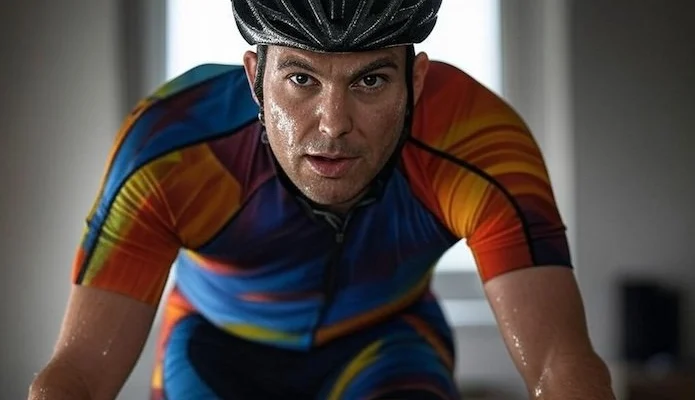
Training in hot and humid conditions: on an indoor trainer in a heated room, wearing thermal clothing to amplify the effect.
Hot baths after training: immersion in hot water to prolong the heat stress and increase the physiological adaptations.
Sauna sessions after rides: an effective way to increase plasma volume without additional mechanical effort.
Training camps in a hot climate: to combine altitude training and heat acclimatisation, a formidable combination.
These methods must be introduced progressively, under supervision, to avoid the risks of dehydration and overheating.
An essential approach for the years to come
With global warming and increasingly intense race conditions, Heat Training will become a must for cyclists aiming for performance. The most advanced teams have understood it: better to prepare your body for the heat than to suffer it. This type of training, although hard, also helps boost endurance.
And while today it is champions like Pogačar and Campenaerts
Structures like PCO, under the impetus of Tanguy Turgis, have already understood this and are applying these techniques at the highest amateur level. And one thing is certain: those who neglect this method risk paying the price on the scorching roads of the Tour… or the Classics.
HEAT Training, a fad? No. A game changer…
Share the post "Burn to Shine: Heat Training, Cyclists’ Ultimate Weapon"