Share the post "Performance and Comfort: The Pros and Cons of Modern Gear"
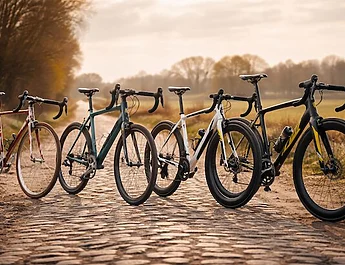
Undeniably, modern mid-range and high-end bikes have reached new performance milestones in recent years. Stiffer, more aerodynamic, and with less rolling resistance, they allow riders to go faster, as evidenced by the rising average speeds in most amateur and professional races. But is this always advantageous for the average cyclist? Let’s examine point by point what the most recent innovations have brought, but also what disadvantages they can create.
By Guillaume Judas – Photos: @depositphotos.com / adobe.firefly.com
Thanks to carbon and the ingenuity of manufacturers, today’s bikes allow riders to go faster than a few years ago, for an equivalent effort. But this performance gain comes with some constraints that are not always to the liking of non-competitors.
The frame: ever more aerodynamic
Modern carbon frames are light, stiff, and above all, more aerodynamic. Air resistance increases with speed, eventually becoming the main resistance opposing forward motion. Many models look aesthetically similar because engineers from major manufacturers work with equivalent tools.
They study tube shapes by computer, with air penetration simulations, before validating their choices in wind tunnels and on the road with a battery of internal tests. Thanks to manufacturing processes that are also progressing and the expertise of manufacturers (often located in Asia), they can choose tube shapes optimized for aerodynamic gains while also optimizing the structure’s weight and stiffness.
But be careful, we are talking here about controlled stiffness, which is not harsh in the high-end, and which allows the frame to live by subtly deforming under the user’s pedal strokes, in order to make it pleasant even after several hours of effort. A bare frame generally weighs between 700 and 1000 g, while being effective against the wind for the most upscale models.
However, the combination of a fast, light, and responsive frame can be difficult to handle and control under certain conditions for an inexperienced cyclist. At high speeds, a racing machine totally dedicated to maximum efficiency can also lose grip and go off the road if it loses contact with the asphalt, for example, in the case of a pothole or an irregularity on the road surface.
What about custom-made? For decades, a high-end frame (in steel) was necessarily synonymous with a chassis custom-made for the user, with tube lengths and seat tube and head angle chosen according to the type of riding. This had the advantage of perfectly adapting the bike’s dimensions to the cyclist’s size and riding style, for comfort and handling.
Today, due to very expensive manufacturing technologies with modern carbon bikes, this practice has almost disappeared. Nevertheless, bike fitting studies have also evolved greatly, and it must be noted that today we encounter far fewer cyclists with tendinitis or other injuries of this type than 30 years ago.
The cockpit: ever more integrated
The arrival of disc brakes and electronic drivetrains with more flexible brake hoses and more pliable wires (or the absence of wires) than traditional cables has allowed all of this to be integrated inside the handlebars, stem, and head tube, resulting in a cleaner cockpit, as well as the entire frame. Besides the aesthetic aspect, this technology has also offered significant aerodynamic gains.
Recent developments in carbon construction have also made it possible to reduce the weight of handlebars and especially integrated bar/stem combos, while maintaining excellent strength and stiffness. Shapes have been optimized to further reduce air resistance on a very exposed part of the bike.
However, this technology greatly complicates maintenance, as every part change requires completely disassembling the front part of the bike. This limits maintenance possibilities for those who are not equipped like professional mechanics.
Integrated handlebars have the major drawback of not being adjustable in inclination (since the handlebar is often integral with the stem, with some exceptions), and their shape in curvature, height, and reach is imposed by the manufacturer’s choice, which can sometimes present comfort problems for some users.
Finally, to reduce the frontal area of the bike and the cyclist in position, again with the aim of improving air penetration, the trend is towards narrower handlebars than a few years ago, a choice often imposed by manufacturers on cockpits supplied with bikes. This results in less steering maneuverability (due to the reduced leverage with a narrow handlebar), and sometimes more discomfort in terms of the cyclist’s position, especially on climbs.
Ever taller wheels
Thanks to carbon, rims are taller while maintaining a reasonable weight compared to older aluminum wheels. Taller rims again mean more aerodynamics, although different factors come into play, such as the shape and width of the rims, but also the spokes, how they are connected to the rim, and the shape of the hubs.
Nevertheless, the aerodynamic gains to be expected from this type of equipment are much smaller than those that can be hoped for from a modern frame, a good rider position on the machine, and appropriate clothing. Cyclists’ fantasies about wheels are therefore often far from the actual results for this type of equipment.
The taller the rims, the more effective they are in certain situations, especially with a tailwind. But they offer lateral wind resistance that can make the bike difficult to control. They are thus less comfortable in the long term than lower rims on varied courses by requiring constant attention, or even debilitating on steep gradients due to their inertia.
Disc brakes have imposed a new type of wheel attachment to the frame, with thru-axles. On this side, it is beneficial for everyone since the gain in lateral stiffness is undeniable, without causing discomfort.
Ever less rolling resistance thanks to tubeless tires
In recent years, enormous progress has been made in terms of rolling resistance, mainly thanks to tubeless tires. These have even largely replaced traditional tubulars among pros. And for amateurs, their practical side is appreciable, with many punctures instantly repaired while continuing to ride, thanks to sealant.
Tubeless tires also offer aerodynamic gains compared to tubulars when combined with rims whose external width matches that of the tire sidewalls. The trend is also towards wider tire widths, from 28 to 30 mm for competitive riding, which provides grip and comfort with lower inflation pressures than with smaller tire widths.
But tubeless technology retains some significant drawbacks. For some punctures, the sealant is not enough, and it is still necessary to repair with an inner tube. Unseating a tubeless tire is often problematic on the roadside, and mounting and dismounting must be done according to the rules of the art, especially with enough pressure to seat the tire against the rim to obtain the necessary seal.
Some wheel manufacturers have also opted for hookless rims, which require a limited choice of compatible tires, and which prohibit an inflation pressure higher than 5 bar, at the risk of the tire coming off the rim.
Finally, tubeless also requires the addition of sealant, which is complicated to handle outside of a workshop or garage, whether when mounting or dismounting the tire. In case of a puncture, the latex-based liquid spreads on the bike and clothes, and it is difficult to clean.
Faster and more versatile drivetrains
Electronic drivetrains offer increased precision and speed for gear changes. They are associated with applications that offer customization possibilities, with multiple, synchronized, or semi-synchronized gear changes that are very pleasant to use.
The latest versions of high-end drivetrains are even wireless, at least at the cockpit level, which further cleans up the handlebars and provides more flexibility in steering compared to cable transmissions.
These electronic derailleurs operate with batteries, which must be recharged after approximately 1000 km, otherwise, it will be impossible to operate the gear changes. Those who go on cycling adventures may find this system less autonomous than a classic drivetrain, in addition to being much more expensive to replace in case of breakdown or breakage.
Thanks to 12-speed cassettes, the range of gears is extended, which offers more versatility to the bike. But despite the 12 cogs, the extreme gears of the cassettes offered by manufacturers are still little used by amateur riders, especially by those who live in regions with little elevation gain.
In theory, cyclists therefore have 12 cogs with two chainrings, but only use seven or eight different gears daily, with tooth jumps in the middle of the cassette detrimental to pedaling comfort.
Significantly more effective brakes
Over the past decade, disc braking has gradually established itself on road bikes. This is an undeniable advantage in terms of safety, especially in wet conditions. Smooth, powerful, and progressive, disc brakes are heavier than rim brakes, but they allow for better integration of components, which is both more aesthetic and more aerodynamic.
With braking applied to a rotor and no longer to a rim, this system limits the need to ride with several different pairs of wheels depending on the conditions.
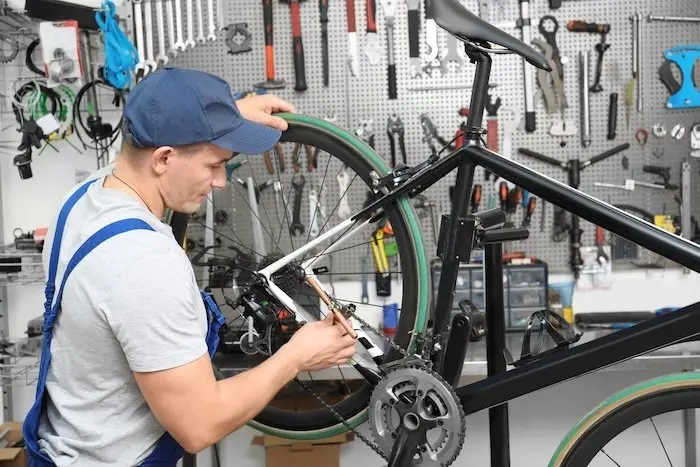
This system also requires less maintenance, with less frequent changes of hoses, oil, and pads than the changes of cables, wires, and pads of the previous system.
On the other hand, it is again more difficult to perform maintenance oneself, without good mechanical knowledge, suitable tools, and the necessary space. These conditions continue to deter the most reluctant, who prefer a simpler system that can be adjusted in a few minutes before the start of a race, for example.
Moreover, disc braking implies more precautions when transporting the bike. The calipers are adjusted very precisely to limit rubbing with the rotors, and they can become misaligned when the bike is transported in the trunk of a car, or in a bag for train or plane travel.
The brake levers must also not be manipulated if the wheels are not mounted on the bike, at the risk of moving the pads inwards towards the caliper. This complicates reassembling the bike before riding for those less mechanically inclined.
More and more information on bike computers
Modern bike computers offer more and more information, to measure ride data, or for navigation by following a GPS track. They can be connected to various sensors that indicate heart rate, cadence, power, and even allow receiving messages.
A convenience for those who love data, but a nightmare for riders who are not familiar with electronics. Especially since the relatively limited battery life of these devices also requires thinking about recharging or changing batteries.
An additional mental load for those who like to ride by instinct, or in total autonomy. Focusing on data also encourages disconnecting from the landscape and losing one’s independence. Because sometimes, you have to accept that a bike computer can bug, or simply lose the GPS signal.
Outfits that help you ride faster
The outfits worn by racers and offered by manufacturers are not to be outdone in terms of performance gains. The materials, and especially the fit, have greatly limited wrinkles that disrupt air penetration.
To be convinced, simply compare the average speed and power of a winter ride with several layers of more or less loose clothing with those of a summer ride on the same course: by producing an equivalent effort, you ride much faster with a thin and fitted jersey.
Among pros, most riders now use a skinsuit (with a few thin pockets) rather than the traditional jersey/bib shorts combo, to minimize air resistance as much as possible.
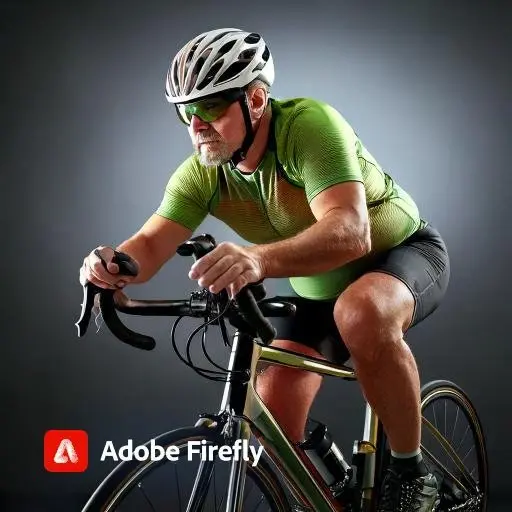
But for the Sunday cyclist, a fitted outfit is not always the most comfortable. This type of outfit is designed for lean athletes, who maintain a certain comfort with what they consider a second skin. A pure amateur can quickly feel constricted, uncomfortable, and highlighting a few love handles is not pleasant either.
Finally, these lightweight outfits offer very little protection in case of a fall. If the problem already arises for professional racers, it can become truly inconceivable for an occasional athlete who rightly wishes to limit risks during their practice.
A constantly evolving sport
Whether we like it or not, cycling is partly a mechanical sport, and evolutions in this direction for more performance are inevitable. However, some of these evolutions are not suitable for all types of riders, especially when they reduce comfort.
Seeking performance improvement, regardless of the level of practice, is a laudable goal in itself, but in this case, one must remain consistent throughout. State-of-the-art equipment doesn’t make much sense if you add a few accessories for your well-being during your bike rides.
For example, a saddle or handlebar bag with repair essentials, tools, or refreshments easily adds 4 to 500 g to your bike. Two large water bottles add a good kilo. In the end, that’s 2.5 kg more that you add to your 7 kg bike that you paid the price of a used car for.
Following equipment evolution must therefore primarily remain a thoughtful approach based on your riding style.
Share the post "Performance and Comfort: The Pros and Cons of Modern Gear"