Share the post "Girs Kom Review"
A year after the Solo, Girs launches the Kom, a bike with athletic lines designed to conquer summits, distinguished by its stiffness and stability, but above all by a relatively accessible price. A fairly light competitor’s bike, equally at home tackling climbs as it is the wind on the flats, but one that will be reserved for cyclists in good physical condition to be fully appreciated.
By Guillaume Judas – Photos: ©Vincent Lyky
Created in the late 90s, Girs is a French brand that has always offered high-performance and accessible bikes, without neglecting a touch of originality. We remember the famous G-Star and G-Max in the mid-2000s and early 2010s, which demonstrated the innovation capabilities of the Girout brothers, the brand’s creators, to promote rider comfort and ergonomic posture.
More recently, Girs has moved closer to Factor, as both brands are distributed by the company Dagg, which also belongs to the Girout family. On certain bike models, the connection between Factor and Girs is evident, at least in terms of manufacturing, as we saw with the Solo. An aerodynamic bike designed to avoid overly complicated maintenance solutions, and positioned in the mid-range with a T700/T800 carbon fiber frame.
With the Kom, Girs has chosen to offer a bike with a different behavior than the Solo. The latter is more intended for cruising at a good pace over long distances thanks to its aerodynamics and comfort. With more muscular tube shapes and the use of T1000 carbon fibers, the Kom, on the other hand, prioritizes weight savings and stiffness, for those who like to ride with frequent accelerations.
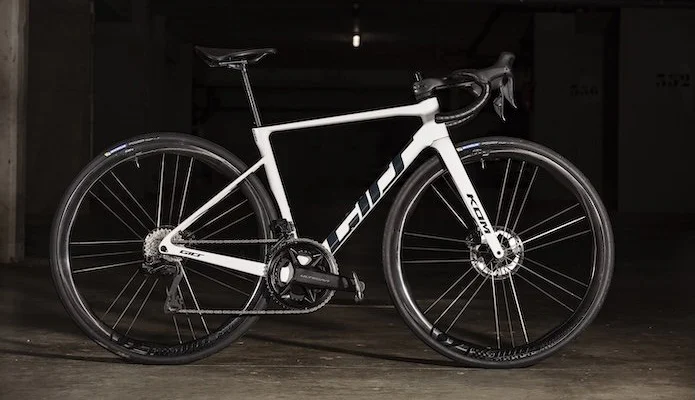
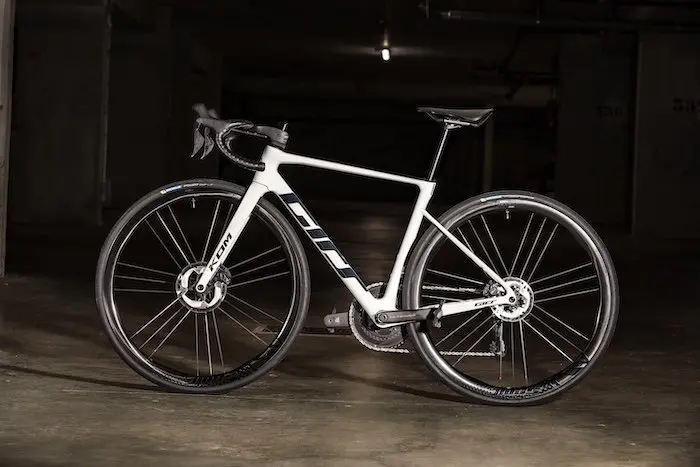
With a monocoque cockpit and perfect integration of the brake hoses, the frame with its sculpted and modern lines weighs 900 g, for a price of €2190 with its fork and headset. Available in five sizes and two colors (white or midnight blue), it is sold from €4550 with Shimano 105 Di2, Fulcrum Racing 900 wheels, and Ritchey handlebars and stem. Our test model, with a Shimano Ultegra Di2 groupset, a Sonic monocoque handlebar, and Sonic Ultra 35/40 wheels, sells for €7515, for an equipped weight of 7.5 kg in size 49.
There is another frame version in the catalog: the Kom R, with M40X carbon fibers loaded with carbon nanoparticles and graphene, for a weight of 790 g and a price of €2990. Enough to build a high-end bike with Shimano Dura-Ace weighing around 7.1 kg, for a price of €9775.
In both cases, the prices are reasonable compared to the competition, and should ensure the Girs Kom great success among racers and those seeking performance in general. Because the Kom is a stiff bike, rather well-maintained throughout its wheelbase, and does not necessarily have the elastic feel of some bikes specifically designed for high mountains or that allow for absorbing an imperfect pedal stroke.
But it demonstrates excellent stability at high speed and positions itself precisely when adopting a tight line in fast corners. Finally, the very light Sonic Ultra 35/40 wheels temper the demanding character of the chassis a bit here.
Muscular Silhouette
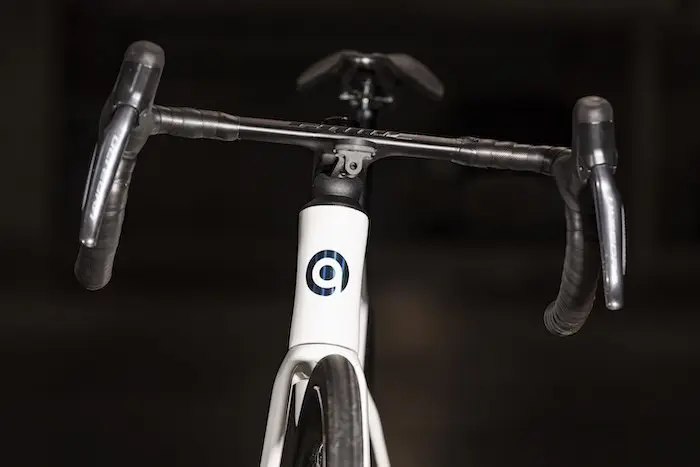
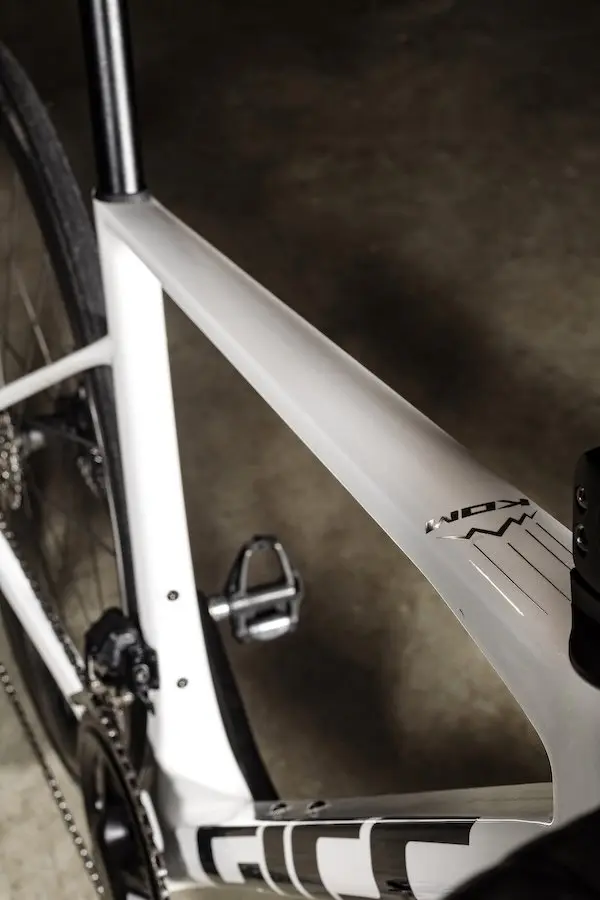
Compared to many current bikes that focus entirely on tube profiles, the Kom adopts an almost more classic line. But on closer inspection, the shape of the tubes seems particularly refined to promote maximum stiffness.
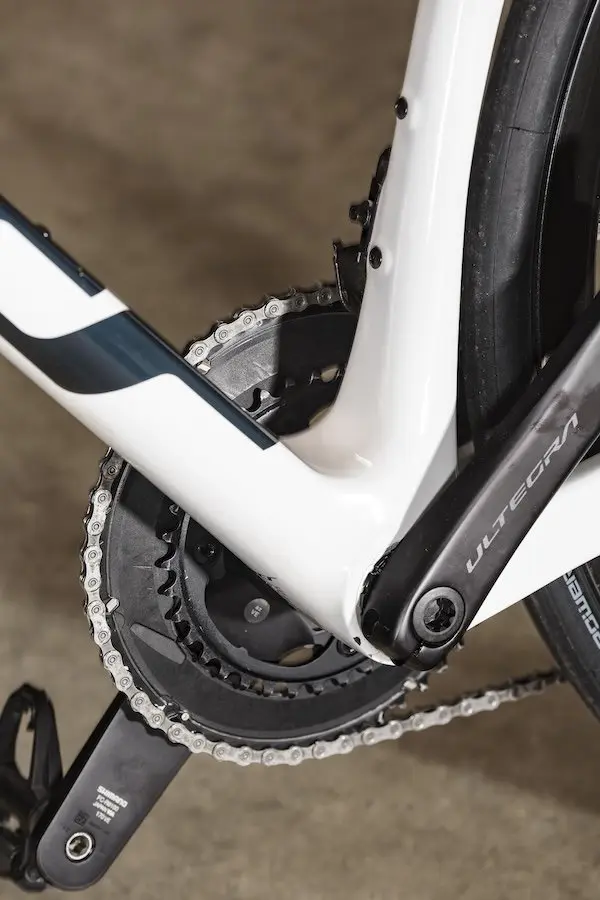
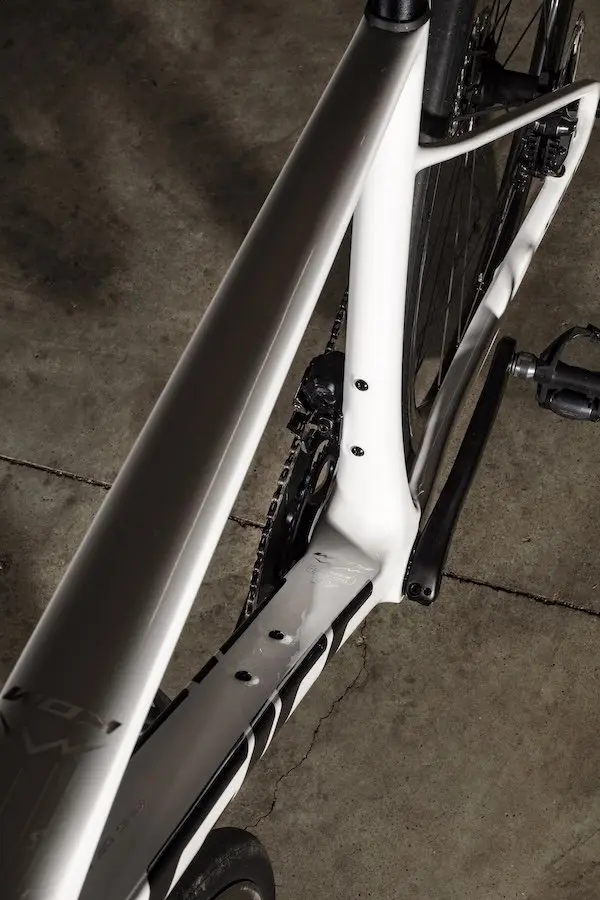
The massive head tube is extended by an imposing D-shaped down tube, down to a very wide and asymmetrical bottom bracket shell, with a T47 bottom bracket format.
The flattened top tube tapers slightly as it approaches the junction with the seat tube, which is round but hollowed out at the rear wheel passage. The chainstays are wide and angular, flaring out to follow the wheel’s spoke umbrella.
Triangular in shape, the seatstays are quite thin, to provide both lateral stiffness and longitudinal comfort. At the front, the fork legs are thick but tapered, to promote airflow around the frame.
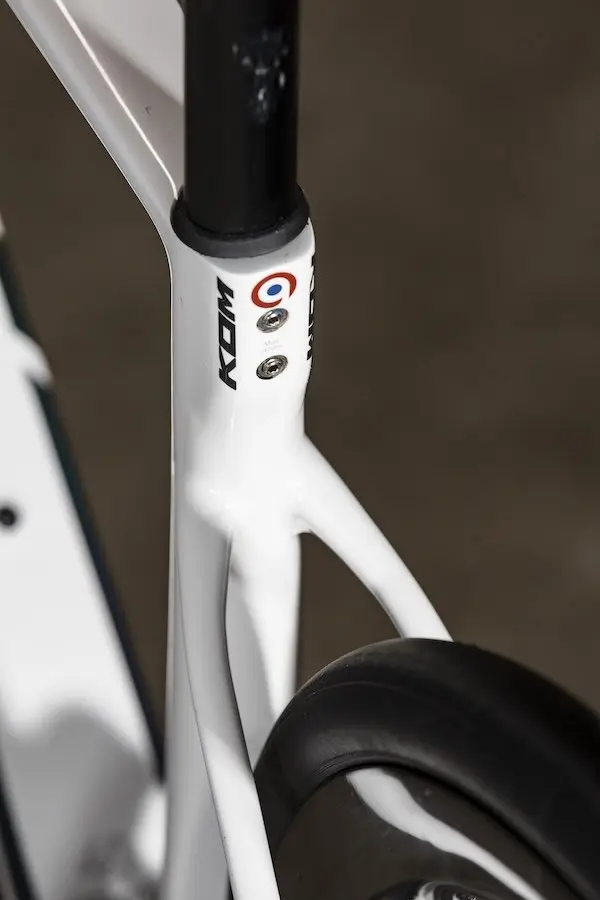
Regarding practical aspects, we note the presence of a round seatpost with a diameter of 27.2 mm, held by a clamp with two small screws placed at the rear of the seat tube.
This standard allows for the mounting of a very light seatpost, as can be found on the market, for those who wish to further lighten the machine. Note that the aluminum seatpost supplied with the bike is very practical to adjust.
Regarding the adjustment of the cockpit height, Girs has opted for two-piece spacers, so that adjustments can be made without reinstalling the entire braking system, which passes inside the head tube.
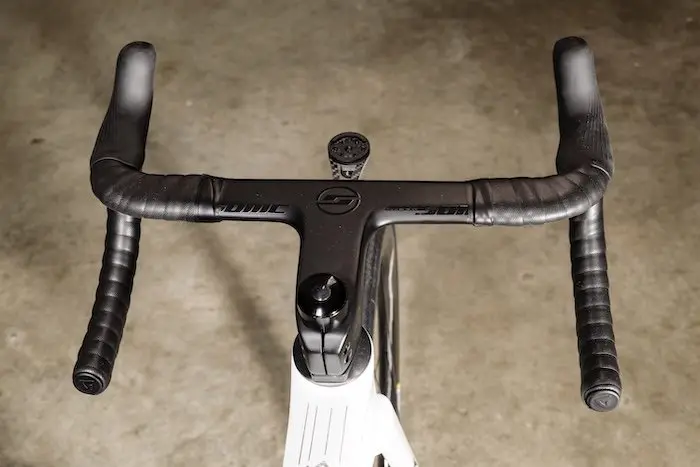
The Sonic Hyper cockpit, with its refined ergonomics, stands out for its aerodynamic upper part and high stiffness, perfectly consistent with that of the frame. Its weight is 390 g.
A Trouble-Free Groupset
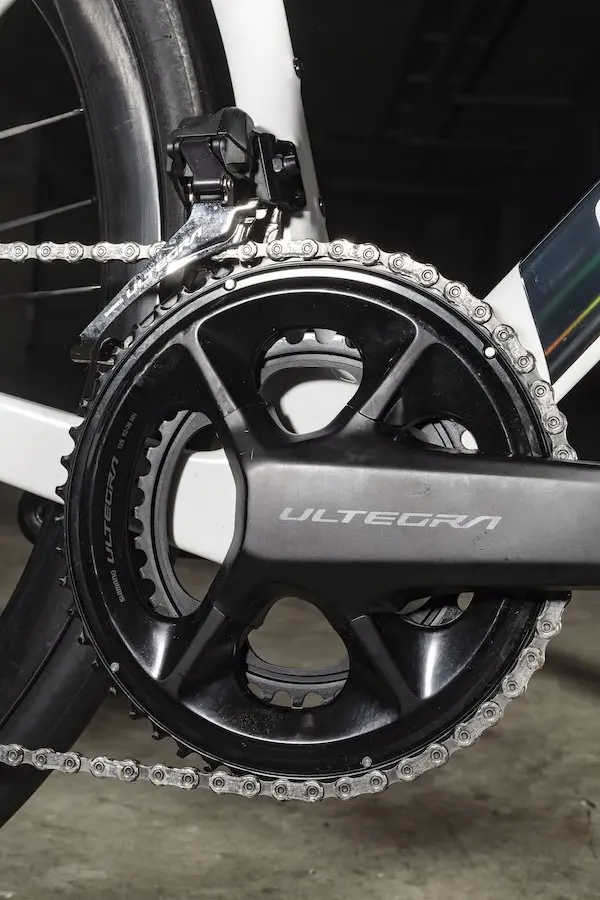
With a Shimano Ultegra Di2 groupset, Girs has chosen for our test bike equipment renowned for its precision and reliability. The shifting and braking performance are equivalent to those of the high-end Dura-Ace groupset, with about 300 g more.
Gear changes are ultra-precise and silent, with customization options via the Shimano E-Tube Project app, such as adjusting shift speed, choosing synchronized and semi-synchronized modes, and even choosing to modify the actions of each button. This is an ideal choice for racers and those who ride a lot, with spare parts in case of wear or a crash being less expensive than on Dura-Ace.
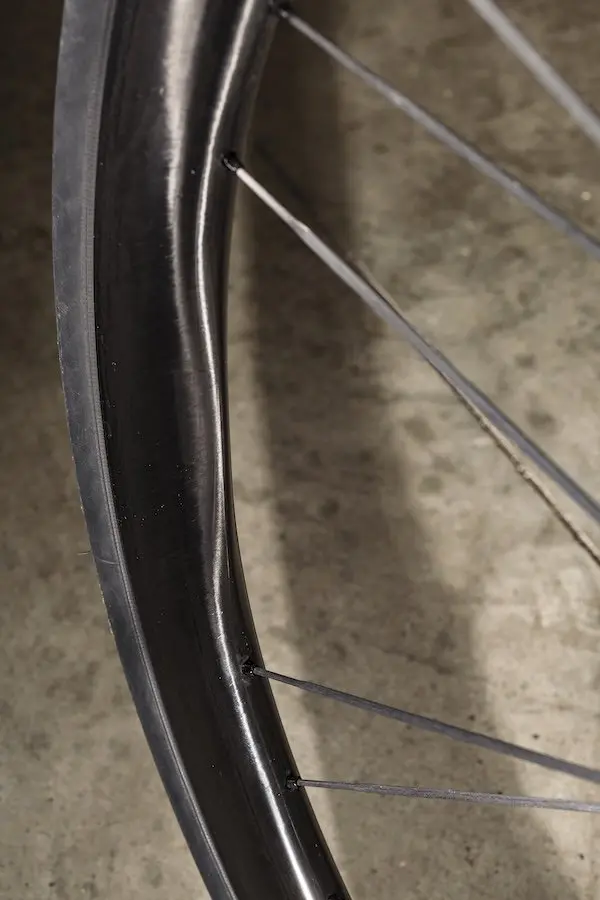
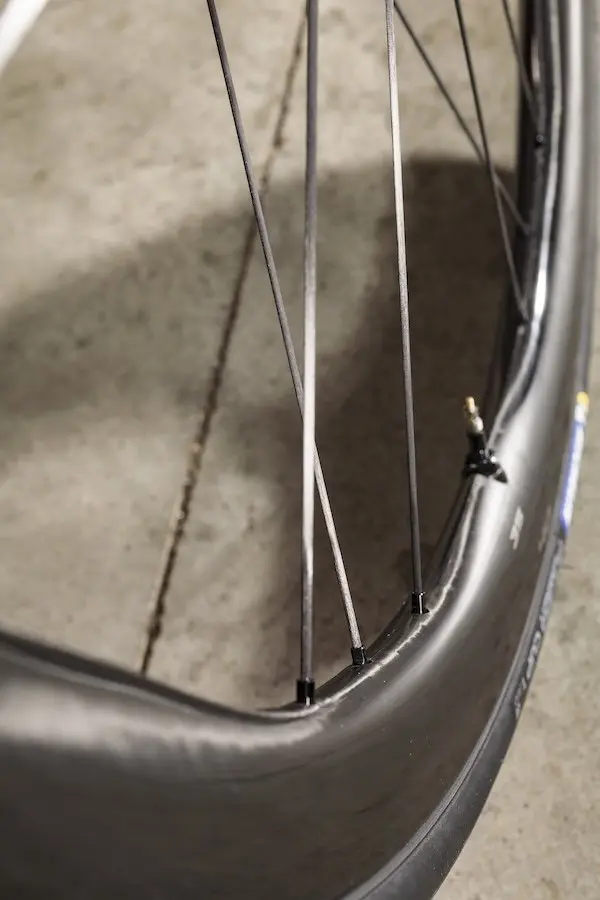
The Sonic Ultra 35/40 wheels complete the judicious setup of this test bike, as they prove to be very light, dynamic, and smooth in use. The rim depth, which varies between 35 and 40 mm, offers little grip to crosswinds, maintaining good bike control, whatever the conditions.
But above all, these wheels are not exceptionally stiff laterally, which allows them to temper the bike’s stiffness a bit here and make it a little more accessible than with higher rims, for example 50 mm.
A Safe Bet
The Girs Kom immediately demonstrates reassuring stiffness in many situations. The bike shows no inconsistency in behavior between its front and rear parts. When pushed hard with energetic pedaling out of the saddle, it reacts promptly, without latency, but also without an elastic effect. One should not rely too much on any deformation of the bottom bracket shell or head tube to overcome a difficulty without using the derailleur. The Kom is best appreciated with dynamic pedaling, adopting a relatively high cadence.
This stiffness is accompanied by welcome stability at high speed, whether on fast descents, where the bike never wobbles even in the wind, or in successions of turns where it proves very pleasant to ride, providing precision and rigor in maintaining trajectories.
With its tubeless wheels and 28 mm tire width, it does not excessively punish the rider on poor road surfaces, and maintains road holding and traction that have always been emblematic of Girs bikes.
The Sonic wheels mounted here optimize the bike’s dynamism, while softening its exclusive character a bit. Their light weight, significant fluidity, and medium rim depth facilitate accelerations and changes of pace, without offering too much wind resistance. They are certainly a little less engaging than wheels with 50 mm deep rims, as I noticed when comparing the two setups on long flat sections with a favorable wind, but they are also more maneuverable and more comfortable, which is not negligible over long rides.
As for the Sonic cockpit, which I had already had the opportunity to test on the Solo, in addition to its comfortable ergonomics, it shines with its overall stiffness, perfectly in harmony with the frame’s behavior. Because an overly flexible handlebar mounted with a stiff frame (or vice versa) provides curious sensations, highlighting the weaknesses of one of the elements, and a lack of steering precision in certain situations.
This is not the case here, although I was a little bothered during the very first rides with the bike by the 38 cm handlebar width: a narrowness justified to optimize an aerodynamic position, but which therefore offers less leverage when riding out of the saddle. It took me some time to adapt to this dimension and to fluidify my out-of-the-saddle swaying motion.
In addition to the seriousness of the bike’s overall proposition as assembled, it is finally worth highlighting the practical aspect of the technical solutions chosen to make life easier for potential buyers. Although stable and stiff as expected from a competition bike, the Girs Kom is designed without complications, with fluid hose integration that does not require overly complicated maintenance during position adjustments, an easy-to-adjust round seatpost, a stiff derailleur hanger that offers extremely precise gear changes, and now common bottom bracket and thru-axle standards.
In short, the Girs Kom asserts itself here as a safe bet, all the more interesting given its reasonable selling price. It is intended for racers or well-trained sportive riders, those who will be able to adapt to its muscular character while appreciating its versatility on different terrains. A great success.
The GIRS KOM in brief… Pros: stiffness, stability, value for money, wheels FRAME: T1000 Carbon – FORK: Carbon – WHEELS: Sonic Ultra 35/40 – TIRES: Michelin Power Cup tubeless 700×28 mm – CRANKSET: Shimano Ultegra 52-36 – CASSETTE: Shimano Ultegra 12s 11-30 – DERAILLEURS: Shimano Ultegra Di2 – BRAKES: Shimano Ultegra, 160/140 mm rotors – LEVERS: Shimano Ultegra Di2 – HANDLEBAR: Hyper Sonic Combo – SEATPOST: Super Sonic alu – SADDLE: Selle Italia ModelX – NUMBER OF SIZES: 5 – WEIGHT: 7.540 kg in size 49 (without pedals) – PRICE: €7515 (frame kit at €2190) – Contact: www.girs.bike
|
Share the post "Girs Kom Review"