Share the post "The Importance of Pad Placement on Cycling Shorts: The Elastic Interface Method"
When positioned correctly, the chamois in a pair of cycling shorts becomes every cyclist’s best friend, ensuring comfort and performance while preventing discomfort and unpleasant sensations. But to fully enjoy the benefits of a chamois, it’s essential to position it correctly. To avoid these problems, Elastic Interface offers its business customers a positioning service.
Source: Press Release
In cycling shorts, the chamois (which hasn’t actually been made of chamois leather for nearly 40 years—it’s been replaced by synthetic materials, so we’ll refer to it as an “insert”) plays a fundamental role for every cyclist, whether professional or simply a passionate amateur. It is a key component that ensures maximum comfort, prevents all types of discomfort, and optimizes performance while riding.
Just like the palm of a pair of gloves or the insole inside a pair of shoes, this famous pad represents one of the three points of contact between the athlete and their bike. Using state-of-the-art manufacturing processes, Elastic Interface—a brand specializing in this type of product that supplies numerous cycling apparel brands—has developed three lines of high-performance products and technologies (ChamoisTech, PalmTech, and InsoleTech).
Focusing specifically on the pad, its primary function is to act as an interface with the saddle, protecting sensitive areas of the body from stress and vibrations while pedaling, ensuring maximum comfort, and preventing unpleasant chafing.
Elastic Interface’s method for positioning the pad
Sometimes cyclists, both men and women, complain that the pad isn’t performing as well as it should while pedaling.
This sensation may be due to improper positioning of the product, which can indeed disrupt the cyclist’s experience in the saddle: this can cause long-term problems for athletes, such as inflammation or injuries, as well as affect the cyclist’s posture and pedaling form and hinder their performance.
To avoid these problems, Elastic Interface offers its business customers a positioning service.
This can be done in two ways:
Positioning the pad from scratch: clothing brands that have chosen Elastic Interface pads for their cycling shorts can send the shorts—without the pad—to the seamstresses at the Italian company in San Vendemiano so that the pad can be positioned correctly.
Verifying the chamois positioning: Elastic Interface’s partners can send their cycling shorts with the chamois already sewn in to verify that it is correctly positioned before beginning production.
Upon receiving the item, the first thing Elastic Interface does is identify the discipline for which that specific product is intended. This is important because pressure points and riding positions on the saddle differ depending on whether the discipline is road cycling, mountain biking, or gravel riding. That is why positioning is also determined based on the bike model corresponding to the discipline in question.
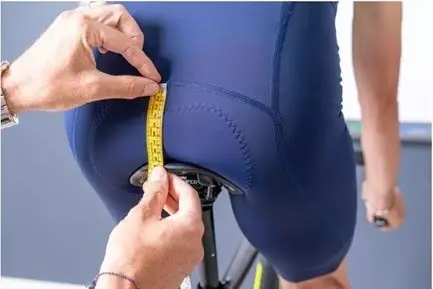
Once the discipline has been identified, Elastic Interface’s technicians can then check and adjust the pad’s position based on how it should sit on the saddle. They then check the rear and side measurements of the chamois in relation to the saddle. The insert must cover the correct contact area where the athlete sits on the saddle in order to properly protect the perineal area and the sit bones.
After measuring the distance (in centimeters) by which the padding needs to be moved, Elastic Interface’s seamstresses unpick the seams of the chamois pad to reposition it as needed. This process is repeated until the brand’s technicians confirm that the chamois is correctly positioned in the cycling shorts relative to the contact surface on the saddle. Once the chamois is properly positioned, the final stitching is completed.
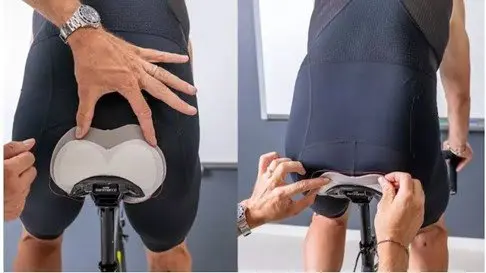
Elastic Interface’s pad designs are conceived and manufactured based on the various disciplines for which they are intended and the anthropometric parameters of both men and women. Once the pad is correctly positioned inside the cycling shorts and relative to the saddle, the padding is able to protect the areas of the body most exposed to pressure and friction, thereby minimizing friction points and promoting microcirculation.
The variety of models and sizes available in the Elastic Interface catalog allows you to choose the chamois best suited to all body types and cycling disciplines.
In practical terms?
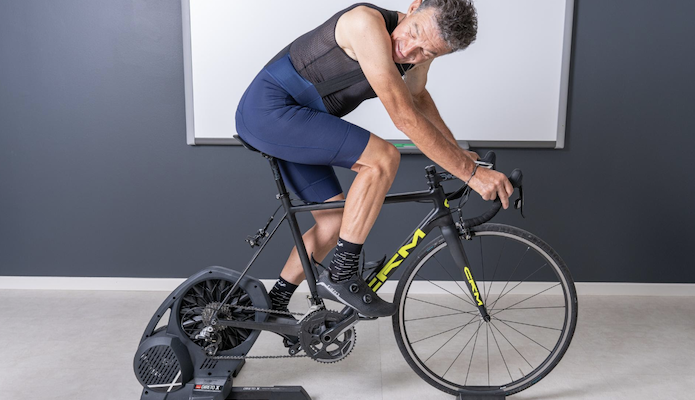
Using this positioning process as a guide, as cyclists, you can also check for yourselves whether your pads are positioned correctly. Just follow these quick and easy steps:
- Put on your cycling shorts properly and make sure they stay 100% in place.
- Sit on the saddle.
Once you’re in position, see which of these three scenarios applies to you:
- The pad is properly positioned: in this case, the protection targets the pressure points on the saddle. It’s neither too far forward nor too far back on your back.
- The pad is too far back: You’ll feel like the padding almost covers your back, and in the front, it’ll feel like you’re sitting directly on the saddle without any protection.
- The pad is too far forward: You’ll feel that your sit bones aren’t protected, and when you pedal, you’ll feel the wings of the pad getting in the way as you try to pedal.
Now that you know how to test the positioning of your pad, you’re one step ahead in ensuring you’re well-protected on your next ride. Check it out for yourself the next time you try on a new pair of cycling shorts!
Share the post "The Importance of Pad Placement on Cycling Shorts: The Elastic Interface Method"