Share the post "165 mm cranks: comfort, performance, and the evolution of cycling practices"
In cycling, the quest for performance often involves equipment adjustments that, while subtle, can have significant consequences. Among these adjustments, crank length is currently at the heart of discussions, both in the professional peloton and among enlightened amateurs.
While 165 mm cranks are increasingly appealing to riders like Tadej Pogačar and Remco Evenepoel, recent cycling history shows that other approaches, such as Chris Froome’s Osymetric chainrings, have also made their mark. So, what are the reasons behind this trend? What are its impacts in terms of biomechanics, aerodynamics, and personal adaptation? And most importantly, what should you keep in mind before making the switch? We tested it for you.
By David Polveroni – Photos: depositphotos.com / DR
Professional Choices: A Constant Search for Optimization
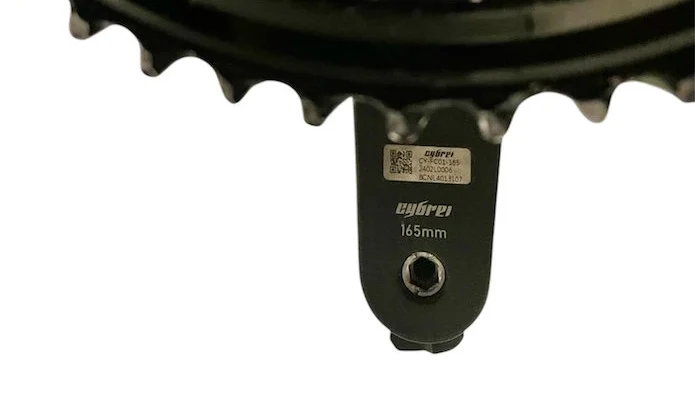
Tadej Pogačar, three-time Tour de France winner, and Remco Evenepoel, 2022 World Champion, have both adopted 165 mm cranks. Their decision reflects an evolution in how riders approach cadence and comfort. Shorter cranks allow for a higher pedaling cadence and reduce biomechanical stress, particularly in knee and hip flexion angles.
These choices are particularly suited to cyclists like Pogačar and Evenepoel, who excel with their fluidity and ability to maintain high intensities over long periods, whether in time trials or climbs. By increasing pedaling frequency, they optimize their muscular economy, while adopting a more aerodynamic position, essential in increasingly demanding modern cycling.
At the peak of his career, Chris Froome made an impression not only with his exploits in the mountains and time trials, but also with his technical choices. Froome used 175 mm cranks, a length considered “reasonable” for his height (1.86 m), but not excessively long either. This choice reflected a desire to maximize leverage and benefit from optimal power on the climbs where he excelled.
However, one of the most striking elements of his equipment was his oval-shaped Osymetric chainrings, which promote a more consistent power transfer while facilitating a higher cadence. The oval chainrings, combined with longer cranks, represented a compromise for Froome between raw power and pedaling fluidity. This configuration highlights that, even in the professional peloton, there is no universal solution: equipment choices must adapt to each rider’s characteristics and style.

Why Are Shorter Cranks Becoming Increasingly Popular?
- Biomechanical Benefits
One of the main advantages of shorter cranks lies in the reduction of stress on the joints, particularly the knees and hips. By decreasing crank length, flexion angles are reduced, which can be beneficial for cyclists suffering from joint pain or having limited mobility. This also allows for smoother power transfer, especially during prolonged efforts, threshold and VO2max, or in demanding positions, such as in time trials.
To feel a tangible effect, a reduction of at least 5 mm is often necessary. For example, the change from 172.5 mm to 170 mm remains perceptible, but it is by switching to shorter lengths (like 165 mm) that the benefits become truly noticeable. That said, each cyclist reacts differently, and the level of sensitivity to changes varies among individuals.

- Cadence and Muscular Economy
Shorter cranks promote a faster cadence, which allows for distributing the muscular load over a higher frequency. This high cadence, particularly sought after today (although we are returning to it for long-distance, ultra efforts..), delays muscle fatigue and improves energy efficiency, especially during long climbs or sustained efforts.
- Aerodynamics and Position
By reducing crank length, the knees rise less high at the top of the pedal stroke, which facilitates a more compact aerodynamic position. This characteristic is particularly interesting for time trials or solo efforts. This explains why shorter cranks are so appealing to modern climbers and rouleurs.
Practical and Economic Implications: A Change to Consider with a Biomechanist
Switching to shorter cranks should not be a decision taken lightly. It is strongly advised to consult a biomechanist before making this modification. The biomechanist can analyze the cyclist’s morphology, pedaling style, and objectives to assess whether this change is relevant. Once the change is made, it is important to test this configuration over several months. The body needs time to adapt, and initial sensations are not always representative of long-term benefits.

Necessary Adjustments
Adopting shorter cranks implies reviewing several aspects of your equipment:
– Saddle height: the saddle will need to be raised slightly to compensate for the decrease in crank length.
– Gearing and ratios: with shorter cranks, a higher cadence is often necessary. This may involve rethinking the gearing used to maintain efficient power transfer. In the past, limitations of cassettes and groupsets often required longer cranks to take advantage of restrictive gear ratios. Today, with modern cassettes offering an extended range, these constraints are largely alleviated.
– Cost for multiple bikes: cyclists owning several bikes will need to equip each of them with new cranks, which can represent a significant investment.
Feedback: My Switch to 165 mm
In 2017, an accident left me with asymmetrical legs in terms of length and muscle strength. This situation long influenced my pedaling style, making prolonged high-intensity efforts uncomfortable, even painful. For years, I used 170 mm cranks, and had been for over 25 years…

A Gain in Comfort, But Not a Revolution
Switching to 165 mm cranks did not transform my riding, but the increased comfort was immediately noticeable, precisely at high intensities where I found more ease, much like oval chainrings can provide. The reduction in flexion angles brought welcome fluidity, especially during sustained efforts at anaerobic threshold or on prolonged climbs. This comfort allowed me to maintain a more stable position, which resulted in better efficiency on long rides.
Rethinking Gearing and Cadence
The switch to shorter cranks forced me to rethink my gearing. With a naturally rather low cadence, I had to get used to pedaling faster, an adjustment facilitated by modern cassettes offering adapted gear ranges. This remains a point that primarily requires work on my part, as old habits return quite quickly…

Conclusion: Comfort, Performance, and Individuality
The adoption of 165 mm cranks represents an interesting evolution, but not a universal solution. While they offer advantages in terms of comfort, reduction of biomechanical stress, and aerodynamics, their relevance primarily depends on the specific needs of each cyclist. The contrasting examples of Pogačar, Evenepoel, and Froome clearly illustrate that this choice must be adapted to each individual’s morphology, pedaling style, and objectives.

Finally, as often in cycling, the golden rule I like to apply (with a certain balance) remains the same: “comfort is performance.” In sportives or amateur riding, being comfortable on your bike is essential to give your best. So, before taking the plunge, take the time to test, adjust, and, above all, discuss it with a biomechanist. It is this thoughtful approach that will allow you to make the most of this subtle, yet potentially advantageous, change.

Share the post "165 mm cranks: comfort, performance, and the evolution of cycling practices"