Share the post "How to train in winter as an amateur cyclist?"
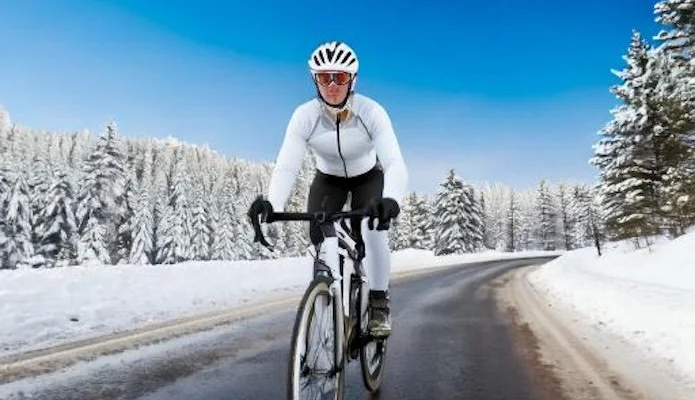
Ah, winter… That time of year when the roads are cold, the days are short, and you hesitate between putting on your long bib shorts or staying under the covers. But let’s be honest, the off-season is also a golden opportunity to lay the foundations for a great cycling season. If you’re an amateur, you may not have the desire or the time to follow a pro program, and that’s perfectly fine. So, how do you train effectively without burning out or freezing? Here’s our guide, with a touch of humor to warm things up!
By Jeff Tatard – Images: firefly.adobe.com
How many times a week should you train?
No need to ride 25 hours a week like Pogacar. You’re an amateur with a busy life, so 3 sports sessions a week are enough. The idea is to find a balance between work, family, and your passion.
Here’s a typical breakdown:
• 1 endurance ride (2 to 3 hours).
• 1 specific session (strength or intensity), especially on an indoor trainer.
• 1 light or alternative session (recovery, technique, or another sport).
In short, aim for quality rather than quantity. Remember: a motivated amateur is better than an exhausted zombie.
December: rest to restart better
December is the transition month. You may have spent the autumn digesting your season (and a few raclettes or tartiflettes). The goal here is simple: rebuild your endurance base.
• Fundamental endurance: 2 to 3 rides per week at low intensity (Zone 2). It’s long, it’s calm, but it’s essential. Remember to listen to podcasts, otherwise you’ll get bored.
• On-bike strength: uphill or on an indoor trainer, do 3×10 minutes at low cadence (50-60 rpm).
• Strength training: squats, lunges, Nordic curls, core work. Yes, lifting weights is also cycling!
The goal: ride “easy like Oliv”, that friend who gets passed by everyone in December, but drops you in April.
January: starting to work a little more seriously
The holidays are over, you may have overindulged in log cake, but January is the time to step it up a notch. We keep the endurance but add a little intensity.
• Long rides with variations: 2 to 3 hours with a few blocks in Zone 3 (3×10 min, for example).
• MAP and threshold: on an indoor trainer, try short but intense efforts: 4×5 minutes at 90% of your MAP (maximal aerobic power).
• Technique: work on your cadence with exercises at +100 rpm for better fluidity.
• Cross-training: vary the pleasures with cross-country skiing if you have access to it, or more conventionally running or even swimming. It’s a change, and your muscles will thank you.
February: the return of intensity
February is the month when you start simulating race efforts. The first competitions are approaching, and you need to wake up the beast within you.
• Mixed rides: 3 hours with blocks in Zone 4 (3×8 min at 90% MAP), followed by sprints (10×10 seconds all out).
• “Hardcore” MAP: do 5×4 minutes at 100% MAP, 4 minutes recovery. Yes, it hurts, but it’s effective.
• Race simulations: if possible, ride in a group and reproduce attacks, accelerations, and varied efforts.
The goal: be ready to perform from the start of the first race. And if you’ve worked hard, you’ll be the one dropping others, not the one blowing up.
Some tips for surviving winter
• Gear up!: if you ride outside, invest in good clothing (long gloves, shoe covers, windbreaker). Nothing worse than freezing on the road.
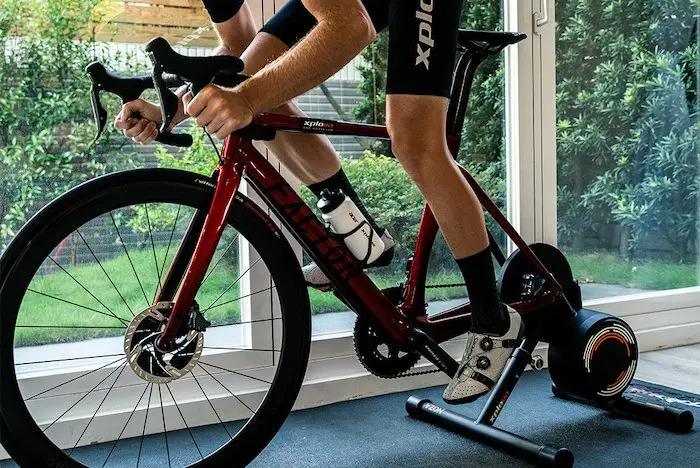
• The indoor trainer is your friend: yes, it’s not glamorous, but it’s practical for intense sessions without risking pneumonia.
• Recover well: don’t neglect rest. A good night’s sleep and a balanced diet are worth all the training in the world.
• Stay motivated: think about your season goals and visualize your progress. Imagine the finish line, arms raised, the bouquet on the podium or the medal around your neck, or simply the satisfaction of dropping your friends on a nice climb.

The winter training triptych: Strength, FTP, and Speed, are you familiar with it?
This type of indoor trainer session is not chosen at random. We particularly like it at 3bikes.fr. Each part has a specific objective, and the order is crucial to optimize training effectiveness. Here’s why we chain Strength, FTP, then Speed, and some practical tips for setting your gears and cadences correctly.
1. Strength (7 minutes at 85% of FTP, 55 rpm cadence)
Why?
We start with strength because it deeply mobilizes your muscle fibers at a moderate intensity, without depleting your energy reserves. This prepares your legs to handle the rest of the session. Working at a low cadence specifically targets the muscles without overloading the cardiovascular system.
Recommended gearing
Use a heavy enough gear to maintain 55 rpm while reaching 85% of your FTP. For example, 52×13 or 14 on an indoor trainer can be a good starting point. Adjust according to your feeling to avoid “spinning your legs.”
2. FTP (7 minutes at 100% of FTP, 95 rpm cadence)
Why?
The second phase works on your functional threshold power (FTP), which is your ability to sustain an intense effort. After the strength work, switching to a higher cadence engages the cardiovascular system more and complements the muscle work dynamically.
Recommended gearing
Slightly reduce the resistance to allow for smooth pedaling at 95 rpm while staying at 100% of your FTP. A 52×15 or 16 gear is often ideal on an indoor trainer, but be careful not to “spin in the void.”
3. Speed (7×30”/30” all out, 100-110 rpm cadence)
Why?
Short sprints (30 seconds all out followed by 30 seconds of active recovery) conclude the session by developing your explosiveness and peak power. This maximal effort simulates attacks, accelerations, or surges you experience in a race. Placing these sprints last ensures you are well warmed up and your muscles are already engaged.
Recommended gearing and cadence
Choose a light enough gear to achieve a fast cadence without too much resistance, for example 50×16 or 17, aiming for a cadence of 110-120 rpm. During the 30-second “recovery,” spin gently on the small chainring around 90 rpm to eliminate lactates.
Why this order?
1. Strength first to recruit your muscle fibers and prepare your legs for the effort.
2. FTP next to activate your cardiorespiratory system without exploding your energy all at once.
3. Speed last, because sprints require a maximal effort that you couldn’t provide effectively if you started with them.
When to integrate it into your routine?
Do this session every 2 weeks during winter. This stimulates your three main cycling qualities (strength, threshold, and explosiveness) while varying the stimuli. With this triptych, you prepare for both long distances and explosive moments in a race.
Note: this session lasts approximately 50 minutes and can be inserted into a training week containing 2-3 other longer rides or specific sessions. Perfect for winter, it guarantees an explosive start to spring!
In summary
Winter is the season when amateur cyclists build the foundations for their future performances. No need to overdo it: 3 to 5 well-calibrated sessions per week are enough. December is dedicated to strengthening and basics, January to introducing progressive intensities, and February to simulating race efforts. With consistency and a methodical approach, you’ll be ready to attack the season with sharp, responsive legs.
And remember: winter is not for shining, but for building. So work hard, put in the watts, but keep an eye on recovery and freshness to unleash your potential in spring.
Share the post "How to train in winter as an amateur cyclist?"