Share the post "A “Sweat Test”, what for?"
Precision Fuel & Hydration is a British company founded in 2011 that promises solutions adapted to athletes and sportspeople in general to maintain good energy and hydration levels during exercise. To optimize the proper functioning of the body and ensure it receives the elements it needs to stay hydrated, it offers a Sweat Test, or “transpiration test” to define the amount of sodium each person loses in sweat. We performed this test for you.
By Guillaume Judas – Photos: ©3bikes.fr / Precision Fuel & Hydration / All rights reserved
The main component of the human body (approximately 60%, or 40 kg for a 70 kg individual), water participates in many essential bodily functions, particularly in the composition of cells and blood. During exercise and depending on the exercise conditions (intensity and temperature), water loss through sweating varies from 0.5 to 2.5 liters per hour.
A 2% loss of body weight in water is associated with a 20% decrease in physical capacity. Finally, perspiration is accompanied by the loss of salt, essential for the proper balance of many bodily functions, and which amplifies the phenomenon of dehydration.
While it is relatively easy to estimate fluid loss during exercise and depending on conditions, the same is not true for salt loss, because the amount of sodium lost can vary up to 10 times between seemingly similar individuals.
For example, simply weigh yourself before and after exercise to determine the amount of water lost. If you ride for four hours at a temperature of 20°C, and you have lost 500 g of body weight but in the meantime you have drunk three 600 ml bottles, your fluid loss is estimated under these conditions at 2.3 liters (3×600 ml + 500 ml), or 575 ml per hour.
To measure sodium loss, this is where Precision Fuel & Hydration comes in. The brand offers a range of energy products (mainly carbohydrate-rich gels) and electrolyte powders or capsules (essential minerals, such as sodium, calcium, and potassium, which play a key role in the proper functioning of the body) to be diluted in pure water.
Its most powerful product, PH 1500, for example, contains up to 3.5 times more electrolytes than other products of this type usually found on the market. And to better advise on the necessary sodium intake dosage, it offers a test to be performed in one of its partner stores. In France, only two stores currently offer this test, in Nice and Paris.
The Principle of the Sweat Test
Each individual loses a different amount of sodium in their sweat, from 200 mg to 2000 mg per liter. This is a characteristic largely genetically determined. According to Precision Fuel & Hydration, this means that a universal approach to hydration cannot be convincing. Thanks to its Sweat Test, the brand thus offers a personalized hydration plan and a mix of products that meet individual needs.
This sweat test lasts a good half hour, and requires no blood test, no effort on a treadmill or indoor trainer, nor waiting for results from an analysis laboratory. It is performed within a network of partner stores, and it is simple and painless.
It provides a precise measurement of the amount of sodium an athlete loses when training or competing. The result then allows for the establishment of a tailor-made hydration strategy according to the context discussed with the test operator. The brand advises when, what, and how much to drink before, during, and after training and competitions, so that the athlete is equipped to achieve their goals.
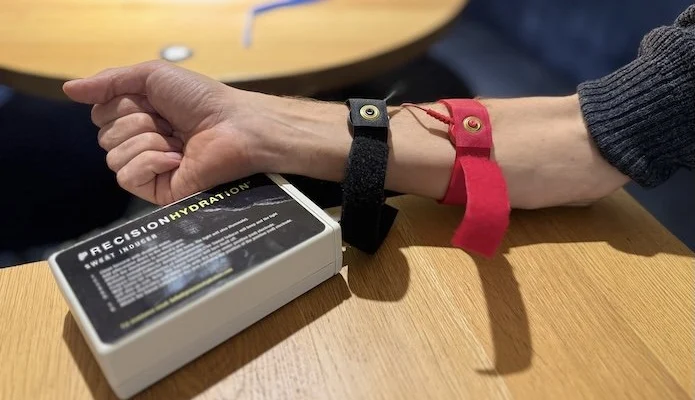
This testing technology is exclusive and is based on a diagnostic tool for certain cystic fibroses. It begins with the placement of two sensors on the forearm, which send waves to produce the formation of mini-droplets of sweat at that precise location.
Then, another sensor is used in the same place to collect these droplets, and then send them to a machine that analyzes the sodium concentration. Finally, the results are scrutinized by an algorithm that determines the athlete’s profile.
Here is mine:
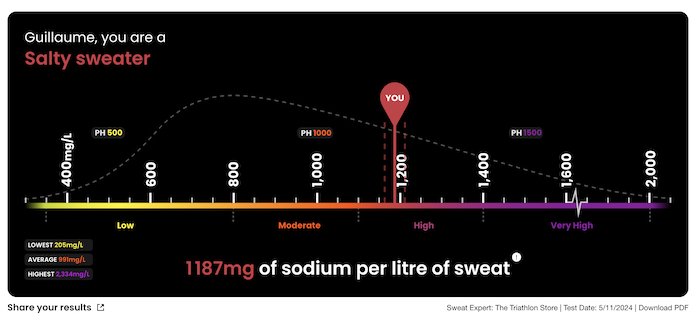
According to the test results, I lose more sodium than average when I sweat. To be honest, I’m not very surprised, as I often return from my summer rides with white marks on my jersey and bib shorts. But beyond sodium loss, it also seems obvious that I very often return dehydrated, being very far from the brand’s recommendations regarding my fluid intake during exercise.
Here is the nutrition and hydration plan proposed by Precision Fuel & Hydration based on my profile and the results of the sweat test, for a five-hour ride in hot conditions:
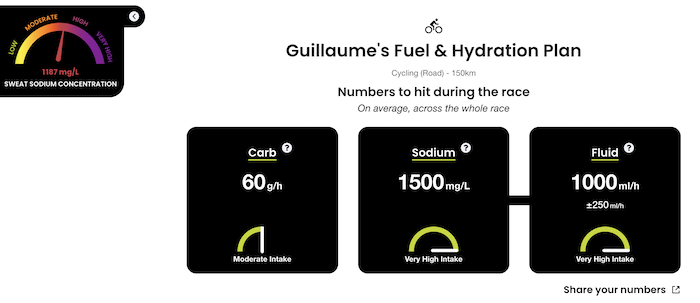
Under these conditions, the brand advises me to drink 1 liter per hour (I’m far from it), with 1500 mg/L of sodium, for a total of 5 liters and 7500 mg of sodium to cover my needs. To this, I should add 60 g of carbohydrates per hour, in the form of gels, totaling 300 g. I’m also very far from this.
The Summary of this Test
Obviously, the purpose of this test is to encourage athletes to consume the brand’s products, which are also the most highly dosed in electrolytes on the market. These products are not particularly financially accessible. To take the example of my typical five-hour ride, I would need to consume five effervescent PH 1500 tablets, which is half a tube of 10 sold for €9.99. I would need to add two PF 30 gels per hour, which is the equivalent of approximately €25 (€10.99 for four gels).
The price of the Sweat Test is €145 at the Triathlon Store in Paris Etoile, where I performed it.
Nevertheless, this sweat test was very useful for me to better understand how my body works, and what strategy to adopt in the future, whether for an indoor trainer session, or for intense training rides, particularly in terms of the quantity of liquid to consume under conditions of heavy sweating, or even the type of drink to consume before and after exercise, for example, mineral waters very rich in sodium.
As for the hydration strategy proposed by the brand, it is worth considering for a particular event, for example a major granfondo like the Étape du Tour, or a long-distance triathlon. Because if we observe a clear increase in performance in high-level events and among all categories of practitioners in general, it is also because in the fields of nutrition and hydration, great progress has been made by science in recent years. It’s up to everyone to decide whether they want to get on board or stay on the sidelines.
Share the post "A “Sweat Test”, what for?"