Share the post "Loïc Lamouller: an old-school racer’s journey to simplicity and truth"
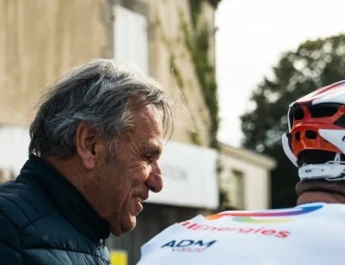
For 3bikes, we met up with Loïc Lamouller, a former great hope of French cycling, to revisit his atypical career. From promising early victories to the disillusionment of the professional peloton, Lamouller opens the doors to his career with rare sincerity. Through his successes, his trials, and his life choices, he takes us behind the scenes of a demanding world, but also into the deep values that guided him far beyond the podiums.
By Jean-François Tatard – Photos: All rights reserved
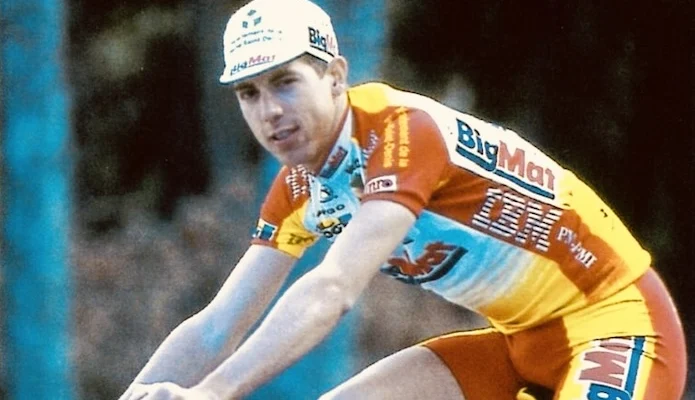
Loïc Lamouller, for those who don’t remember, is the story of a cycling prodigy shaped by endless roads, kilometers devoured with passion, and a destiny forged from childhood. It was his father who introduced him to cycling, not as a competitor, but as a touring cyclist, pedaling hundreds of kilometers across France. From the age of seven, Loïc followed his father’s wheel on 50-kilometer rides, and by 12, he was already tackling 200-kilometer routes. His first encounter with competition, however, was not his doing. One day, a club president, impressed by the young boy’s prowess, persuaded his father to sign him up for a race. Loïc protested, finding competition useless, preferring the thrill of the road for its own sake. But, barely engaged in the challenge, he finished fifth, validating the purchase of his used bike. From then on, he racked up victories with the regularity of a metronome.

His first victory in 1991 is unforgettable: Loïc crossed the finish line to the tears of Michel Baaziz, the club’s youth coach, who whispered to him that if he continued like this, he could win them all. He took that to heart. “Ok, now we’re going to train and prepare,” he then told his father. From then on, Lamouller had only one watchword: progress. Never seeking glory, he became passionate about the science behind the effort, devoured technical books, and optimized his training like a laboratory researcher.
The year 1996 would remain a peak for him. His victory at the Classique des Alpes Juniors was not an isolated feat: it was the result of a meticulous program set up with his coach Jean-Pierre Demenois. Together, from February of that year, they drew up a plan on a whiteboard. Loïc knew where he was going; every ride was part of a future race strategy. The Classique des Alpes demonstrated his climbing ability and opened doors for him among the pros, where he was already promised a place as a trainee. A few weeks later, he also won the French Junior Championship, a feat that marked the end of a dream season where he managed to “execute the program” with the precision of an already seasoned rider.

But behind this success lay an unwavering ethic and a mind as sharp as his legs. Lamouller never felt competition as a simple quest for victory. “I sought to improve myself, to push my skills to their limits,” he says. He even confesses to having known he would one day be a professional from his first victory, but the confidence that animated him was not arrogant: it stemmed from a conviction born of his love for cycling done well, ethically and rigorously.

His transition to the pros, however, was not without its difficulties. During his first winter training camp, the disappointment was immense: the atmosphere lacked emulation and sharing, and he quickly felt that it wasn’t the team spirit he had hoped for. He understood that the world of pros was a different terrain, where intensity no longer had a place and advice was rare. An experienced colleague then told him, laughing, “It’s the same sport, but it’s not the same sport.” This was a shock for the young champion, who had always progressed thanks to meticulous planning and the support of his entourage. Even harder: the temptation to get caught up in unethical practices. He, who had built his entire career on self-transcendence, quickly understood that something else was expected. During a fall during the Tour, injured in the knee, he was offered invasive treatments to “save” his Tour, which led him to call his wife to announce his decision: “Tomorrow, I’m starting and I’m abandoning. It’s over for me.”

This abandonment symbolized a point of no return. “The pressure could have led me to a certain temptation,” he admits. But he chose to remain faithful to his principles, aware that sport must remain a place of authentic self-transcendence, not artifice. The following years were marked by a certain disillusionment; he felt that his potential had not been fully revealed in a system that favored other methods. He acknowledges today that bitterness remains regarding the exploits he could have achieved in a healthier context.
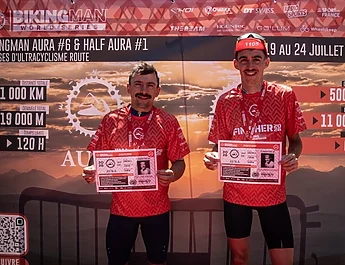
Despite this, Loïc never truly left cycling. After his career, he tried to set up a brand and a bike shop, but the difficult economic climate forced him to stop in 2009. It was only in 2018, thanks to an amateur neighbor, that he reconnected with cycling. He set himself new challenges, notably the randonneur brevets qualifying for Paris-Brest-Paris, which he bravely undertook despite a skin graft. Today, he continues to prepare for this challenge and admits, at 45, to have rediscovered his passion. He remains this eternal enthusiast for progress, optimizing his strength training sessions and monitoring his diet.

Today, Loïc Lamouller has traded competition for personal adventures, covering nearly 9,000 kilometers a year on roads where he grew up. And yet, despite the sacrifices and disappointments, his gaze remains filled with gratitude for cycling, a passion that has shaped his journey. We feel fortunate to have had the opportunity to meet Loïc, a fascinating figure we already admired in our youth. From this interview, we will remember that Loïc embodies a living inspiration for new generations, encouraging them to embrace their own path, far from the pressures of performance.
With unwavering authenticity, he reminds us that true success is not measured in medals or rankings, but in faithfulness to oneself and one’s dreams. His determination to pursue his passion, whatever the circumstances, teaches us that true victory lies in the journey itself, in every pedal stroke, every encounter on the road.
Share the post "Loïc Lamouller: an old-school racer’s journey to simplicity and truth"