Share the post "MPCC: The 3rd Credibility Figures report of the year to combat doping has just been published"
In a year marked by the Olympics, the third 2024 Credibility Figures report reviews the efforts made to combat doping on a global scale. The question of the means of the fight also leads the MPCC to question, for cycling, the state of play at the Continental level.
Source: Press Release
Memories of the Games of the XXXII Olympiad (Olympic and Paralympic) certainly remain vivid worldwide, a month after their closing. From strong images of the ceremonies to individual and collective exploits, including the self-sacrifice of Paralympic athletes, a symbol of a message of hope in these troubled times, the Paris 2024 Olympic Games reminded us that sport spreads beautiful and great values, universally recognized and shared.
Many of these values are promoted by the MPCC, a committed movement and main actor in the fight against doping in cycling, for fair competitions and the physical and mental health of riders. It reminds us that high-level sport cannot do without deploying significant resources to combat doping. During the last Olympic Games, approximately 6,000 samples were taken from 4,150 athletes, representing about 40% of the total participants. Only six cases of adverse analytical findings emerged from these controls, quickly leading to provisional suspensions. While this number may seem negligible, investigators and laboratory personnel still have thousands of files to process, and it is likely that other cases will be revealed in the coming months.
In addition to the work of chaperones and doping control officers, the Court of Arbitration for Sport (CAS) established two temporary offices in the French capital during the Olympic Games. One of them was dedicated to quickly processing confirmed doping cases. This is further proof that with strong political will, significant resources, and intransigence, cheating can be contained. Nevertheless, the year 2024 has been marked by various affairs: that of the Chinese swimmers, whose positive tests in 2021 were allegedly covered up by the World Anti-Doping Agency (WADA), the political reaction of the United States, which launched a federal investigation into this matter, and the suspension of certain national agencies, with the targeted countries struggling to bring their legislation into compliance with the World Code.
The case of tennis player Jannik Sinner raises questions
Recent weeks have been particularly marked by the announcement of the positive test of one of tennis’s stars, Jannik Sinner, world No. 1 and winner of two Grand Slam tournaments. The Italian, who tested positive for clostebol (an anabolic steroid), pleaded contamination by a spray and ultimately convinced the ITIA, the body governing integrity in tennis worldwide, and an independent tribunal of his good faith. While the affair caused a stir on all courts around the world, WADA was quick to respond by filing an appeal with the CAS on September 26.
Finally, the tense climate on the anti-doping front could not be illustrated without this important ongoing political change. The MPCC had already reported on the very particular situation in Kenya, which is proactive in the fight after narrowly avoiding exclusion from several international competitions. In 2016, the country established a national agency, ADAK, and since 2013, a strict legislative arsenal. While it could count on a substantial budget of approximately 5 million dollars in 2022, its future is now in limbo, according to its president. The agency would have received only 150,000 dollars for the 2024-2025 fiscal year and is therefore almost unable to fulfill its mission: paying its staff, going on site to collect samples, and sending samples, whose shipping cost is deemed exorbitant, to accredited laboratories. At the time of writing, the head of WADA’s African office had just met with the Secretary of State for Sports to discuss this highly sensitive and important issue for the future of Kenyan sport.
The biological passport at work
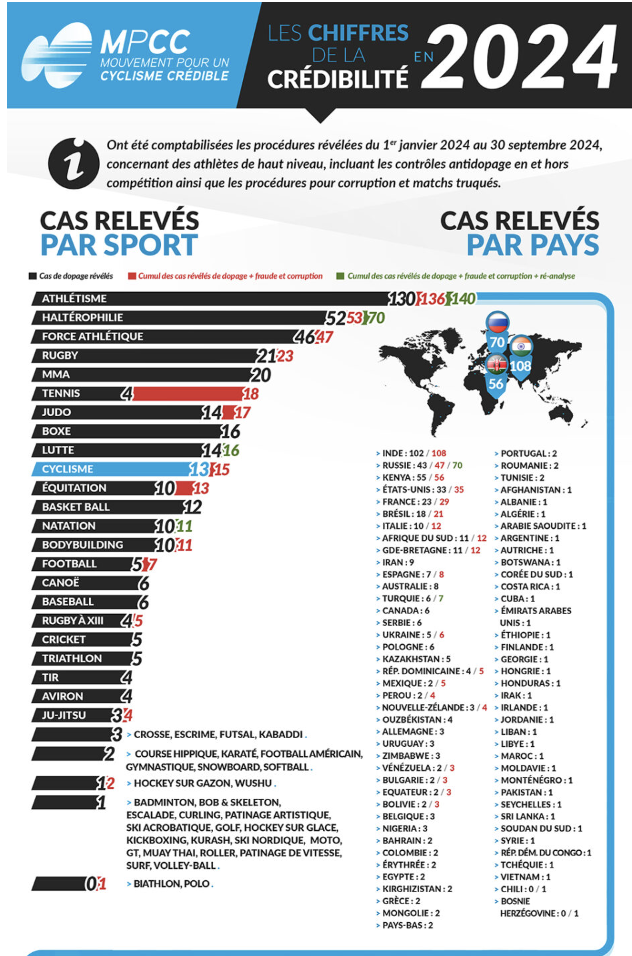
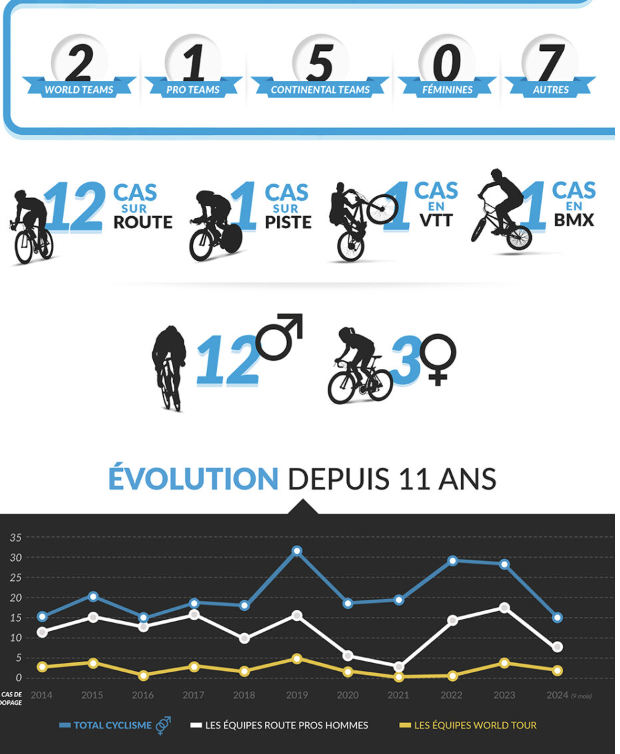
Through these Credibility Figures, the MPCC therefore primarily wishes to put into perspective the position of cycling, once considered the poor relation of the anti-doping fight, compared to other sports. It is only the tenth most affected after the first nine months of the year, according to cases revealed by the press and national anti-doping agencies, far behind athletics (140 cases recorded worldwide), rugby (23), or MMA (20), whose upward trend should be noted. As of September 30, 15 doping cases from different disciplines (road, BMX, track, para-cycling) have been made public. This figure remains in line with the recent trend of about twenty annual cases recorded and consistent with the findings of the first report on ongoing suspensions among professionals.
Protecting Continental teams
Current events have also impacted these publications, as two Portuguese riders competing at the Continental level were caught by their biological passport, a result of a more repressive turn undertaken by the Portuguese Federation and Adop (Portuguese Anti-Doping Authority) to extend this monitoring to all national riders competing at the third world level, i.e., approximately 80 riders representing 9 teams in 2024. This affair highlights the importance of being proactive in the fight against cheating, through ever more financial resources given to national agencies and anti-doping laboratories, through a collaborative spirit between the various sports stakeholders, whether institutional or political, and through the accountability of the primary protagonists: the athletes themselves.
The MPCC therefore renews its call to all World Tour teams, women’s and men’s, that are not yet members to join the movement to be active in the fight against doping, the credibility of our sport needing to be consolidated by greater participation of stakeholders. The MPCC further encourages Continental level teams to commit, despite their lower media exposure and the challenges they face across the different continental calendars. A much larger number of member teams at the third world level would help to bring certain issues to light and to keep riders and managers away from the temptation of doping. It is by remaining active that the fight will be won.
Share the post "MPCC: The 3rd Credibility Figures report of the year to combat doping has just been published"