Share the post "Pauline Ferrand-Prévot: A Difficult Return to Road Racing and the Importance of Energy Management"
This past Saturday in September 2024, during the Road Cycling World Championships in Zurich, Pauline Ferrand-Prévot encountered an unexpected difficulty: her return to road racing resulted in an early withdrawal, far from the performances she had accustomed us to in mountain biking. While this disappointment surprised many of her admirers, it also highlights a more complex energetic issue: the management of lipolysis.
By Jean-François Tatard – Photos: Instagram Pauline Ferrand-Prévot/Hugh Miller/Creative_Commons
For several years, Pauline Ferrand-Prévot has established herself as one of the most versatile athletes in world cycling, with titles in both mountain biking and road cycling. But what became apparent in Zurich was a difficult return to road racing, where the energetic demands differ greatly from those of mountain biking. In mountain biking, where the race lasts less than an hour and a half, the body primarily draws on carbohydrates to sustain the intensity of short, intense efforts. But on the road, the body functions differently. It must activate lipolysis, a process by which it uses fats as a more sustainable and efficient energy source for long efforts.
Pauline’s problem, which she had already mentioned this week before the race in an interview with another media outlet, seems to be linked to a lack of adaptation of her metabolism to this particularity of road cycling. From an energetic point of view, she does not yet seem ready to fully exploit lipolysis. Indeed, due to her diet and preparation method focused primarily on mountain biking, her body tends to rely more on carbohydrates than on fats. This limits her endurance in long events, where the use of fats as fuel is essential to last the distance.

The human body has limited carbohydrate reserves: the liver can store approximately 2000 calories in the form of glycogen. Once these reserves are depleted, the body must switch to using fats as an energy source. This is where lipolysis comes in: it is the mechanism by which the body begins to burn fats to produce energy. However, some metabolisms struggle to activate this process, and instead of drawing on fats, they continue to rely on remaining carbohydrates, which does not allow for sustained effort over prolonged periods.
This is exactly what seems to be happening with Pauline. Her body, accustomed to functioning on carbohydrates, struggles to activate lipolysis. This limits her endurance in long races, where the energetic transition to fats is crucial. Consequently, she will need to adjust her diet and her approach to effort to optimize her metabolism’s ability to use fats as fuel more efficiently.

For Pauline, this difficult return to road racing may be a sign that she needs to re-evaluate her nutritional and energetic priorities. Adapting to this lipolysis process could take time, but with her determination and experience, we can expect her to quickly find a new balance to excel on the road.
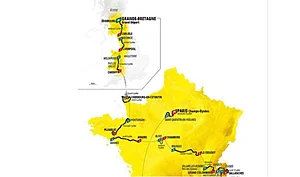
Ultimately, the failure in Zurich is just one step in learning about her new challenge, which is to win the Tour de France. Pauline Ferrand-Prévot has the ability to overcome this adaptation phase, we are absolutely certain, and it will therefore be interesting to see how she adjusts her energetic approach to come back stronger on the road in the coming months. The evolution of her metabolism could well become a key element for her future performances.
Share the post "Pauline Ferrand-Prévot: A Difficult Return to Road Racing and the Importance of Energy Management"