Share the post "Fariba Hashimi: The Story of an Afghan Cyclist Who Transcends Sport"
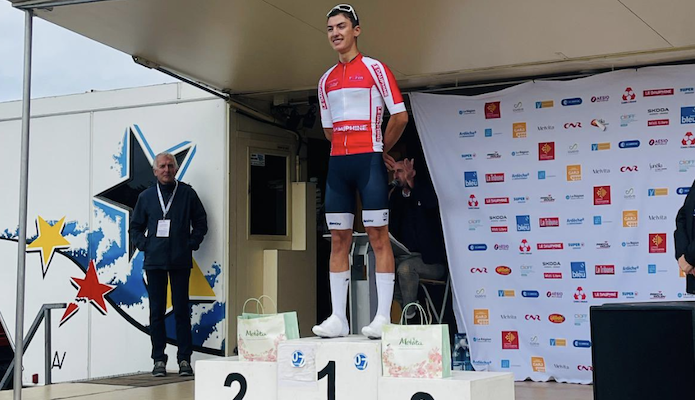
This past weekend, a deeply moving story resonated throughout the cycling world, echoing far beyond the winding roads of Ardèche. Fariba Hashimi, a 21-year-old Afghan cyclist, triumphed on the demanding slopes of Mont Lozère, winning the queen stage of the Tour de l’Ardèche. But this was more than just a sporting victory: it was an act of bravery, a symbol of resistance and hope. In a world where so many women are still deprived of their freedom, Hashimi made history by becoming the first Afghan female cyclist to win an International Cycling Union (UCI) race. Her achievement transcends the boundaries of sport, powerfully reminding us that, sometimes, cycling is also a fight for rights and dignity.
By Jean-François Tatard – Photos: X/@afghancycling – Instagram/fariba__hashimi/
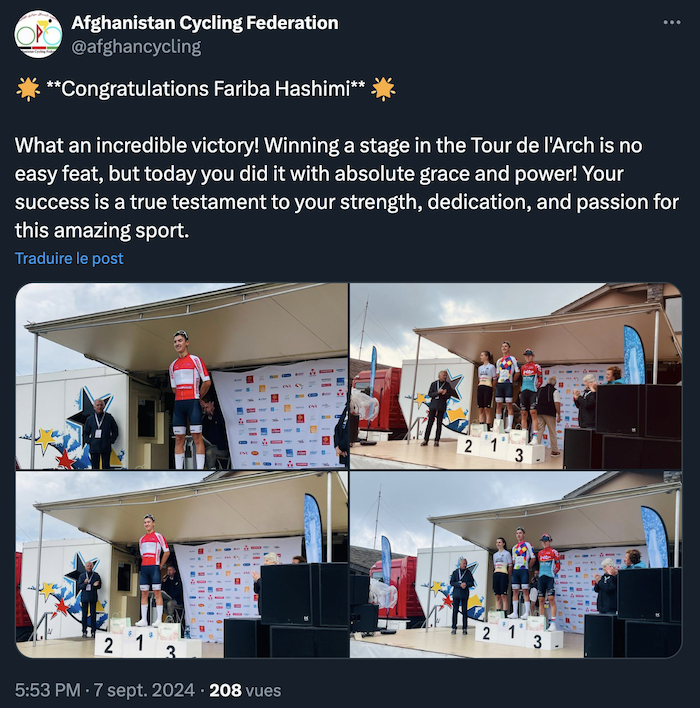
Her story is not limited to this brilliant victory, because behind every pedal stroke lies a journey of survival and resistance. Fariba and her sister Yulduz, both passionate cyclists, were forced to leave their native Afghanistan in 2021, when the Taliban returned to power. With this return, women’s rights suffered a brutal setback, nullifying the hard-won advances in the country after decades of conflict. For Afghan women, access to education, work, and sports became a real challenge, if not totally forbidden. Fariba and Yulduz, determined to pursue their passion and defend their freedoms, had no choice but to flee.
Now based in Aigle, Switzerland, at the World Cycling Centre – a center of excellence supported by the International Cycling Union (UCI) that helps athletes from disadvantaged countries – they have found a refuge where they can continue to train and compete. However, for these two young women, sports competition is much more than a simple physical challenge. Every race is a way to symbolically fight the oppression weighing on their fellow citizens who remained in Afghanistan. In a country where the simple act of riding a bike is now an act of rebellion for a woman, Fariba and Yulduz embody a struggle far greater than that of the finish line: that of freedom, dignity, and emancipation.
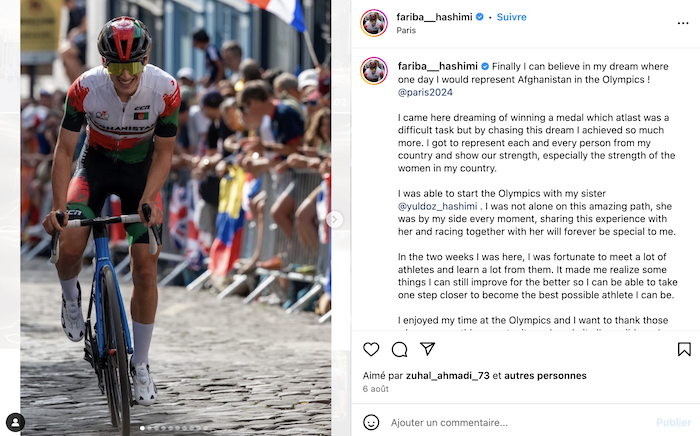
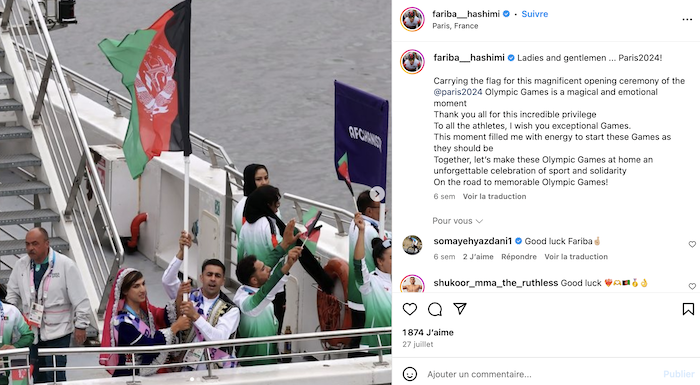
Their story is all the more poignant as their family remains under constant threat from the Taliban in Afghanistan. Their relatives have had to move several times to avoid reprisals, and their youngest brother was injured in a violent attack, an aggression motivated by his sisters’ participation in the Paris 2024 Olympic Games. Despite the dangers, Fariba and Yulduz continue to proudly wave the Afghan flag during their races, showing the whole world that they are not ready to give up their fight. They are fighting not only for themselves, but for all Afghan women, proving that sport can be a powerful lever for social change.
At 3bikes.fr, we could not overlook this story that extends far beyond the realm of sport. Fariba Hashimi’s victory is not simply that of an athlete at the peak of her discipline, but rather that of a woman who has managed to transform adversity into extraordinary strength. Her triumph at Mont Lozère is above all a cry of resistance against oppression, an act of rebellion in the face of injustice, and a brilliant demonstration that even the most immense obstacles can be overcome. Cycling, for Fariba, is not just a physical challenge: it is a way to break the chains that hinder the freedoms of so many women in the world. Every pedal stroke, every climb, every victory carries a powerful message of strength and resilience. Her courage in the face of threats and persecutions, her determination to pursue her dream despite exile, and her brilliant success inspire us all. Through her exceptional journey, we salute an extraordinary athlete, but also a silent activist who fights for fundamental rights through her sport.
In a world where, even today, millions of women are deprived of their rights, including the right to practice a sport, Fariba Hashimi’s example resonates as a poignant reminder: cycling, like any other form of physical expression, is a vector of freedom. In Afghanistan, where the Taliban have reinstated repressive laws that prohibit women from activities as simple as going out alone or cycling, Fariba proves that the boundaries imposed by society can be crossed. Her ascent during this Ardèche stage is more than a sporting feat: it is a political statement, a testament to women’s ability to achieve the impossible, to overcome the invisible and visible barriers imposed on them. She embodies a promise of hope for all those who are still silenced, showing that they too can climb mountains, literally and figuratively.
And that is the beauty and power of her story. Fariba Hashimi’s victory, far beyond cycling, invites us to reflect on what we can achieve when we refuse to yield to injustice. Her journey is an ode to perseverance, freedom, and hope, reminding us that, even in the darkest moments, there is always a light to follow. Fariba’s path is paved with suffering, sacrifices, and courage, but her success proves that the future belongs to those who, despite obstacles, choose never to give up.
By celebrating this athlete, we celebrate all women who, every day, fight for their freedom. May her example inspire others to never stop believing in their dreams, to never stop fighting for a more just, more egalitarian world. Because ultimately, cycling – like life – is a race forward, and Fariba shows us that no matter the gradient, with enough determination, we can all reach the summit.
Share the post "Fariba Hashimi: The Story of an Afghan Cyclist Who Transcends Sport"