Share the post "What is the value of professional female cyclists’ performances?"
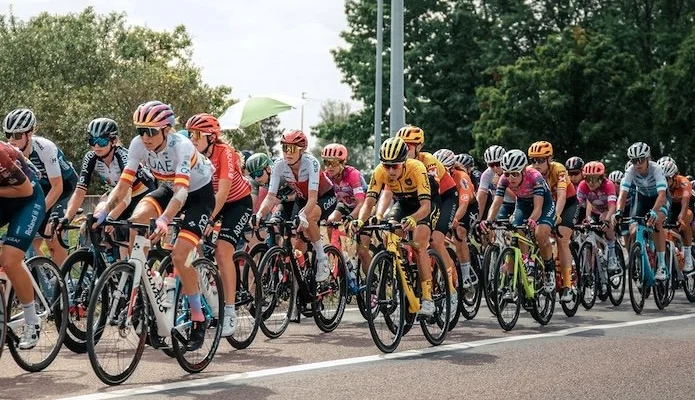
The level of the best professional female cyclists is high, as shown by the climbing times on the major passes of the last Tour de France Femmes avec Zwift, or the Olympic Games time trial. These performances are far superior to those of most male amateur cyclists.
By Guillaume Judas – Photos: depositphotos.com / ©Billy Ceusters
On the Tour de France Femmes avec Zwift, Austrian Valentina Cavalar (Arkéa-B&B Hotels) and Dutch Demi Vollering (SD Worx) climbed the difficult Col du Glandon (19.3 km – 1437 m elevation gain – 8.1% average gradient) in 1h05’26 and 1h05’27 according to Strava data, which places them respectively 92nd and 94th among men and women combined out of… 30,087 classified cyclists. However, the QOM (the female equivalent of the KOM) is held by British Illi Gardner, a former professional turned climb hunter, in 1h05’13, a performance established solo on July 6, 2024.
For comparison, the best absolute time recorded by the application belongs to Laurens Ten Dam during a Tour de France stage in 2012, in 57’53, ahead of six competitors from the Tour de l’Avenir in 2021 who climbed the pass in just over 58′. A little further down the segment ranking, in the category of best sportive riders, we find times of 1h02’39 for Thomas Lemaitre on August 29, 2021, on the GFNY Vaujany, and 1h02’50 for Peter Pouly on the Haute Route Alpes on August 21, 2012. Our collaborator David Polveroni, an excellent climber with a strong track record in mountain sportives, set a time of 1h03’52 on July 14, 2015.
The speed difference between the best men and the best women here is just over 10%.
During this last stage of the Tour de France Femmes, the riders then had to tackle the final climb of Alpe d’Huez. On Strava, the most significant segment does not include the last, flatter kilometer in the resort, and shows 12.62 km at an 8.3% average gradient, for 1047 m of elevation gain. Demi Vollering set a time of 47’19, at an average of 16 km/h, for a climbing speed of 1333 m/h, which corresponds to approximately 5 watts/kg, on the eighth day of racing and at the end of a 150 km stage with over 4000 m of elevation gain. The QOM, however, still belongs to Illi Gardner, in 43’54, established on July 2, 2024, on a dry climb, but solo. The British rider’s Strava data indicates an average power of 242 watts for a stated weight of 44 kg on her Zwift profile, or 5.5 watts/kg. We’ll let you appreciate the level.

Among men, the KOM for this segment is held by American Sepp Kuss on July 14, 2022, on the Tour de France, ahead of Romain Bardet, in 36’53. Among amateurs, the best times are held by former pro Stefan Kirchmair in 38’28 on July 1, 2022, Andrew Feather on September 27, 2022, in 38’43, or Arthur Blanc on September 3, 2020, in 39’27, but each time on dry climbs, performances that should therefore be compared to Illi Gardner’s and not Demi Vollering’s. It should also be noted that the Dutch rider had completed just over 50 km before the final climb, accompanied only by her compatriot Pauliena Rooijakkers, who took very few turns at the front. Finally, on this segment, Illi Gardner is ranked 68th among men and women combined, out of 154,000 cyclists.
A stratospheric Olympic time trial
Let’s now talk about the Olympic Games time trial in Paris, on July 27, 2024, which was contested over a distance of 32.4 km. Men and women covered the same distance, on the same day and in the same (rainy) conditions.
Remco Evenepoel won among men in 36’12, at an average of 53.702 km/h, ahead of Filippo Ganna by 15 seconds and Wout van Aert by 25 seconds.

Australian Grace Brown won among women in 39’38, at an average of 49.050 km/h, ahead of British Hanna Henderson by 1’31 and American Chloe Dygert by 1’32. A gap of 3’26 with Remco Evenepoel, but which would still have placed Brown in 27th position in the men’s race, on par with Slovenian Jan Tratnik. The only four amateur riders entered in the Olympic event, from “small” cycling nations, are all behind.
On this type of effort, there is a speed difference of approximately 9% between the best man and the best woman.
More difference between men and women on explosive efforts
The performance gap between men and women seems more pronounced on shorter efforts, such as on the steep climb of the Mur de Huy (1.23 km at an 11.7% average gradient), the finish line of La Flèche Wallonne in both categories.
The best time among women on the Strava segment belongs to Demi Vollering, in 3’54, a time established on September 30, 2020, an unusual date for the Belgian classic which had been postponed that year due to the pandemic. A race where she took third place, 6 seconds behind her compatriot Anna van der Breggen and Danish Cecilie Utrup Ludwig, who did not publish their data on Strava.
Among men, the best time on the application belongs to Michael Woods in 2020, also in 3’04, the year he took third place in La Flèche Wallonne, in the same time as Marc Hirschi, winner, and Benoit Cosnefroy, second across the line. A time that seems to be 5 seconds faster than the unofficial record (not verifiable on Strava) set by Julian Alaphilippe the following year, when the Frenchman won with the world champion’s jersey on his back.
Demi Vollering’s time places her in 152nd position among men and women combined, out of 31,498 athletes classified on the segment. Among amateurs, the best time is held by young Frenchman Louis Coqueret in 3’36, a performance established in training on July 15, 2020.
The speed difference on this climb between the best woman and the best man here approaches 25%, which shows that the best female athletes are slightly more disadvantaged on explosive efforts.
In any case, these data demonstrate how extraordinary the best professional female cyclists are, far better than the vast majority of amateur cyclists, competitors, sportive riders, or Sunday cyclists. These elements can only make one appreciate women’s cycling at its true value, even if the level of female riders continues to intensify over the years, and some performances will logically continue to improve.

Share the post "What is the value of professional female cyclists’ performances?"