Share the post "A day in the Shimano neutral support car at the Tour de France Femmes"
We were present at the final stage of the Tour de France Femmes avec Zwift 2024, aboard one of Shimano’s neutral assistance cars. This is an essential system for the smooth running of the race, aiming to ensure sporting equity among competitors, who are not always lucky enough to be followed by their team car. A unique experience that allowed us to live the suspense surrounding the attribution of the yellow jersey live, right up to the last meters of the final climb to Alpe d’Huez. Let’s take a closer look at the crucial importance of these blue cars at the heart of the peloton.
By David Polveroni – Photos: All rights reserved
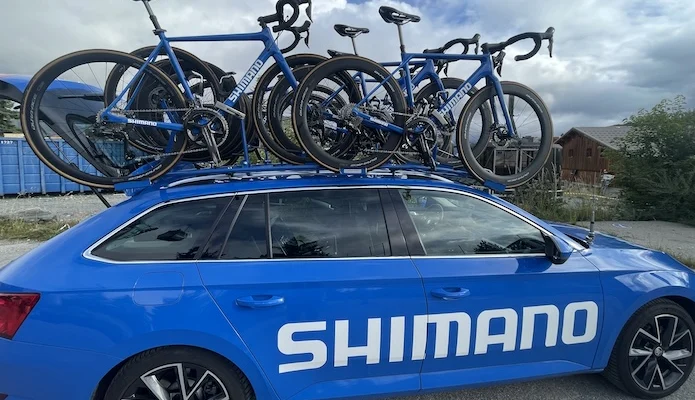
As the peloton prepares to set off from Le Grand-Bornand for this final stage of the Tour de France Femmes avec Zwift towards Alpe d’Huez, the three Shimano cars take up position. The final exchanges between mechanics and drivers, mostly Dutch, resonate with a palpable atmosphere of excitement. A few minutes before the start, the adrenaline rises. Our car is number 1, just behind the general management car, where Marion Rousse, race director, and Bernard Thévenet, former Tour de France winner (1975 and 1977), are located.

When the start is given, we are listening to the race radio, waiting for a breakaway to form. If the gap with the peloton exceeds 40 seconds, we can then position ourselves behind the breakaway group. Otherwise, we remain at the front of the peloton, ready to react. In addition to the race radio, which informs us in real time of the competition’s progress and transmits various instructions, Shimano has an internal radio for communication between the three cars and the single motorcycle within the peloton of 120 riders this morning. Strategy is essential: one car positions itself behind the peloton to monitor groups forming, while the other positions itself at the front of the race, ready to change places according to the evolving situation.
First climb: Tamié. The front of the peloton is very active and a breakaway forms. We stop to let it pass, then we’re off behind this group of about twenty riders, including the polka dot jersey wearer, Justine Ghekier, who fights with courage and determination to defend her jersey. After two kilometers spent behind the group, I realize there’s a problem with a UAE team rider, who seems to be struggling at the back of the breakaway. The agitation intensifies in the car, radios shouting in English. I notice she’s having difficulty using her large chainring on the flat section of the climb. The driver (or rather the pilot!) approaches her to ascertain the nature of the problem. It turns out she indeed has issues with her chainring, but she prefers to wait for her team car. Even if she doesn’t intervene in the end, the job of neutral assistance is to be ready to do so, as quickly as possible depending on the race situation.

We then return to our position to continue following the breakaway. We are now starting the descent. It’s better to respect the three-hour digestion rule before getting into the car! Believe me, it’s a real sport, driving to follow competitors of this level on a descent. No gap should be left between each car, otherwise the whole harmony of the process can break down. The pace is sustained and the polka dot jersey shows signs of fatigue, struggling to maintain her speed amidst speed bumps and humps. In the valley, as the gap reaches almost three minutes, two pee breaks are scheduled – precious and rare moments in the heat of the action. As with the rider who finally managed to shift to her large chainring, the mechanic at the back of the car must be able to handle any unforeseen event.

Each new season, Shimano inventories each team and, before each race, a check is made to ensure all equipment is in order to be able to assist any rider. Each car is thus equipped with:
- 3 bikes with Shimano pedals
- 3 bikes with competitor brand pedals
- 4 Shimano wheels with rim brakes
- 8 Shimano wheels with disc brakes (140 and 160 mm rotors) – 2 rotors of each size (140 and 160 mm) – 4 competitor brand rear wheels
- 1 pair of pedals from each brand present in the race
- 2 chains
- 2 batteries for Shimano Di2
- 20 bidons
- 24 50cl water bottles
- 30 energy gels
- 30 energy bars
- All necessary tools for a race
That’s solid preparation to face many eventualities!
The Col du Glandon approaches, the dreaded ogre of this Tour de France. This high mountain stage ends with the formidable Glandon – Alpe d’Huez sequence. We all remember Lance Armstrong’s bluff in 2001, when he seemed to be in difficulty before flying off alone from the foot of the Alpe climb. Here, there’s no room for bluff: the leading group gradually shrinks, with only about ten riders left halfway up at Saint-Colomban-des-Villards. This confirms my impressions from the start: they’re riding fast! Whether on climbs, descents, or in the valleys, my Garmin in hand shows me that we are just a slight notch below the best French cyclosport riders. Col du Glandon in 1h05’30 for Vollering, one minute more for the rest of the favorites. Connoisseurs can make the comparison…

Now, the Dutch rider is in the lead, accompanied by her compatriot Pauliena Rooijakkers (Fénix-Deceuninck) and Valentina Cavalar (Arkéa – B&B Hotels). When the gap exceeds 40 seconds at the Grand Maison dam, we position ourselves behind the group during the fast descent into the Romanche valley. The Arkéa rider struggles to keep contact, and the pace set by Demi Vollering proves to be high. But, just like in our car, through the tight turns and then speeds of nearly 90 km/h on the straightaways, she finds the strength to catch up with the two Dutch riders. An expenditure of energy that could cost her dearly in the final climb.

In the valley, the sports directors of the two respective teams consult each other through the window. What could they be saying to each other in this palpable tension? Rooijakkers collaborates little with Vollering, and the yellow jersey group of Katarzyna Niewiadoma is closing in. The suspense continues until the finish line, as you saw on screen. Vollering, who wins at the summit, will be four small seconds short of dislodging the Pole. Two kilometers from the finish, with no further intervention to report, we head directly to the technical area to join the Shimano truck and put away all the cars that have finished with the Tour de France Femmes! Every evening, the bikes are carefully washed; everything must be impeccable, just like Shimano!

The neutral service, which replaced Mavic in 2021 on the Tour de France, is also present at many other events throughout the season. In total, six neutral breakdown service teams, spread across Europe, are present at the three men’s Grand Tours, the World Championships, the five cycling Monuments, as well as all spring one-day classics for men and women. Shimano also intervenes in many other races on the UCI calendar, for both the women’s and men’s circuits, and provides neutral assistance for junior and U23 competitions, track events, and para-cycling events. Although Shimano is not directly involved in the riders’ performance, neutral assistance represents an essential link in the smooth running of the race, sometimes contributing decisively to victory!

Share the post "A day in the Shimano neutral support car at the Tour de France Femmes"