Share the post "Carbon monoxide doping: a controversial practice on the Tour de France?"
The 2024 Tour de France has concluded, revealing impressive performances and sparking passionate discussions. This edition was marked by the supremacy of Tadej Pogacar, whose apparent ease raised many questions. An investigation revealed that several teams, including Visma-Lease a Bike, UAE Emirates, and Israel-Premier Tech, allegedly use carbon monoxide recyclers to improve their riders’ performance. A practice not formally prohibited, but one that seriously raises ethical issues.
By Jean-François Tatard – Photos: depositphotos.com
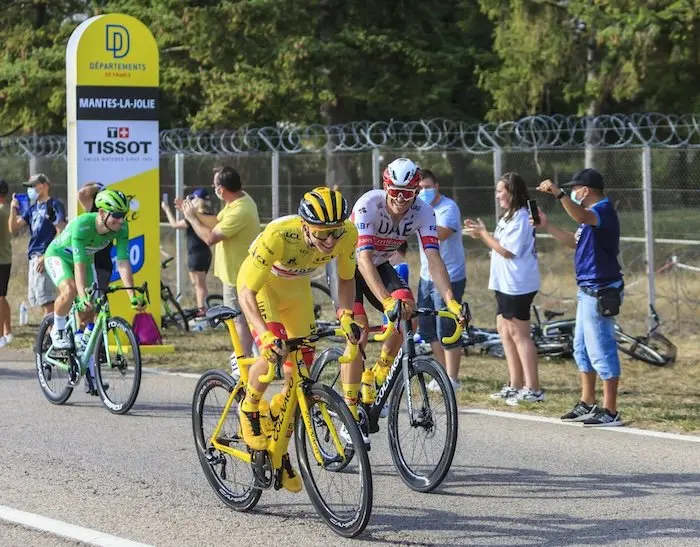
Despite an entertaining spectacle, with three stage victories for French riders, the popularity of an Eritrean who won the public’s heart, and Richard Carapaz’s fierce battle to snatch the polka dot jersey from Pogacar’s shoulders, the latter’s dominance raised doubts. Some attribute this dominance to the weakness of his competitors, Remco Evenepoel and Jonas Vingegaard, who were returning from convalescence, while others praise his relaxed and instinctive approach that brings a new freshness to cycling. Even Adam Yates admitted that at UAE Emirates, there is often no elaborate strategy in advance, and everything relies on Pogastar‘s last-minute decisions.
The facts remain, however, and regardless of the competition: the Slovenian crushed numerous climbing records, including the final ascents to Pla d’Adet and Plateau de Beille, where he beat the times of Marco Pantani and Lance Armstrong by more than three minutes.
Context and Practice
Recently, an investigation revealed that several teams, including Visma-Lease a Bike, UAE Emirates, and Israel-Premier Tech, use carbon monoxide recyclers to improve their riders’ performance. This method aims to simulate the effects of altitude training, allowing athletes to increase their red blood cell production, which improves their endurance and aerobic capacity.
Pogacar’s Revelations
Tadej Pogacar, one of the favorites of this edition of the Tour, was questioned about this practice. He initially denied its use before clarifying that he had participated in tests to evaluate his response to altitude. However, Pogacar stated that he had only completed half of the initial test, leaving doubts about the actual and complete use of this method by his team. He also emphasized that it was not a direct inhalation of carbon monoxide, but rather a test to see how his body reacts to conditions similar to those at high altitude.
Implications and Reactions
The use of carbon monoxide, although not prohibited by the World Anti-Doping Agency (WADA), raises ethical and safety questions. Inhaling this gas can be dangerous, and its use to improve athletic performance is perceived by many as a disguised form of doping. Reactions in the cycling world are divided, with some calling for stricter regulations to prevent abuse. This practice, although technically authorized, raises concerns due to the health risks and ethical questions it poses.

This controversy highlights the limitations of current anti-doping regulations and the need for increased vigilance to maintain the integrity of the sport. The debate surrounding the use of carbon monoxide at the 2024 Tour de France could mark a turning point in the fight against doping and the definition of acceptable practices for improving sports performance.
Pogacar’s casual but effective approach and the lack of pre-established strategy at UAE Emirates, as Yates admitted, add to the complexity of this debate. While this carbon monoxide story raises questions, it also recalls the importance of transparency and ethics in professional cycling. The ease with which Pogacar dominated his competitors raises questions, but it could also reflect exceptional talent, despite the controversies.
Share the post "Carbon monoxide doping: a controversial practice on the Tour de France?"