Share the post "My Étape du Tour 2024"
Nicolas S. offers us his report on the 2024 Étape du Tour, an event he experienced in suffering. To the point of questioning his next goals. The pains of the end?
By Nicolas S. – Photos: Sportograf.com / DR
“Saturday, July 6, it’s around 6:30 AM in Nice in front of the IBIS Nice Lenval hotel, and I’m getting ready to head to SAS 1 of the 2024 Étape du Tour. I’m with Antoine and Fabien, and we’re waiting for the other buddies to come down so we can hit the road.

A long preparation
Many months have passed since the Tour’s presentation at the Palais des Congrès and the announcement of the 2024 Étape du Tour route. No surprises for me; I already had a good idea that we would have to go to Nice to participate in the most popular French sportive. No mythical Tour climbs, no gradients beyond 8%, no flat sections to recover, but particularly long ascents throughout the 138 km, 4 passes, and 4600 m of elevation gain that we would have to cover if we decided to register. I’m not super excited about the route, and I’m already worried about the logistical nightmare this Étape represents. Nice is at least a 9-hour drive from home; I don’t consider using the train or plane for a second, not knowing how to travel light. The finish line is particularly far from Nice, and I’m starting to rack my brain to figure out how we’re going to manage the return without having to ride an extra 80 km on top of the official route. I haven’t yet paid the hundred euros needed to get a bib, but I’m already planning the organization, which is a good sign.
As for the 2023 Étape, I entrusted the management of my training program to my coach, with the difference that he would advise me from the autumn, instead of early April, which would give him much more time to lay the foundations. The first weekly instructions arrived in early November, and I found myself running and swimming every week. I grumbled about it at first, but quickly I found a certain pleasure in diversifying my physical activity and even started thinking that I could quite easily continue running throughout the year. Of course, the Sunday long endurance ride still had its place in the program, and very quickly, it incorporated efforts of varying lengths and intensities.
The beginning of 2024 arrived quite quickly, and I told myself that I still had plenty of time to fine-tune my form by July, which tended to reassure me. In my mind, there was no doubt that I would be stronger this year than in my first two participations, and I saw no reason not to finally achieve one of my cycling holy grails by entering the Top 1000 of the Étape ranking.
This feeling was reinforced by the program my coach put together for me, with much more variety in effort intensity and, above all, the obligation to line up for La Jacques Gouin at the very beginning of March to validate the start of preparation. La Jacques Gouin is a kind of institution in Ile-de-France that takes place every year in the south of the region on a 115 km course often subject to wind and rain. My late registration pushed me quite far back on the starting line, and I had to fight hard to catch the main peloton, which started at a furious pace under the impetus of many racers and Belgian riders, including some big names in the sportive world and even ex-pros. I didn’t set any particular goal for this fast-paced long ride other than not finishing too far behind some acquaintances who usually rank in the first part of the standings. The 3h15 of racing flew by, the last climbs of the course really broke the legs. I was quite satisfied with the almost 35 km/h average and 228 normalized Watts I achieved that Sunday morning, and I concluded that the first months of training were in line with expectations for the upcoming objectives. Once again, I stepped out of my usual comfort zone and returned home pumped up to tackle the bulk of the preparation.
Rainy spring
The rides got longer and longer, and the indoor trainer sessions followed one another with a regularity that commanded the respect of many of my friends. My only available slots in the midst of my professional and, above all, personal life were Wednesday evenings, often after 9:30 PM, and Friday lunchtimes, taking advantage of teleworking. Wednesday sessions were not always easy to endure, both physically and motivationally. I often dreaded them when I saw that I had to do 30/30 intervals or sustained power exercises for quite long periods. But I held on, regularly asking myself why I was doing this and if it was worth it, but I held on.
I continued to devour everything related to training and nutrition podcasts, and I became an unconditional fan of the Cyclismes et Performance episodes, which I find both incredibly precise and particularly accessible to the average person. My Sunday rides, this year, were quite regularly solo. These long solo moments, coupled with the far-from-perfect 2024 weather, weighed heavily on my desire and regularly brought up the idea of giving up everything. As on the indoor trainer, I held on as best I could, thinking of better days and anticipating the future satisfaction of a successful stage.
These long endurance rides were still and always an opportunity to train my body to absorb as many carbohydrates as possible. I would come home in the late morning with my pockets full of wrappers, allowing me to count the ingested doses; I regularly reached 70 to 80 g/h. There are now certain brands of dietary products that I can no longer stand to look at, I’ve eaten so much of them.
The first videos and reconnaissance articles for the 2024 Étape appeared online. Here too, I diligently watched and read everything published by Les Watts, Pédaleur, or 3bikes to dissect what awaited us in July. A general message emerged from all these reconnaissances: the course and its gradients, which might seem gentler than usual, should not be underestimated; humility would be required in the face of the effort, and the 4600 m of elevation gain respected. The descents proved to be numerous and technical; there would be no flat sections or dead time on this course, which resembled a proper little construction site.
Weeks passed, and my coach regularly subjected me to an effort test in the form of horrible Ramp Tests or 3 to 5-minute tests on well-chosen climbs in the Chevreuse Valley. The values only increased over time, and I matched my best recorded data ever. All systems were go to tackle my first real objective of the year: the Ardéchoise on the Volcanique course.
The Ardéchoise as an appetizer
Saturday, June 15, at 2:30 AM in Ardèche, we were awake in our small rental in Saint Victor because of an unusually violent thunderstorm crossing France. The alarm was supposed to ring in just over 3 hours, yet we couldn’t close our eyes due to the strength of the gusts and the amount of water battering the windows of the house. I was already wondering how and in what state we would start the race.
Everything was calmer when we had the hearty, protein-rich breakfast, but it was still raining in Saint Victor. I set off quite early, hoping to be well-placed on the line and not have to jostle too much to tackle the Col du Buisson, which comes very early on the course and acts as the first major selection. I was dressed like a damp autumn day, and I had only one hope during the half-hour drive to the start in Saint Félicien: not to get a flat between the house and the starting line. The brand new Turbo Cotton tires and Latex inner tubes mounted on my wheels wasted no watts, but they also forgave no flint.
I headed to the priority pen and crossed paths with Stefan Kirchmair, who didn’t seem in a hurry to get to the start of his race, which was due to begin in just a few minutes. The guy’s palmarès (filled with victories at La Marmotte, the Étape du Tour, etc.) was quite impressive.
The start was, as usual, very fast and made quite complicated by the ambient humidity. Nevertheless, I approached the Col du Buisson in a rather good position. Quite quickly, I found the group’s pace too high for me and dropped from the main group. At that point in the race, there was no danger; the 186 km course and almost 3400 m of elevation gain allowed the ambitious to burn out slowly and the cautious to gain places as the kilometers passed. Unfortunately, for my part, the engine never really started, and I was going to have one of my most complicated days on the bike. All day long, I saw groups pass that I couldn’t latch onto as soon as the road steepened. I was stuck as soon as it climbed; the day promised to be very long.
It crossed my mind to branch off onto the Boutières course, almost 60 km shorter and nearly 1000m less elevation, but misplaced ego, the hope that my legs would start turning again, and above all, the fear of looking like an idiot on Strava pushed me to the left of the road, at the course split, towards Mézilhac.
The rest of the day would be a long Stations of the Cross, without strength and without desire. Freezing at the Mont Gerbier de Jonc pass, I had no good sensations all day and couldn’t warm up either. I crossed the line around 65th place, slightly worse than last year, even though the level was generally lower and the goal was to get into the Top 50. All this is ultimately quite anecdotal when the body decides to give you a shitty day on the bike; those who have never cycled cannot understand. The others, you know.
I was happy to drink a beer at the finish village and cracked a little after these long months of preparation and commitment, which resulted in a shitty day from which I shouldn’t have expected anything in particular other than a little pleasure, because it’s just cycling, because it’s just a sportive.
Home stretch
Three weeks remained before the Étape du Tour; the relative disappointment of the Ardéchoise was quickly swallowed, and I got back to work to find the few extra Watts that could make a difference on July 6. As since the beginning of the year, sensations in training were very good, and I surprised myself by enduring and chaining, without too much difficulty, 5-minute climbs at more than respectable power levels. The return of the sun to the Paris Region brought some cheer after the catastrophic spring and early summer we were experiencing once again.

Saturday, July 6, it’s around 6:30 AM in Nice, in front of the IBIS Nice Lenval hotel, and I’m getting ready to head to SAS 1 of the 2024 Étape du Tour. The organizational constraints and difficulties related to the particular logistics are behind us. We’ve been here for several days and have had time to scout the very treacherous first kilometers of the course. We’ve transformed the hotel into a veritable Spanish inn, reserving the largest rooms on different floors of the building for ourselves; we’re a group of nine, divided into groups of three. We’ve been able to wander peacefully around the enormous and magnificent start village, we’ve taken the time to chat with the Pédaleur buddies, with Geoffroy Lequatre, with David Polveroni; it was a good time. We’ve dropped off cars in Touët sur Var so everyone can get back safely after the event, and we’ve arranged for returns more or less by skill group. We’ve negotiated with the hotel manager to have breakfast moved up to 5:30 AM. Our minds are free of everything except perhaps stress; all that remains is for our legs to do their part of the work.
Stations of the Cross
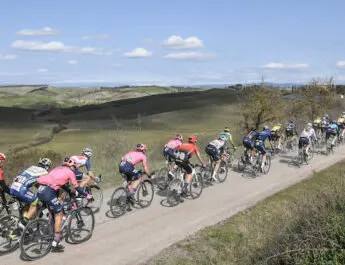
Outwardly, everyone in the pen is quite calm; I recognize quite a few people from previous years or social media. Despite the crowd of participants, you always run into familiar faces. SAS 0 has just left; good luck to the friends who are in it. In 7 minutes 30 seconds, it will be our turn to set off. The start is neutralized behind a car to avoid accidents on the exit from Nice. The organization made last-minute changes to the first kilometers to avoid the numerous construction zones. Even adjusted, these first kilometers are very complicated, and many crashes and slowdowns occur until the foot of the Col de Nice.

The time has come to settle into a target power, low enough not to burn out, high enough to make good progress. It’s already humid in the first climbs, and I’m sweating profusely; I’m far from the only one. I quickly put my nutrition strategy into action and start downing the first Maurten gels after a good half-hour of racing. They, which are usually very neutral in taste, suddenly seem extremely sweet to me; I have 12 to swallow over the 6 hours and some change of cycling that await me. It’s going to take a strong stomach. A sip of drink every 10 minutes, a gel or half a bar every 30 minutes—this well-orchestrated chronology, refined over weeks and months, is also a good way to make time pass quickly, to disconnect the brain from the ongoing efforts, and to give oneself intermediate checkpoints. Believe me, you often cling to whatever you can.
As usual, I feel like I’m starting much more cautiously than many competitors, I’m not panicking because it worked out quite well for me last year. The Cols de Nice and Braus are passed without too much difficulty and, above all, at levels of perceived effort that seem very satisfactory to me given the Watts produced. I pass the first aid station without stopping; I’ve decided to make only two express stops to refill my two bottles; I’m completely self-sufficient for all “solid” food.
First descent, first moments of real concentration. Everyone is warned that these are not the easiest. Far from being a great descender, I am in total confidence on my bike, which allows me to stay in contact with the guys I was with at the summit. It’s fast, we’re careful, but it’s fast, and the foot of the Turini appears quite quickly before us.

First moment of emotion at the sight of the sign “Col Summit – 24 km”, it’s going to be long. I remember too well the 29 km of the Croix de Fer which left me with a slight bitter taste. The gradients are not severe, I knew that, but I already feel less spry than in the first cols. I hope to manage to maintain something around 230 watts, but I will have to lower my expectations. I don’t panic, as a good old-timer I now know how to manage these long periods. Everyone is now climbing at their own pace, we are not yet halfway through the course but the peloton effect is already gone. My Wahoo shows me the profile of the col and the kilometers to come, I am delighted to see that the gradient remains moderate, I am happy to realize that a good flat section awaits us quite quickly. That one will do good, we put the chainring back on and pick up speed. It lasts long enough to regain some strength and especially to considerably reduce the distance separating us from the summit, these are what I call free kilometers. I overtake some acquaintances, we exchange a word, but not too much, oxygen is more for the muscles than for social ties. Still as much sweating, the weather is good without the heat being too overwhelming as it could have been in Joux Plane or Alpe d’Huez but it’s humid. I lose a lot of mineral salts, it always impresses my friends, I’m used to ingesting a salt capsule per hour to supplement everything my body evacuates.
The panorama is fantastic, but the precipice is dizzying
The summit is finally there, and one of the black spots of this course appears: the descent of the Turini. All comments are unanimous, the descent is technical and the asphalt is of poor quality. I quickly realize that another particularity characterizes the twenty kilometers that await us: the panorama is fantastic but the precipice is dizzying. It’s truly impressive, and clearly, you must not miss a turn and rely on the meager barriers to prevent you from falling into the void. We try not to think about it too much and launch ourselves as best as possible towards the Vésubie valley that awaits us a little further down. Many guys end up on the ground; I see a guy looking for his bike in the ravine, I see one groggy sitting on the guardrail, it calms the ardor a bit and pushes us to press the brakes a little more. The weather starts to look very threatening, and the first drops fall as we descend. I start to fear a summer black ice effect just as a guy misses a turn in front of me and falls. Just enough time to ask him if he’s okay and make sure he’s able to get back on his feet before heading down the descent, which we are all quite happy to see arrive.

It’s still raining a little on the Étape du Tour route, but fortunately we’re in the south, and the sun’s rays quickly reappear and dry us off without delay. Half of the stage is already covered in terms of kilometers, but only 2000 m of elevation gain are displayed on the bike computer. I take a hit to the head thinking about the remaining 2600 m to climb. As often, I wonder why I embarked on such an adventure.
I know we’re approaching a key moment of the course. We’re heading towards the Col de la Colmiane, which isn’t very long on paper, but whose approach roads, without being completely flat, require riding in a peloton to avoid losing too much time and energy riding alone. I expected false flats, but these are indeed gradients worthy of a climb in the Chevreuse Valley that we have to overcome to reach Saint Martin de Vésubie. I cling to wheels and am satisfied to find some moral resources to make the effort not to stay alone. I eat, I drink, I take my salt capsule, I continue my energy maintenance strategy.
We arrive in Saint Martin de Vésubie, which we have heard a lot about in recent years due to the floods that devastated the village. Just a few weeks ago, late snowmelt and heavy rains brought chaos back to this valley, of which little already remained.

First aid station stop at the foot of the Colmiane, just enough time to empty two sachets of powder into one bottle, throw two electrolyte tablets into the second, and grab 2 liters of water to fill them; it’s already time to get back on the road. 2 minutes flat; if there’s one point I’ve improved on in the last two years, it’s the time spent at aid stations.
We cross Saint Martin de Vésubie and pass over a bridge that allows us to access the foot of the pass and, above all, to cross the riverbed. It’s simply impressive and frightening. The accumulation of rocks easily suggests the violence of the elements that raged here.
The Colmiane is not a very long pass, announced at around 7 km on the race profile, but taking into account the entire approach phase, it is indeed a climb of almost 17 km that we have to overcome. Time takes its toll, forces diminish, I feel that there isn’t much left in my legs. I have a lot of trouble placing myself in the race, but I feel that the Top 1000 will be difficult to reach. Nevertheless, past experiences prove it to me, you must never let yourself sink on this type of event because everyone suffers in the same way.
I have time to enjoy the scenery; we pass through particularly remote and inaccessible areas. This is strongly felt by the very marked absence of spectators along the roads, whereas I have always found the Étape du Tour to be an event to do for that aspect. I think of the participants who will have to abandon, and I really wonder how they will be able to reach the finish, the only available road being generally that of the event.

Passing the summit of the Colmiane, a quick glance at the aid station area, which, like the others, is located in a really cramped space. Access to aid stations is often a point of criticism raised by people starting in the higher pens; I have the impression that this edition will be even more criticized than the others.
The descent of La Colmiane was one of the great moments of the course, at once fast, easy, and magnificent. We don’t lose our good habits and put the map on the GPS to anticipate any complicated turns. Group descent, acceleration out of turns, onset of cramps when putting on a bigger gear; it’s really time to finish this damn event.
Last stop at the foot of the Col de la Couillole before starting the final 16 km climb. Last aid station stop to fill the bottles one last time, two last minutes without pedaling before crossing the finish line.
I pass the timing barrier at the foot of the pass, which also allows family and friends to see me suffer from a distance thanks to Live Tracking. I attack the pass full of hope and desire when my rear wheel suddenly locks up.

I stay on the bike as best I can; I feel like I’ve broken a spoke, the hub, or even unseated the tire. A quick glance, I see that, in fact, the windbreaker I had tucked under my jersey has come loose and gotten tangled in the rotor and spokes. A brief moment of panic as I realize I’m going to have trouble removing all this mess. I finally manage to do it, but I have to tackle the pieces stuck in the caliper. In the end, exactly five minutes lost getting everything back in order. I say goodbye to my windbreaker and to the top 1000 at the same time.
I regroup and set off at a better pace than the one I was maintaining in La Colmiane. The climb is really long; once again, I focus in 5 km increments, then quickly kilometer by kilometer. The cumulative elevation gain displayed on the Wahoo still seems far from the expected 4600 m, and I hope that murderous gradients don’t await us on the last sections of this interminable climb. I see the village of Roubion clinging to the mountain a little higher on the right side of the road; I remember Les Watts’ video saying that the summit wasn’t far, but that we shouldn’t count on a decrease in gradients.
Once past the five-kilometer arch, everything seems a little easier, at least in appearance. Concentration is now mobilized in 500-meter increments. It’s time to throw in the last forces; truly, there’s not much left.

Once past the last kilometer arch, everything would seem really easy; the signs every 100 m bring the finish line closer at an incredible pace. Last arch, it’s finally over; I cross the line in 1080th position. I start dreaming of a potential Top 1000, thinking of the possible guys from SAS 0 who might have finished just ahead of me. Fatigue makes me dream a little too much.
What now?
I collect my medal and my musette, I head towards the pasta party and above all I go to join my friends who have already arrived. I park my bike in the park, which I find particularly spartan this year. I find everyone, and their faces are rather dejected. Through discussions, I understand that we all generally had the same feeling: a particularly complicated stage, really difficult with no dead time, always on the attack. We all suffered much more than necessary, which reassures me to see that I’m not the only one who took a beating.

We agree not to linger too long and to head to Touët to pick up the car and return to Nice. We are lucky not to have any more effort to make, unlike many participants who will have to battle against the wind in the valley. The descent through the Gorges du Cians was an absolutely brilliant moment, a bit like the descent of the Colmiane, with caution nonetheless not to crash after the post-stage beer. If you are passing through the area, go see these magnificent reddish rocks.
Another stage finished, the third. Once again, I finish somewhere between 1100th and 1300th place. Like every year for three years, I miss the top 1000, like every year for three years, I fall short by about 8 minutes (if I neutralize my 5-minute windbreaker stop at the foot of the Colmiane for this year). In all honesty, I don’t know where or how to gain those 8 minutes. Well, yes, I do know: I need to go eat some mountains to get my body and legs used to chaining climbs longer than an hour.
Back at the hotel, legs full of fatigue and head full of questions. Do I still have the desire and motivation to go through another year of particularly demanding preparation for an event where pleasure doesn’t really find much place? My coach, with whom I debriefed at length, thinks I’ve exhausted the question. It’s obviously far too early to make definitive and, above all, hasty decisions.
I dreamed of a Marmotte, Étape du Tour double for 2025, to properly celebrate my father’s 40th anniversary of participating in the famous Oisans event. The Marmotte, 40 km and a few hundred meters more to climb. It’s a whole different story. Do I even have the motivation?
Sunday, July 7, it’s around 8:30 AM in Nice, in front of the IBIS Nice Lenval hotel, the trunk is loaded, and I’m getting ready to hit the road towards the Paris Region. The 900 km separating us from home will give us time to replay yesterday’s film. Perhaps I’m too demanding, perhaps I overestimate myself, perhaps I put too much pressure on myself, one thing is certain: I like the idea of having a goal in sight, and whether next year involves the Étape du Tour or not, I’ll have to find something to do.
Next September, I will participate in Versailles-Deauville and win my beloved Normandy after 260 km on the roads where I started cycling. Soon, not too soon I hope, we will arrive in October at the usual Tour presentation ceremony at the Palais des Congrès. The aches in my head and muscles will have faded. It will then be time, depending on the proposed route, to ask myself if, for a fourth time, I will get back to work to finally achieve that famous Top 1000.“
Share the post "My Étape du Tour 2024"