Share the post "Long-Term Test of Hutchinson Blackbird Racing Lab Tires"
The Lockheed SR-71 Blackbird was a variant of the Lockheed A-12 Oxcart spy plane, with at least 32 units built for the U.S. Air Force, which used it primarily from 1968 to 1990. That’s the standard definition of the Blackbird. But Hutchinson simply drew inspiration from it to name its new flagship product in the road tire line. After nearly 4,500 km, we can confirm that these tires are practically flying down the road!
By David Polveroni – Photos: DR
For more information on this new high-end tire, we invite you to revisit the product presentation and our first impressions. But to sum it up, this is a tire that promises to be the fastest ever developed by Hutchinson, featuring revolutionary new technologies such as Mach Tread 3.0 rubber and the SwiftEasy Casing construction. According to the brand, it offers a 10% performance gain over the previous generation, as well as a 15% wider tread that provides improved traction and better cornering grip.
Installation
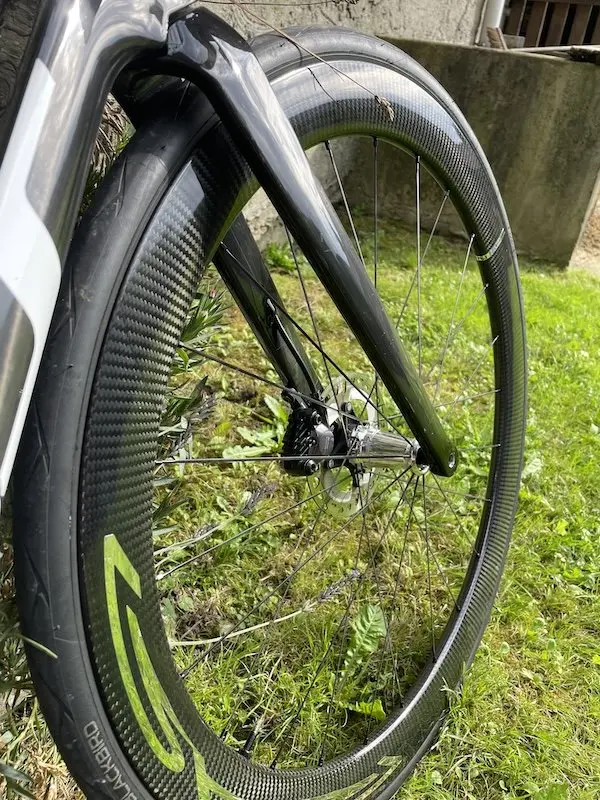
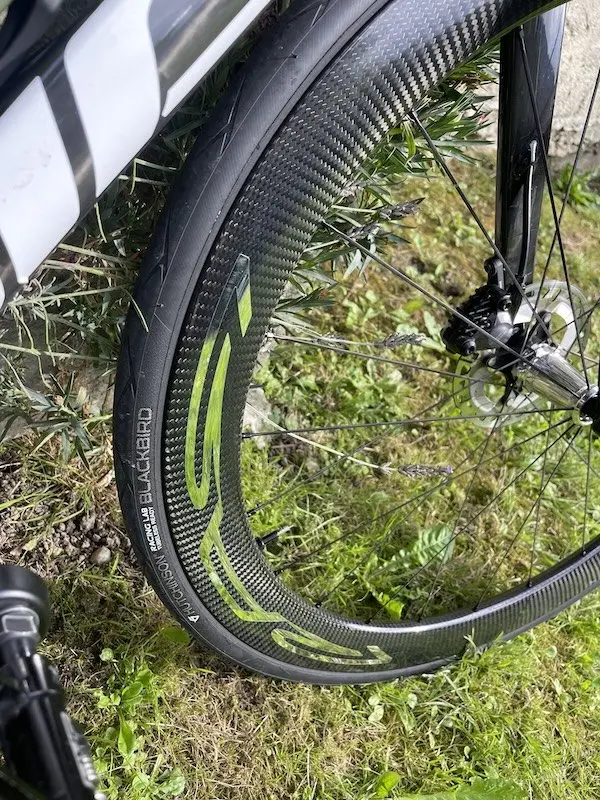
For this test, I opted for a black, tubeless 26 mm version to match rims with an internal width of 21 mm. The tire sits perfectly flush with the rim, which is an aerodynamic advantage. These tires, mounted on RAR Even rims, seat themselves with just a pump—no tire lever required. This is rare enough to be worth noting. On other rims, I’ve had to use an air tank, but here they inflate very easily, without any trouble, and seal up perfectly. Just 20 ml of latex is enough. I used Hutchinson Protect’Air.
Keep in mind that for road bikes, the most popular sealants are Stan’s NoTubes, Hutchinson, Orange Seal, Silca, and Pirelli, which (from what I’ve gathered, though I haven’t tried it yet) is said to be the best with the fastest sealing speed. At Hutchinson, I assume they’re already working to match or even surpass this feature.
The tire weighs slightly more than a Continental, coming in at 267 g on the scale for the 26 mm size (280 g for the 28 mm size)—an extra 20 g that, as we’ll see later, doesn’t put it at a disadvantage at all.
On the Road with the Hutchinson Blackbird
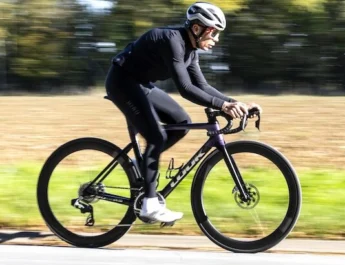
Given my weight of 56 kg, I opted for 4.5 bar in the front and 4.8 bar in the rear for roads I’d describe as variable, meaning a pressure that gives me decent performance and comfort on rough sections without feeling like I’m riding on chewing gum on the smooth, well-maintained sections. In the latter case, I’ll increase the pressure by almost 1 bar. For rainy conditions, I lower it by 0.3 compared to the initial pressure.
The first few revolutions of the wheels remind me of a tubular tire. Here, you get a very comfortable road feel. It’s a tire that’s closer to a Vittoria than a Continental. In fact, switching back to the Continental makes it feel stiffer; the road feel is clearly different. On a GP 5000 STR, you get the sensation of something gliding over the road, but in the sense of low rolling resistance. I’ll come back to that later.
The second major change is the grip. As you’ve probably gathered, I’m comparing these a lot to the GP5000 STR tubeless version, which remains the benchmark. Here, it’s clear that cornering confidence is much higher. You can really feel that the tire inspires more confidence. It’s striking. This is a major advantage in terms of safety on both dry and wet surfaces—an area where Continental still has room to improve. Hutchinson has perfectly nailed the right rubber compound to deliver this optimal grip. Grip is provided by the rubber compound on the shoulders of the tread, while the center tread offers rolling resistance that’s touted as among the best. To verify this, we sent the tire to Alban Lorenzini, who specializes in this kind of performance testing.
In summary, we’re very close to the Continental’s performance, with only 3 W more per pair at 30 km/h.
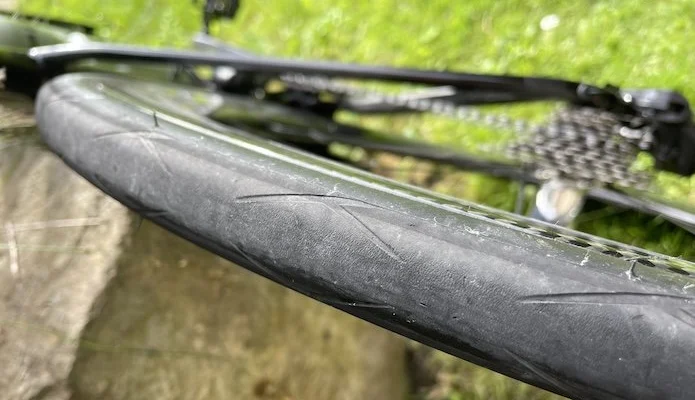
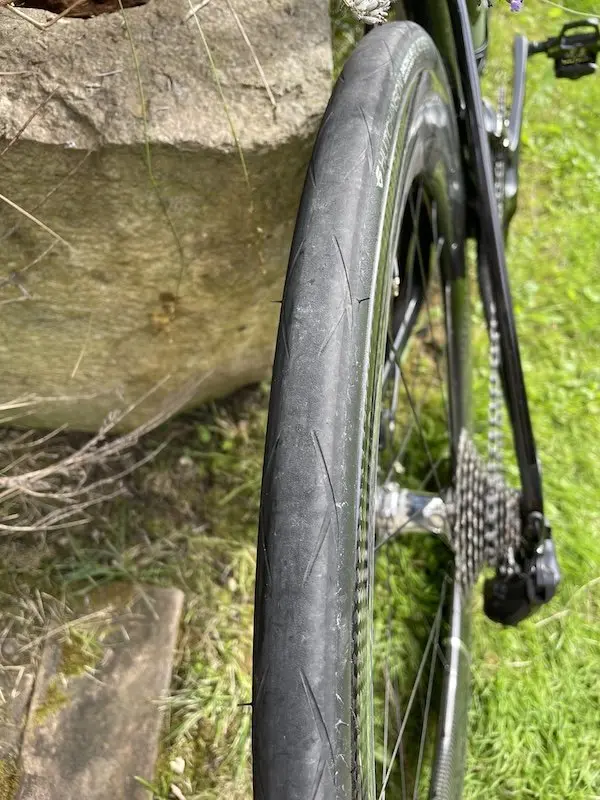
But where the French brand really stands out is in durability. Over the years, the German giant has reduced rolling resistance at the expense of durability. You shouldn’t expect much more than 3,500 km from a GP 5000—and even that’s being optimistic. With the Blackbird, I’ve never had a flat. There are some small cuts on the rear tire after 2,500 km, and I’m approaching 4,200 km with plenty of life left in it… So for me, there’s no contest, even though getting a flat is always a gamble. You can get a flat on brand-new tires or go 30,000 km without ever getting one…
One important change from the Fusion 5: the tire doesn’t swell. Its original size stays the same over time. This is important because ending up with a tire that’s as big as a balloon after just a few rides isn’t ideal…
The verdict on the Hutchinson Blackbird test
The overall verdict is quite excellent. Hutchinson has developed a highly versatile tire that offers comfort and grip, rivaling the best in terms of rolling resistance. This slight shortcoming stems from a minor trade-off: a bit more rubber for significantly more kilometers. In short, it’s all good. We’re already eagerly awaiting the expansion of the lineup with a tire more akin to a GP5000TT, to be reserved for specific goals, as well as a durable tire for high-mileage riders who don’t mind slightly higher rolling resistance and want, above all, to avoid roadside repairs. As for me, I’ve never had that problem… The retail price is listed at €69.99 for the tubeless version and €49.99 for the tube version.
=> Buy the Hutchinson Blackbird tubeless for €62.99
=> Buy the Hutchinson Blackbird tubetype for €44.99
Hutchinson Blackbird tires at a glance… Pros: grip, durability, comfort, made in France Price: €69.99 for the tubeless version, €49.99 for the tube-type version. Contact: cycling.hutchinson.com |
Share the post "Long-Term Test of Hutchinson Blackbird Racing Lab Tires"