The topic of oversized derailleur cages is currently one of the most divisive in the cycling world when it comes to high-end equipment. It must be said that the prices of the few brands offering this type of product range from approximately €200 to over €800—from exotic components of questionable reliability to accessories backed by well-oiled marketing campaigns promising unmatched performance and aerodynamic efficiency. So it’s entirely fair to question the real-world benefit of an oversized derailleur cage with ceramic bearings.
Traditional manufacturers such as Shimano, SRAM, and Campagnolo have remained somewhat cautious on this subject, even refuting the idea that this type of setup could have an impact on drivetrain efficiency. However, the rear derailleur on the new SRAM Red AXS groupset also features larger pulleys than the previous model, which primarily improves chain wrap and thus the smoothness of the entire drivetrain, especially on the smallest sprockets. But the fact is, it’s very difficult to precisely measure the power gain from this type of setup. We tried to do so with this new derailleur cage from CeramicSpeed—the leading brand in this market—but didn’t see any truly significant gains. Nevertheless, that doesn’t mean there are no benefits at all. Here’s why. A StifferDerailleur Hanger The original OSPW (Oversized Pulley System) derailleur cage was launched in 2015 by CeramicSpeed, It quickly proved popular among those seeking optimal drivetrain efficiency—particularly on time-trial bikes—thanks to the ceramic bearings used in the pulleys. Pulleys that spin very freely and without friction are always impressive. This suggests that the system offers less pedalling resistance than conventional plastic pulleys, even though we know that under load the benefits aren’t always easy to quantify.
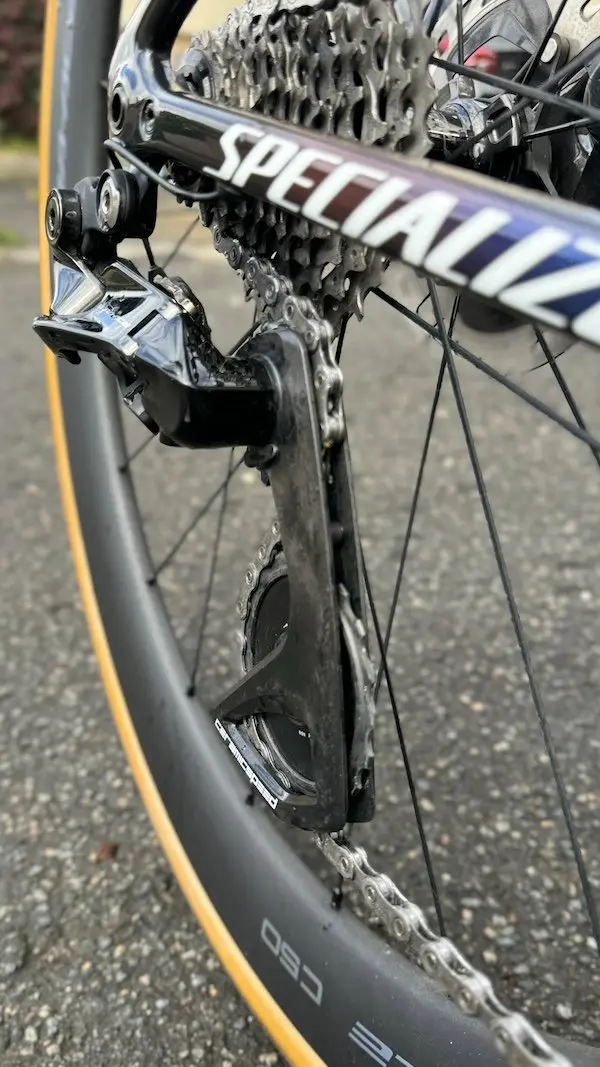
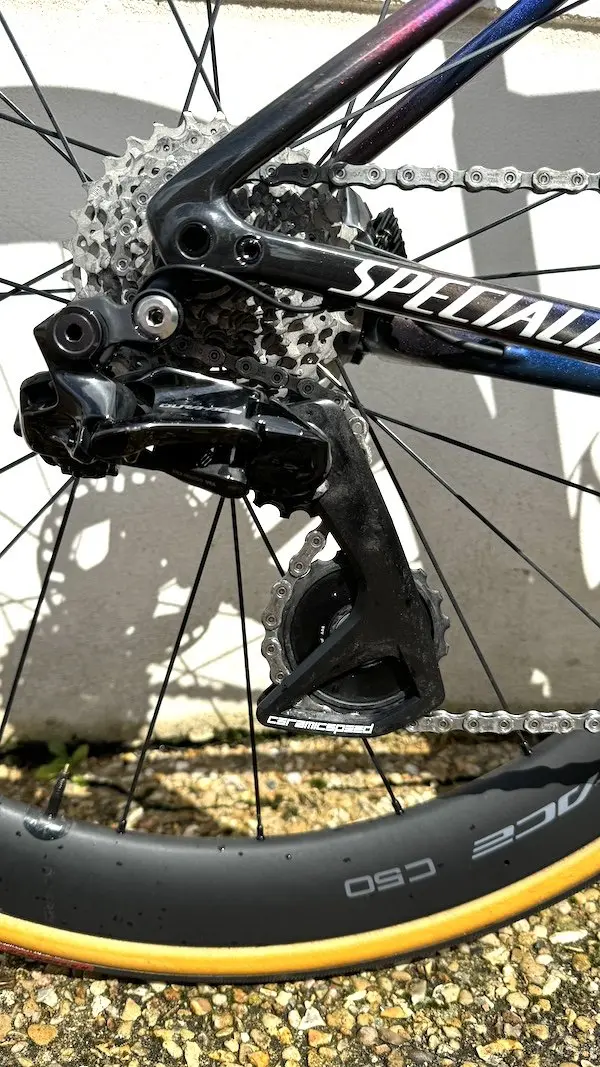
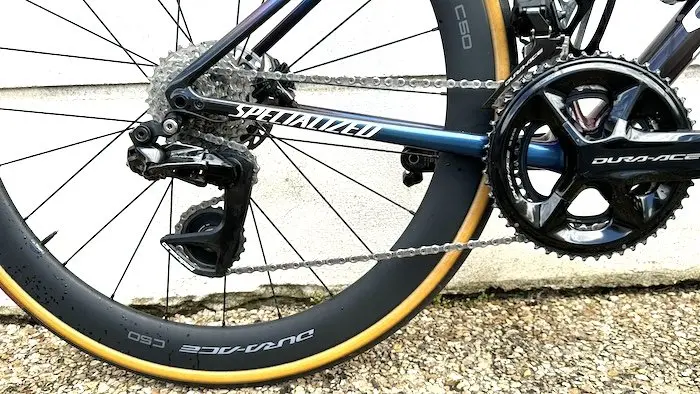
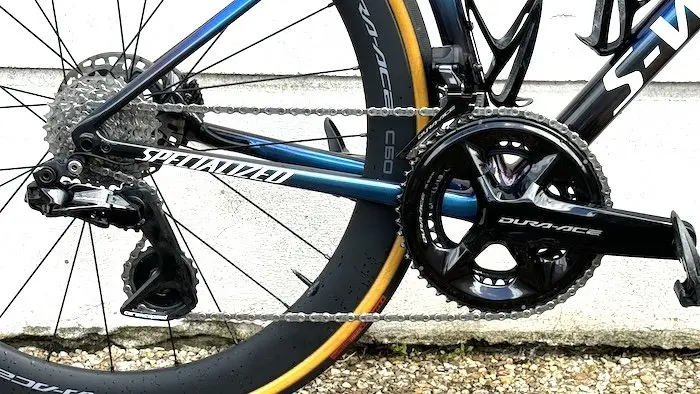
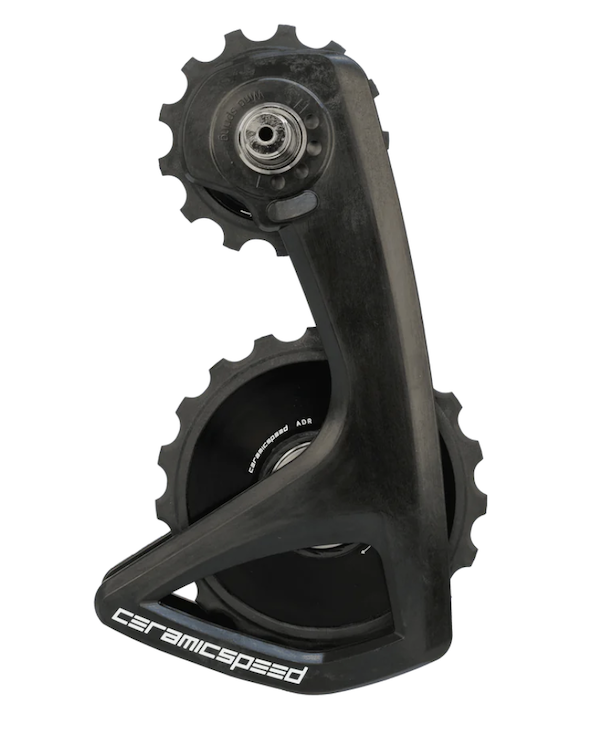
In 2023, the Danish brand unveiled an aerodynamic OSPW, tested in a wind tunnel. With the new OSPW RS Alpha Disc derailleur cage, it adds new features for greater stiffness and durability, featuring a reinforced cage that also allows for decorative options or logos to be added, ensuring a racing-style finish. This stiffness was sometimes lacking in the early models, which could lead to imprecise shifting. That is no longer the case here, though the cage is slightly heavier: at 103 g, the OSPW RS Alpha Disc weighs 50 g more than the Shimano Dura-Ace cage and 25 g more than the original OSPW. =>Buy a CeramicSpeed derailleur cage
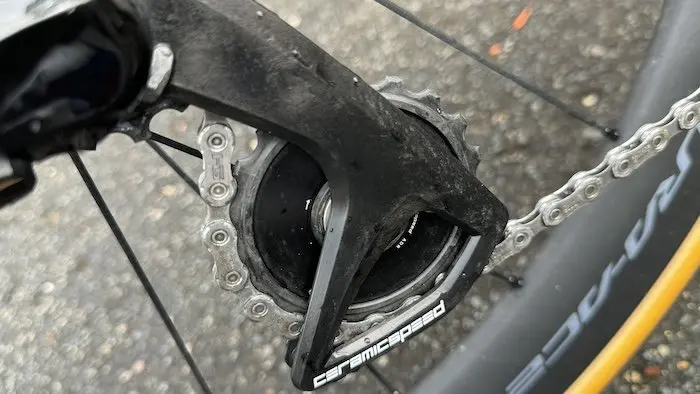
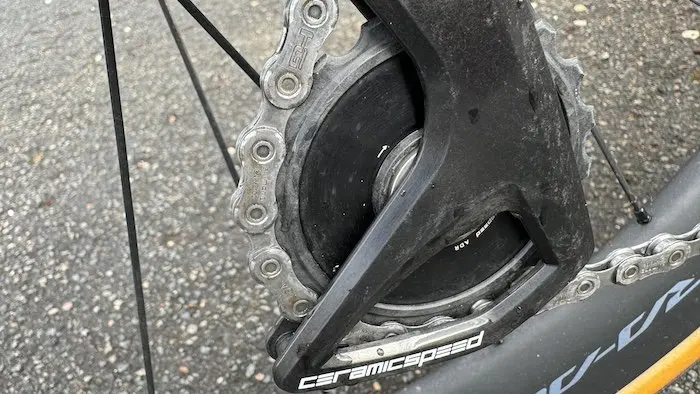
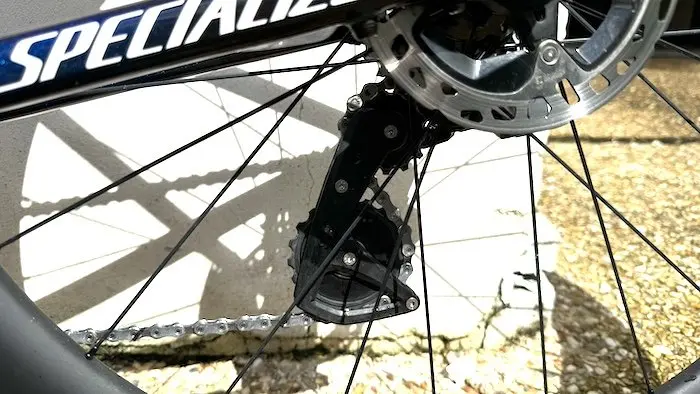
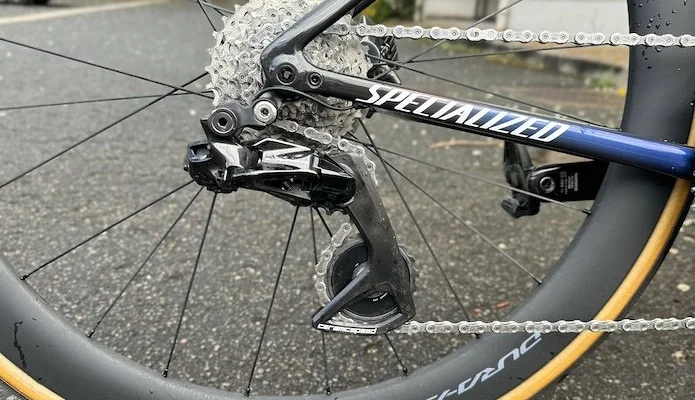
Most notably, it features a solid lower pulley—or “Alpha Disc,” as the brand calls it—a design previously seen on the OSPW X derailleur cages for SRAM mountain bikes. The Alpha Disc is designed in two parts, featuring an aluminum disc to eliminate the risk of debris getting trapped inside the open sections of conventional pulleys, and a wide-and-narrow tooth profile made from a composite material designed to extend wear protection and reduce drivetrain noise.
Finally, CeramicSpeed has also developed a feature calledADR (Active Debris Remover) that makes it virtually impossible for dirt to penetrate the bearings of the OSPW RS. It’s basically a dust cover anchored in a groove around the pulley that completely encloses the bearing. CeramicSpeed reportedly developed this feature in collaboration with certain professional cyclocross teams, such as Team Tormans, which used a prototype of this derailleur cage for an entire season. The riders reportedly noticed a clear difference in drivetrain performance under the most challenging conditions.
Although this derailleur cage seems, on paper, perfectly suited for cyclocross or gravel bikes, it’s also a great fit for a road bike, ensuring a quiet and reliable drivetrain.
Does the CeramicSpeed OSPW RS Alpha Disc derailleur cage save watts?
When you invest more than €500 in a derailleur cage, you’d like to think it will improve your performance. CeramicSpeed claims an efficiency gain of a few watts when a bike is equipped with all the ceramic bearings available from the brand—namely, those in the bottom bracket, the wheels, and the derailleur pulleys. Another benefit is said to come from a specially treated chain, but that’s a whole other topic.
I tried to conduct a comparative efficiency test between a standard derailleur cage mounted on a Shimano Dura-Ace rear derailleur and this OSPW RS derailleur cage. The bike already had a CeramicSpeed bottom bracket, by the way. To conduct this test, I mounted the bike on a Wahoo Kickr indoor trainer with both derailleur cages and performed several sets of intervals, basing my intensity on the wattage readings from Garmin Rally power-meter pedals. The idea was to determine the difference in watts between the two power readings—from the pedals and the trainer—for each derailleur cage.
Unfortunately, the data collected doesn’t allow for any definitive conclusions, since the observed differences fall within the accuracy range of both sensors (1% in both cases). That means that with a margin of error of three watts for an effort around 250 watts, it’s impossible to say whether there’s a real performance gain or not.
On the Road with the CeramicSpeed OSPW RS Alpha Disc Derailleur Hanger
Once I got past the slight disappointment regarding the weight (the cage weighs twice as much as a Dura-Ace cage), I had also hoped for a significantly improved ride feel, at least on the workshop stand. But since the freehub body on my Dura-Ace wheel naturally lacks smoothness, I also had to do without the “wow” effect that this type of cage normally produces when spinning the chain backward.
On the road, I was initially pleasantly surprised by how quiet the drivetrain was. This OSPW RS Alpha Disc derailleur cage really dampens the little chain rattles, and you always feel like you’re riding with great smoothness. Furthermore, the derailleur shifts cleanly and precisely even in extreme cross-chaining situations—far more so than with the first cages of this type. These are major positives, but they weren’t enough to justify the investment during my first few rides.
However, over time, I’ve noticed an unexpected advantage to using this oversized derailleur cage. I don’t usually like riding with the small chainring, especially a 36-tooth one, as is the case with the combination required when paired with the 52. In the past, I’ve always preferred “large” small chainrings—a 42 when possible, then a 39. When shifting the chain onto the small chainring, I’ve always felt like I was spinning around the crankset and getting less efficiency than with an equivalent gear ratio using a large chainring and a large sprocket. I suspect that’s because there are fewer teeth on the chainring meshing with the chain, plus the chain’s path around the derailleur. Thanks to this oversized derailleur cage, the chain follows a smoother, more rounded path around the derailleur. It’s tighter and flutters less. The transition between the large and small chainrings is therefore smoother, and I regularly find myself not automatically trying to shift back to the large chainring after a section that required a very low gear. I was able to confirm these sensations by alternating rides with a test bike, also equipped with the same Dura-Ace drivetrain but without the oversized cage. Overall, I find the entire drivetrain to be smoother with the CeramicSpeed cage, though these are merely sensations that are difficult to quantify with a stopwatch.
Finally, a quick inspection of the OSPW RS Alpha Disc cage after 2,500 km confirmed that the bearings still spin exceptionally smoothly by hand, which seems to validate the claim that they are protected from debris. Meanwhile, traditional pulleys require thorough degreasing and cleaning to even come close to matching this performance.
So, is that enough to justify the €579 price tag for this CeramicSpeed OSPW RS Alpha Disc derailleur cage? In absolute terms, the benefits it provides will be minimal. I appreciate using this derailleur cage, which makes my drivetrain smoother and quieter without compromising its precision, as well as its reliability and durability, which should set it apart over time compared to a conventional pulley system. However, you shouldn’t expect a measurable performance gain beyond the feel of it. Think of this component as the icing on the cake, so to speak.
The CERAMICSPEED OSPW RS ALPHA derailleur cage at a glance…
Pros: drivetrain smoothness, precision and quietness; derailleur cage stiffness; feel when using the small chainring. Cons: weight, price.

 The topic of oversized derailleur cages is currently one of the most divisive in the cycling world when it comes to high-end equipment. It must be said that the prices of the few brands offering this type of product range from approximately €200 to over €800—from exotic components of questionable reliability to accessories backed by well-oiled marketing campaigns promising unmatched performance and aerodynamic efficiency. So it’s entirely fair to question the real-world benefit of an oversized derailleur cage with ceramic bearings.