Share the post "Garmin Tacx Neo 3M Smart Trainer Review"
Launched at the very beginning of the year, the new Garmin Tacx Neo 3M is one of the most accurate and powerful indoor trainers on the market. Featuring a motorized flywheel, dual-sided power measurement, and two Bluetooth connections, it primarily adds integrated Motion Plates to the already highly regarded Tacx Neo 2T, from which it directly derives. These plates allow for fore-aft movement while riding, offering more realism than ever for indoor training sessions. However, its price is very high.
By Guillaume Judas and Sébastien Argentin – Photos: ©Sébastien Argentin / DR
To get a good quality smart trainer and regularly perform qualitative indoor training sessions, the entry ticket is around €500 to €600. But there are even more powerful, more accurate devices that offer more advanced features for even greater realism. It’s up to each individual to decide what investment is necessary to maintain pleasure and motivation to continue training when outdoor conditions are difficult or time is short. The new Garmin Tacx Neo 3M undoubtedly belongs to the category of the most upscale devices, like the Wahoo Kickr Move, its direct competitor on the market, by the way.
High-end features
Compared to a mid-range smart trainer, the Garmin Tacx Neo 3M offers very high power measurement accuracy, as good as the best power meters you can install on a bike. This can be a significant argument for those who seek to train precisely with power data and do a lot of indoor training. In addition to its accuracy, it offers a maximum resistance of 2200 watts and simulates a maximum gradient of 25%. Garmin also claims a largely revised ERG mode for more control and precision compared to its previous models. As a reminder, ERG mode allows you to program training sessions by following intervals with target power, and the indoor trainer automatically adjusts its resistance to force you to maintain the desired power.
It features a flywheel with a motor that allows it to simulate descents, an undeniable asset during long sessions on Zwift or another training application. Thanks to this feature, pedaling is more realistic and closer to the conditions encountered on the road. During virtual competitions, it is thus possible to coast on descents without being dropped by the peloton.
On the Garmin Tacx Neo3M, the different surfaces of the application used are also simulated. Cobblestone sections, wooden bridges, or gravel paths are materialized by realistic small jolts and a characteristic clicking sound (different depending on the surface).
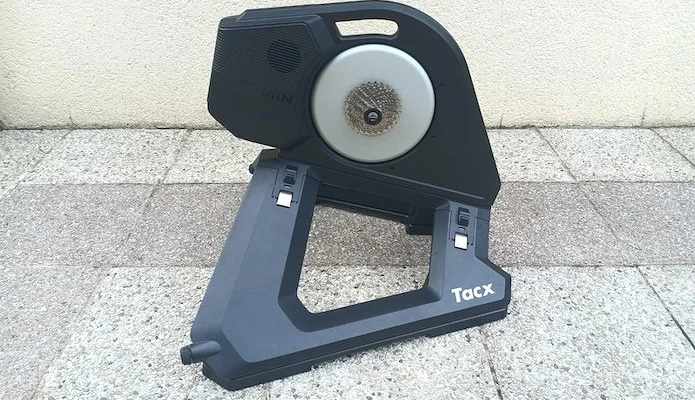
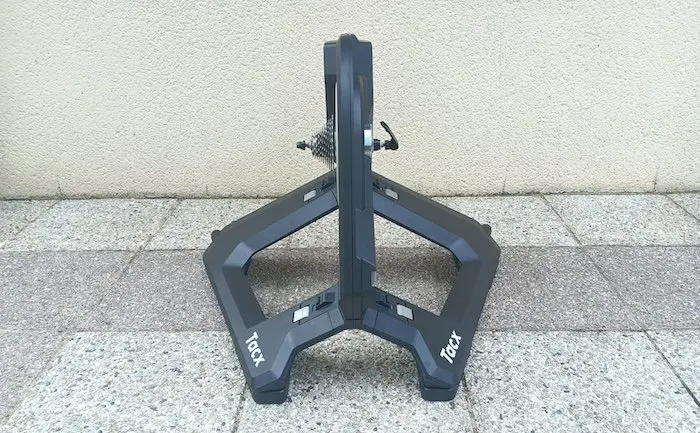
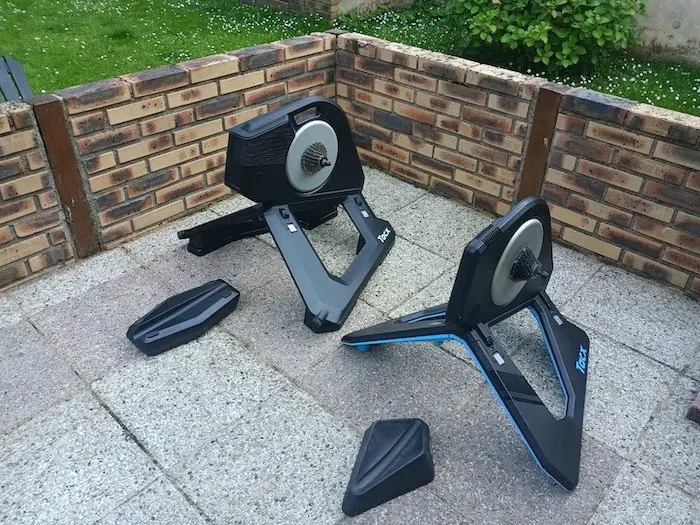
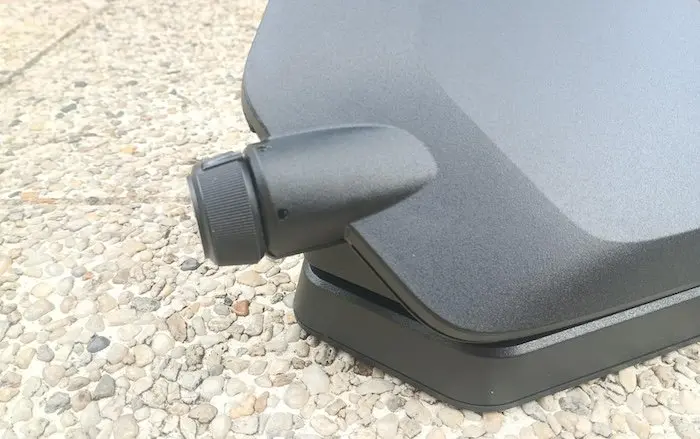
To these features already present on the Tacx Neo 2T, the Neo 3M adds a very practical handle for moving the device, and above all integrated Motion Plates, to ensure fore-aft movements during use in addition to the natural lateral flex of the device. The benefit? Smoother and more natural pedaling, closer to the movements actually encountered on the road, and less stress on the bike frame, which is thus not completely locked onto a support during effort. To judge the effectiveness or not of the Motion Plates, simply lock them on the indoor trainer. But once you’ve tried them, it’s hard to do without them.
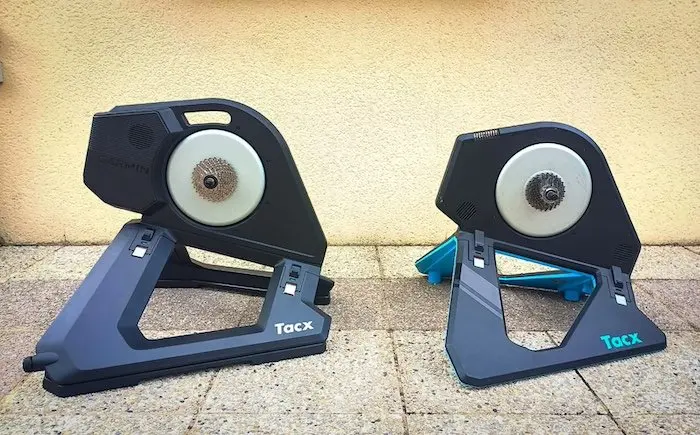
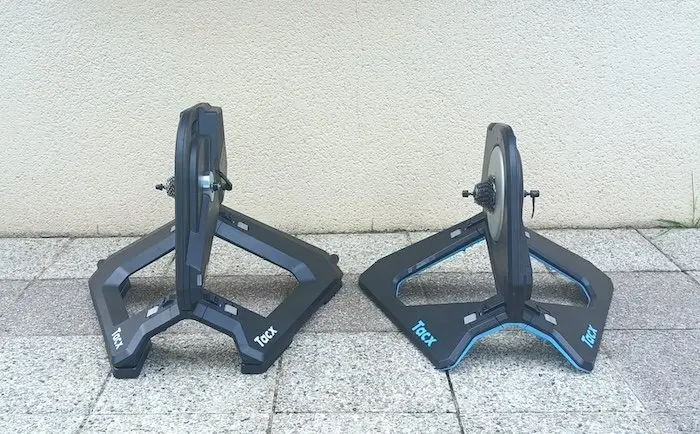
This particularity slightly increases the size of the Neo 3M compared to the Neo 2T, with an additional width of 55 mm, 50 mm more in length, and 45 mm more in height. The weight also increases from 21.5 kg to 23.6 kg. Fortunately, the foldable legs help to limit the space required for storing the device when not in use.
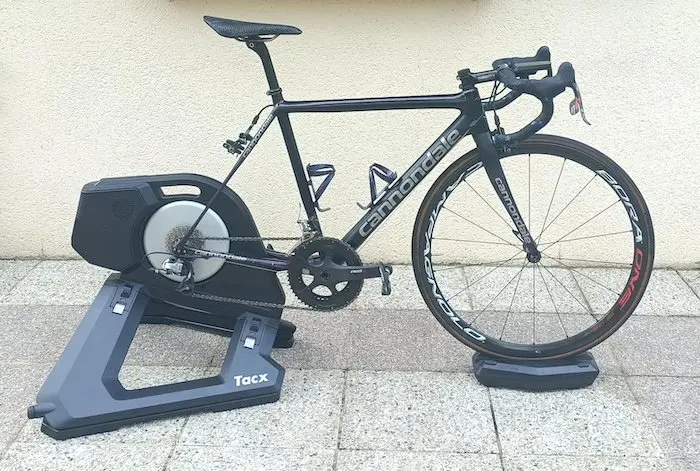
The Neo 3M is, of course, stable and quiet, while being compatible with almost all bikes (road, gravel, mountain bike, with disc or rim brakes). It comes with an 11-speed cassette mounted on a Shimano/Sram HG freehub body, but Shimano Micro-Spline, Sram XD-R, or Campagnolo freehub bodies are also available as options. Curiously, with a bike fitted with a 25mm tire, the supplied front wheel support causes the bike to dip slightly forward, by a few millimeters. There are two directions for the support (to allow a mountain bike tire to be inserted), but the “road” side does not allow the bike to be perfectly horizontal.
The Neo 3M can be used offline with progressive resistance, but it now supports WiFi/Ethernet connected accessories to limit the risk of connection loss. It can be connected simultaneously to various devices, peripherals, or applications thanks to two simultaneous Bluetooth connections in addition to unlimited ANT+ connections. Finally, even if it can be considered a bit of a gimmick, the integrated LED light projected on the floor allows you to gauge the effort level thanks to a wide range of colors.
These latest updates compared to the Neo 2T, launched five years ago, are not too much to justify a very high selling price for the Neo 3M, officially at €1999.99. Because the Neo 2T has also benefited for some time from an option with added Motion Plates, which can now be found at €1299.
Very natural lateral and longitudinal movement
The first pedaling impressions do not completely disorient a user accustomed to the Neo 2T. We find the same very natural sensations during gradient variations on Zwift, with very progressive resistance transitions comparable to those encountered on the road. In virtual descents, the flywheel seems to accelerate, thus simulating a moment of coasting: a very advantageous feature for virtual group rides or competitions as explained above, but also for extending the distance of an indoor trainer session, by reducing the risk of boredom caused by overly regular pedaling. The simulations of surface changes also go in the same direction, even if they seem a little less pronounced than what we had already appreciated on the Neo 2T.
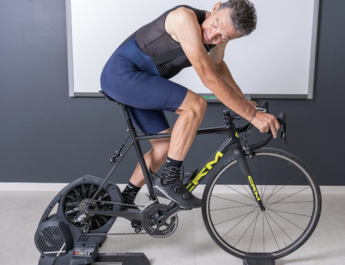
The latter already had a very slight lateral freedom, or rather a form of flexibility, imperceptible when riding out of the saddle but which avoided pedaling too constrained when seated. The Neo 3M seems to benefit from slightly greater freedom, which when combined with the fore-aft movement truly frees up the pedaling motion. In the event of a sprint or a powerful effort standing on the pedals, the freedom of movement is not as pronounced as on the road, but in a seated position, it is very similar to the sensations felt during intense effort facing a climb or any difficulty. This freedom in both directions, in addition to greatly limiting stress on the bike frame, can also prevent certain joint or tendon injuries for those who ride a lot on this type of device.
Power measurement accuracy
With the Neo 3M, Garmin claims a power measurement accuracy of 1%, which concretely means that for a real effort at 300 watts, the device indicates between 297 and 303 watts. This is equivalent to the best power meters on the market. The accuracy of a power meter is also defined by its reliability over time and its absence of drift in measurements. Note also that Garmin indicates that it is no longer necessary to calibrate the Neo 3M. Compared to the Neo 2T, we did not find any significant difference in power measurement, and we therefore tend to trust the Neo 3M. For those who train with power and intend to use this indoor trainer as a reference, it is important to specify that power on an indoor trainer is not the same as on the road. For the same perceived effort, you always produce a little less watts on an indoor trainer, because there are not the same frictions as on the road. If you perform interval training on an indoor trainer and on the road with a power meter, it is important to use references for the indoor trainer on one side, and for the road on the other.
However, as stated earlier in the article, the Garmin Tacx Neo 3M can perfectly serve as a power measurement device for those who train a lot on an indoor trainer during the week, and ride more freely outdoors on weekends. They will thus appreciate the accuracy and flexibility of the ERG mode during guided training with this type of constraint. It obviously precisely follows the power imposed by the program, but with a sensation of super natural and progressive transition. In case of exceeding the target value, the ERG mode easily brings you back into the correct zone by quickly adapting the resistance felt under the pedals. And conversely, if you are below the zone to follow, it precisely adapts the resistance a bit as if the slope in front of you was progressively steepening. Here again, the Garmin Tacx Neo 3M justifies its high-end positioning by being one of the most pleasant devices to use. This is a definite advantage when investing time and energy to train properly.
The most expensive indoor trainer on the market
So, is the price of the Garmin Tacx Neo 3M justified? It is the most expensive indoor trainer on the market, only surpassed in this area by smart trainers that act as a second bike, but which are obviously heavier and even more imposing. It is even more expensive than the Wahoo Kickr Move tested in these columns in January 2024, offering even more realistic lateral and longitudinal movements and a motor simulating descents. But the Wahoo has the advantage of being compatible with the Kick Climb, which changes the bike’s inclination according to the simulated gradient. Ultimately, everything will depend on how you intend to use this indoor trainer. If you base a large part of your training on indoor training and plan to spend several hundred hours a year on this type of device, its features, accuracy, and build quality are undoubtedly decisive. If your indoor training practice is more occasional and limited to a few sessions in winter, it is better to opt for a less advanced device, or for a Garmin Tacx Neo 2T, almost as powerful and which can now be found at more attractive prices than at the time of its release in 2019.
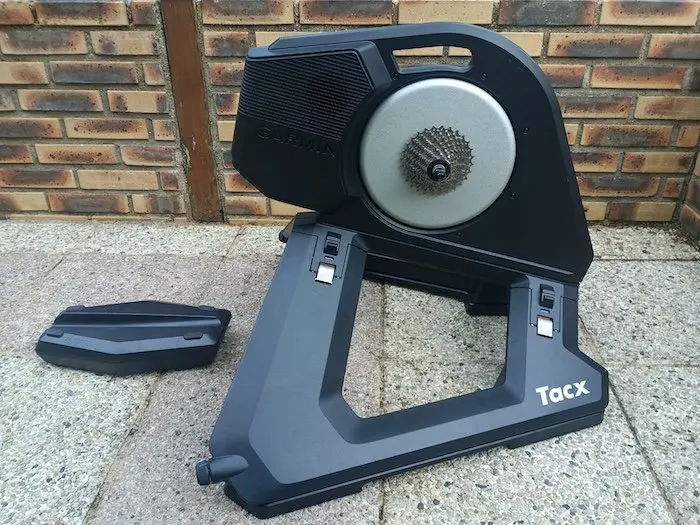
The GARMIN TACX NEO 3M indoor trainer in brief… Pros: Integrated Motion Plates, motorized flywheel, powerful ERG mode and very smooth power transitions, dual Bluetooth communication, handle Dimensions: 630 x 800 mm – Height: 595 mm – Folded dimensions: 695 x 355 mm – Weight: 23.6 kg – Wireless communications: ANT+ connectivity, Bluetooth wireless technology – Maximum power: 2200 Watts – Maximum gradient: 25% – Freehub body: Shimano/SRAM 9 to 11 speed (compatible, 11-speed cassette included) / Campagnolo / SRAM 12 speed/XDR / Shimano Hyperglide+ 12 speed – Compatibilities: direct mount quick release axle (130/135 x 5 mm) for bikes equipped with a quick release axle / Thru-axle caps, (142 m/148 mm x 12 mm) for thru-axle bikes – Price: €1999 – Contact: garmin.com |
Share the post "Garmin Tacx Neo 3M Smart Trainer Review"