Share the post "Long-Term Test of the New Orbea Orca"
Last summer, we had the opportunity to get our first hands-on experience with the new Orbea Orca, both in its top-of-the-line version and in a more affordable version. As part of our long-term test of the new SRAM Red AXS groupset, we rode nearly 5,000 km on this versatile OMX carbon fiber frame this spring. That gave us a much clearer idea of the bike’s capabilities.
By Guillaume Judas – Photos: ©Different Media Productions / Orbea / NVCR

With this new Orca—the seventh of its name—Orbea sought to return to the original philosophy of its iconic model, aiming to design a lightweight, dynamic, and easy-to-handle frame that’s comfortable and ideal for tackling steep climbs. A model that perfectly complements the Orca Aero, the Basque brand’s other road bike, a high-performance bike on fast, open roads. Most potential customers obviously won’t be able to afford both bikes. Fortunately, the Orca is much more than just a climber’s bike, as we discovered during this test, which spanned a little over two months, mainly on gently rolling and windy routes—terrain that isn’t normally ideal for this machine. It’s worth noting that in a version equipped with the Shimano Ultegra Di2 groupset, the Orca OMX has just been named Road Bike of the Year by Le Cycle magazine.
Specific Build
For a detailed look at the Orca’s design, we invite you to revisit the overview and initial test ride of the bike, in its top-of-the-line OMX carbon version with a Shimano Dura-Ace groupset and Oquo RP35 LTD wheels.


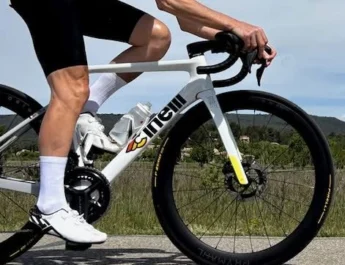
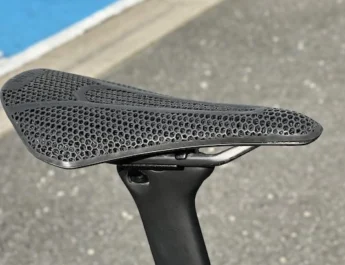
It was during the long-term test of the new SRAM Red AXS groupset that I was able to get my hands on an Orca OMX again—a version that isn’t currently sold as such, built and tuned by SRAM. Alongside the high-end groupset, Zipp 353 NSW wheels were installed in place of the Oquo wheels I had previously ridden. A Zipp handlebar (later replaced during the test with a Most), a Fizik saddle (later replaced during the test with a Specialized Power Expert Mirror), Zipp carbon bottle cages, and Shimano Dura-Ace pedals rounded out the final build, based on a frame, fork, seatpost, and stem identical to those found on any Orca OMX model in the lineup. I weighed the bike at 7.130 kg in size 51, fully assembled and ready to ride, which is consistent with the advertised 6.64 kg (without pedals or bottle cages) for the Dura-Ace version equipped with Oquo RP35 LTD wheels.

I can’t wrap up this brief overview without mentioning the color: this “Cloud Orange–Stone Blue” combination rarely leaves anyone indifferent. You either love it or hate it. This color scheme is one of four options offered when ordering a standard Orca OMX, and in our opinion, it’s not the best choice. This satin orange (“salmon,” as my daughter would say) is also difficult to clean. Nevertheless, it’s important to remember that at Orbea, everything is customizable thanks to the MyO program, which lets you choose a unique color combination and opt for specific configurations (stem or crank lengths, chainrings, cassette, wheel size options—smaller or larger— tires, or handlebar setup). In short, it’s still entirely possible to make an Orbea Orca your own, down to the smallest detail, even starting with a model equipped with Shimano 105.

On the road and in the wind with the Orbea Orca OMX
Between early March and early May, I didn’t have the chance to ride the Orca in the high mountains. I first rode the bike, equipped with the new SRAM groupset, in early March in Italy, spending a few days riding through the Prosecco hills. The route included some flat sections, but mostly varied climbs ranging from 2 to 4 km with an average gradient of 6 or 7%, and even a few steeper ascents with sections reaching 15%. This experience complemented my first ride on this Orca OMX frame over the Pyrenean passes in early summer 2023. There were climbs, but also descents, where the frame was able to demonstrate its capabilities on mountainous terrain.

Comfortable, responsive, and agile, the bike offers a smooth ride that makes steep slopes relatively easy to tackle, provided you’re in the right gear. The bottom bracket seems stiff enough to prevent power transmitted to the pedals from being lost, but the slightly more flexible front end—and especially the more supple rear triangle—provide excellent responsiveness when you stand up on the pedals, and even help smooth out gear-selection mistakes by allowing you to rely a bit more on torque when you’re wobbling around on the bike. In short, the frame isn’t excessively stiff and prevents muscle fatigue by flowing with your movements, and it’s always easy to pick up speed again, even when you’re feeling tired. Nevertheless, it remains precise and reassuring on descents, allowing you to tackle elevation changes safely.

But unlike the first Orca we tested, this Sram Red model is equipped with Zipp 353 NSW wheels, featuring wavy rims with a height ranging from 42 to 46 mm. These wheels are taller than the Oquo 35 LTDs fitted to the first bike I tested, but also wider (optimized for 28/30 mm tires), hookless, and, curiously, a bit lighter. In my opinion, they’re also slightly stiffer. While the Zipp wheels have very little effect on the bike’s handling on climbs, it’s on flat and rolling sections that they offer a noticeable advantage over the Oquo 35s, providing a bit more aerodynamics and inertia.

So it was on my usual stomping grounds that I put the Orca OMX to the test, especially during a winter that seemed determined to drag on. Flat stretches, slight inclines, sudden dips, and small bumps, along with wind (lots of wind), were the order of the day on most of my rides, particularly in March and April.
Overall, the Orca isn’t the best-performing bike on the market when it comes to tackling long, exposed straights. It’s still easy to handle, but it always seems to struggle a bit when the wind is blowing hard or the speed picks up. It’s a bike that handles better during successive accelerations than when riding at a steady pace. The Zipp wheels, however, offer a clear advantage here and make the bike more versatile than it would be with 35-mm-tall wheels.

Before tackling open roads, I usually have to ride through the city for about ten kilometers, amid light traffic but with numerous traffic lights, stop signs, accelerations, and slight inclines, which still add up to about 150 meters of elevation gain before reaching more open roads. Under these conditions, the Orca’s responsiveness works wonders and immediately sets it apart from the bike I usually ride in the winter (a Gravel Factor LS converted into a road bike). This is mainly thanks to it weighing a full kilo less and the frame’s forgiving handling. The steering feels particularly precise and responsive, which also contributes to the ease of handling in these conditions. I experienced these characteristics consistently throughout this long-term test.
While the frame isn’t excessively stiff laterally, this shouldn’t be interpreted as a sign of weakness or fragility. During this long-term test, I had the opportunity to do strength-training rides, which involved riding at a low cadence in the highest gear on certain climbs. I didn’t notice any play in the bottom bracket under these heavy loads, nor any friction in the front derailleur, which shows that the frame’s bottom bracket remains stable. The bike, however, does feel slightly more flexible at the front during powerful sprints on flat terrain. Compared to other bikes more specifically designed for this type of effort, you can feel a slight flex at the front when you stand up forcefully on the pedals at the start of the sprint.

On the (short) hills of the Chevreuse Valley, the bike always feels light and airy as soon as you stand up on the pedals. The frame isn’t locked laterally, so you’re just as comfortable pushing hard at a cadence of 90 rpm as you are riding powerfully at 60. As I mentioned in my first review of the bike, it’s easy to handle and doesn’t require perfect coordination to ride aggressively during a hard effort. That’s what also makes it so accessible to riders of almost any skill level. Even for cyclists who aren’t very fit or who ride only occasionally, its smooth, responsive handling seems to adapt perfectly to the rider’s mood (or fitness level) at any given moment.

In terms of comfort, as I’d already noted during the first test ride, the Orca doesn’t sacrifice its light weight for excessive bouncing, which could ultimately prove tiring. The bike feels well-balanced on rough surfaces, and—most importantly—it accommodates wide tires. With the Zipp 353 NSW rims (25 mm internal width), the two successive tubeless tires mounted on this bike (Goodyear Vector and Specialized S-Works Turbo 2BR) were measured at an actual width of 31 mm. With a tire pressure of around 4.5/5 bar, traction, grip, and vibration absorption are outstanding.
The verdict after nearly 5,000 km on the Orbea Orca
This latest version of the Orca is indeed a worthy successor to the original model, launched over 20 years ago, offering easy and accessible handling, comfort, and a responsive ride that’s appreciated in everyday use. With the Zipp 353 NSW wheels, the bike is, in my opinion, even more versatile than the first model tested in the summer of 2023. The Orca doesn’t lose anything on climbs, while being slightly more efficient on flat sections.
The Orca OMX is therefore one of the most interesting all-around bikes available today. And while Orbea doesn’t offer this exact test bike in its catalog, you can still choose your wheels from the Oquo lineup based on the terrain you usually ride on, as well as customize color details and accessory sizes through the MyO program. This is a top-of-the-line offering that you definitely shouldn’t pass up if you want to get the most out of this exceptional bike.
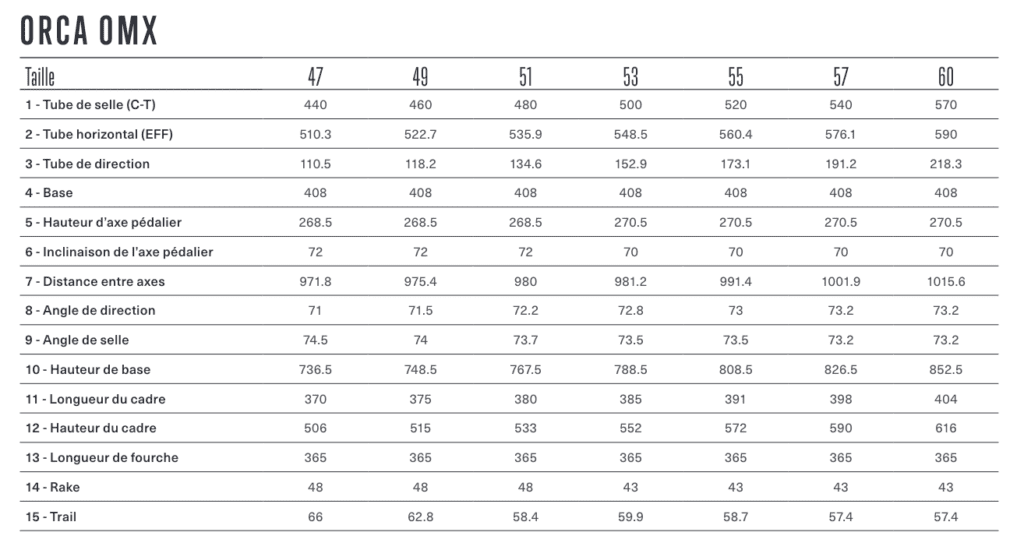
| The ORBEA ORCA OMX at a glance… Pros: weight, handling, approachability, responsiveness, integration, comfort, MyO customization program NUMBER OF SIZES: 7 – WEIGHT: 7.130 kg fully equipped with pedals, bottle cages, and computer mount (size 51 with SRAM Red AXS and Zipp 353 NSW wheels) – Frame kit at €4,282, complete bike starting at €5,832
Contact: www.orbea.com |
Share the post "Long-Term Test of the New Orbea Orca"