Share the post "More than 4500 km with the new Sram Red AXS groupset"
Sram officially launches its new high-end Red AXS drivetrain group, five years after a previous version that was undeniably successful. While with this new iteration the American brand has managed to retain the main characteristics of its flagship group (12 speeds, disc brakes, wireless electronic derailleurs, and a cassette with a 10-tooth small cog), significant efforts have been made to reduce weight (154 g less), improve lever ergonomics, and braking quality, as we were able to observe during this intensive test conducted over the past two months. Our verdict after more than 4,500 km ridden with the group.
By Guillaume Judas – Photos: ©Different Media Productions
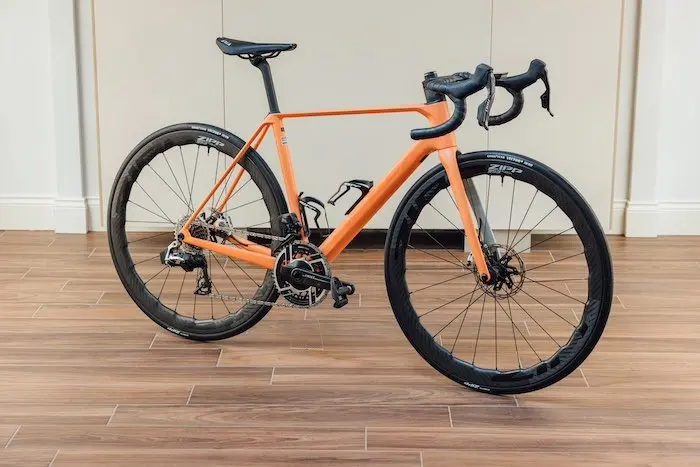
Released in 2019, the Sram Red eTap AXS logically awaited its successor, just over a year after the launch of the American brand’s second-tier group, the Force AXS.
With this renewed version of its flagship group (now called Red AXS), Sram does not revolutionize the field of drivetrains, retaining everything that has made it successful so far, namely wireless electronic derailleurs, a 12-speed cassette with a 10-tooth first cog, disc brakes, as well as multiple gearing options, in double or single chainring, with or without a power meter.
However, with this new Red, Sram revises its design to shed some weight (and now come very close to its direct competitor Shimano Dura-Ace), and improve lever ergonomics and braking quality. The gearing ranges offered are also superior to Shimano and Campagnolo, with four different cassettes and six chainring combinations available.
The complete weight of high-end groupsetsTaking into account the announced weights* from the three main protagonists in the high-end groupset domain, and accurate to within a few grams after all checks, Sram is back in the race against Shimano and Campagnolo with this new Red AXS.
*The weight of a complete groupset includes: crankset, threaded bottom bracket, cassette, chain, derailleurs, brakes, rotors, brake hoses, levers, battery(ies) and cables if necessary. Weight may vary by a few tens of grams depending on crank arm length, chainring size, and cassette teeth.[/td] |

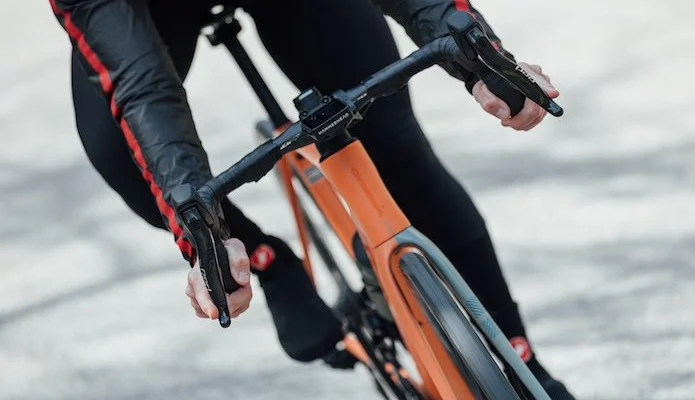
Aesthetically, the new Sram Red AXS group is first distinguished from the previous one by the shape of the brake/shift levers, which are longer, thinner, and have a lever with slightly more intricate curves that seem to fall directly under the fingers.
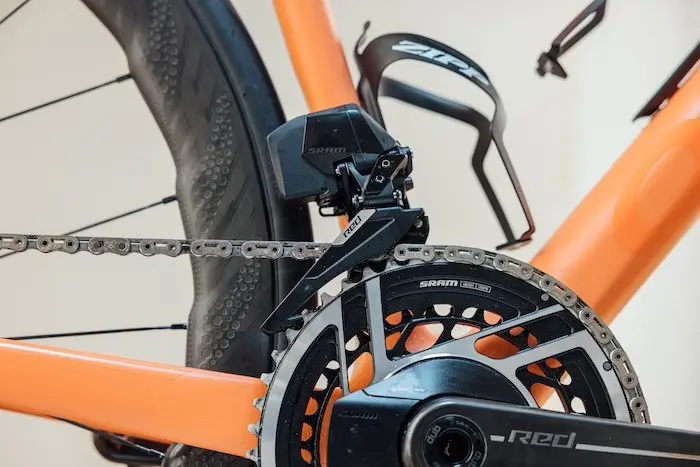
Keen observers will also notice the different profile of the brake calipers, as well as the slightly larger lower derailleur pulley of the rear derailleur.
The crankset, another prominent feature of the group, incorporates a bit more black in the teeth, but not enough to completely change the spirit of the Sram Red, still featuring chainrings integrated into the crank spider.
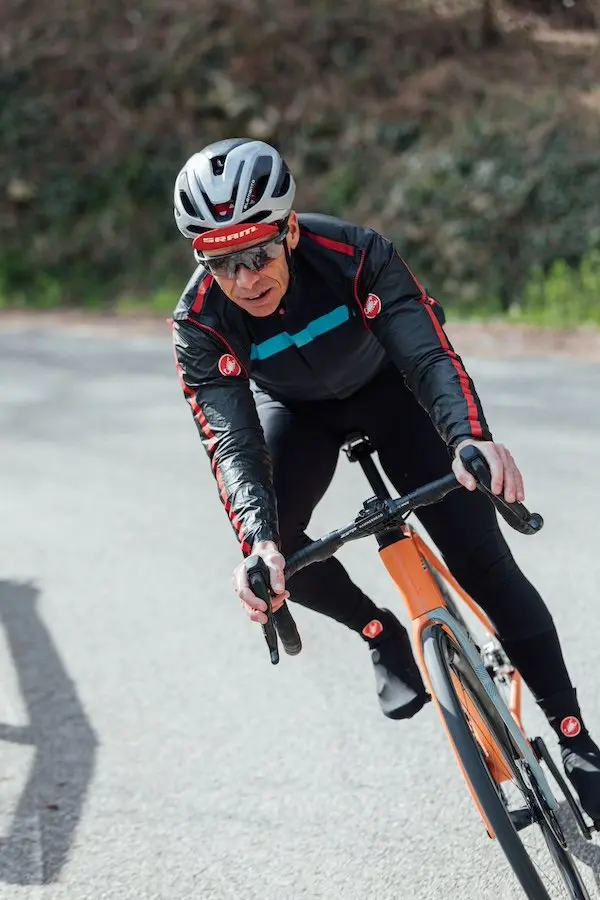
Thus, I was able to ride several group rides without anyone noticing that this was a preview test of a drivetrain group that is likely to mark the coming seasons by bringing significant advances in terms of fluidity, silent operation, comfort, and ultimately pleasure.
The new Red, however, sees a significant price increase to around €4,500, which will unfortunately keep it out of reach for many riders.
=> Buy the new Sram Red groupset on sale for €3350

New levers and significantly improved braking
Sram has redesigned the architecture of the levers and shifters to adapt them to all hand sizes and offer powerful, fluid, easy, and accessible braking from any position on the handlebars. Independent reach and contact point adjustments still allow for customizing the lever setup and feel.
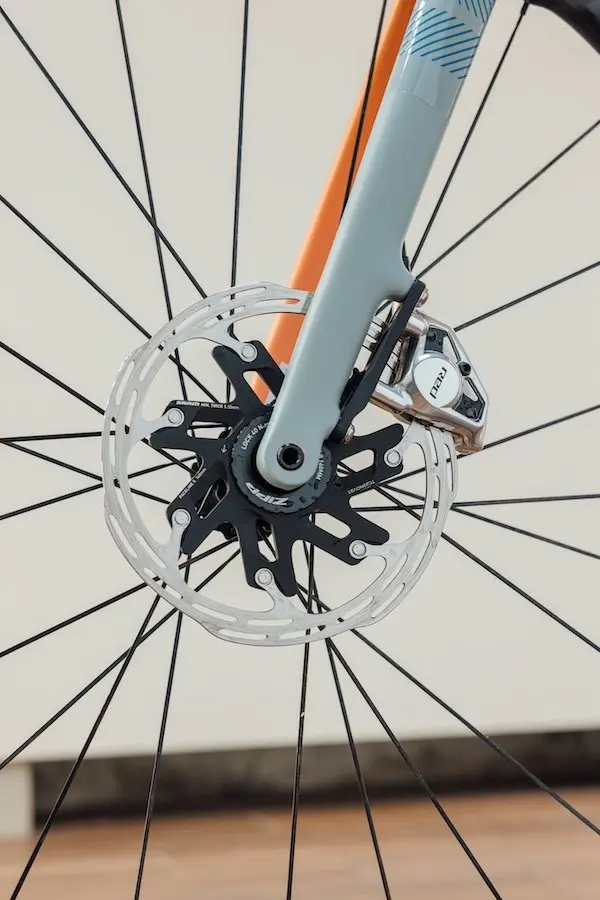
The brake caliper is not only stiffer according to Sram, but also lighter, and features ample pad clearance for friction-free operation. Even though the brand retains DOT brake fluid as in previous versions, the braking is finally on par with the competition.
I immediately felt confident, whether on dry or wet surfaces, with powerful and, above all, perfectly modulated braking, in addition to being actionable with just one finger on the lever. Silent on dry surfaces, the braking sometimes remains a little noisy in wet conditions, but without excess.
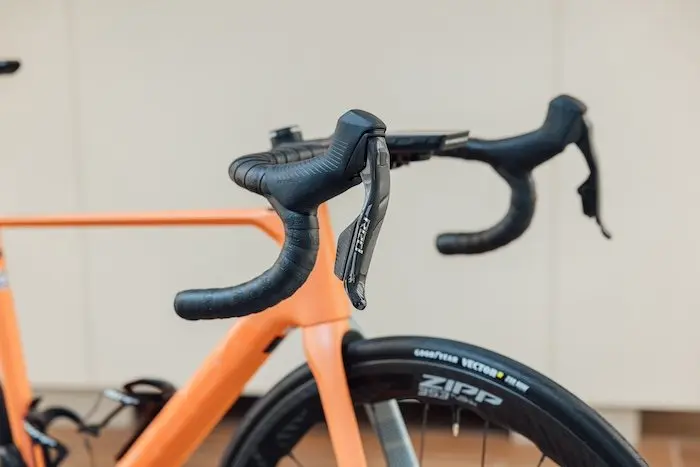
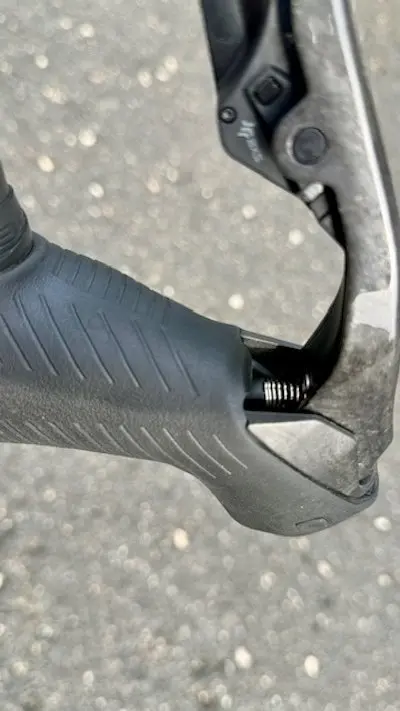
Regarding the levers, the comfort of the grip is improved thanks to a longer and thinner shape, and especially to the abandonment of the raised upper part at the end of the lever. Under the lever, near the brake lever, there are still some somewhat sharp shapes where you can rest your index finger, but they are no longer as abrasive as on the previous model.
I would have still wished that for a product of this price, an effort would have been made at this level to soften the contact with the finger.
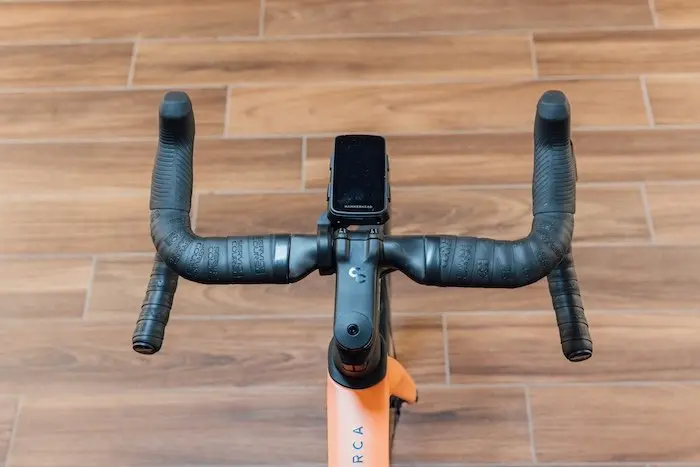
According to Sram, the best lever ergonomics are achieved by applying a 7° angle between the hand rest area and the ground. And 45° relative to the top of the handlebars, since the brake levers themselves are slightly offset outwards for easier access. It should also be noted that the levers are a few millimeters longer than on the previous model, and may potentially lead to changing the stem length of the bike.
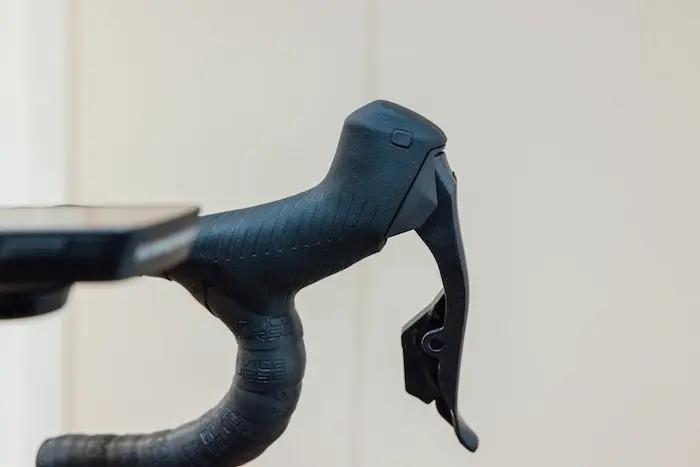
Sram Red levers also incorporate for the first time what the brand calls bonus buttons, at the top of the levers within thumb reach, on the inner part. Different functions can be assigned to these buttons via the Sram smartphone app, whether it’s shifting gears by repeating the action of the eTap levers placed behind the brake levers, or controlling the bike computer to change menu pages, or start/stop lap times, for example.
I used these buttons a lot during the more than 4,500 km of this test, as I usually do with the same function on Shimano. For me, this is a real benefit on this new version compared to previous generations of Sram drivetrains.
The lever/brake assembly with hoses is announced to be 83 g lighter per pair than the previous Sram Red. A spectacular advance, achieved by improving comfort and efficiency. A big bravo to the American brand on this point. And I add that although the system is lighter, it produces no vibration or rattling noise, and offers a truly high-end feel in use.
Red AXS Lever/Brake System
|
For the rotors, Sram now offers a Red Paceline X version, combining a silent and lightweight braking surface with an equally lightweight aluminum carrier. The pair of 160 mm rotors thus saves 8 g compared to the old version, without losing efficiency, quite the opposite.
Red AXS Brake Rotors
|
Fast and silent derailleurs
The rear derailleur, defined as being at the heart of the AXS ecosystem, is lighter than the previous version (-16 g). Compatible with double and single drivetrains, it also accepts the four cassette combinations now offered, from 10-28 to 10-36. The lower derailleur pulley increases from 12 to 14 teeth to reduce chain curvature and improve the fluidity of the entire drivetrain.
The derailleur also adopts Orbit chain management technology, as in mountain biking, to prevent chain slap and ensure safe and silent operation.
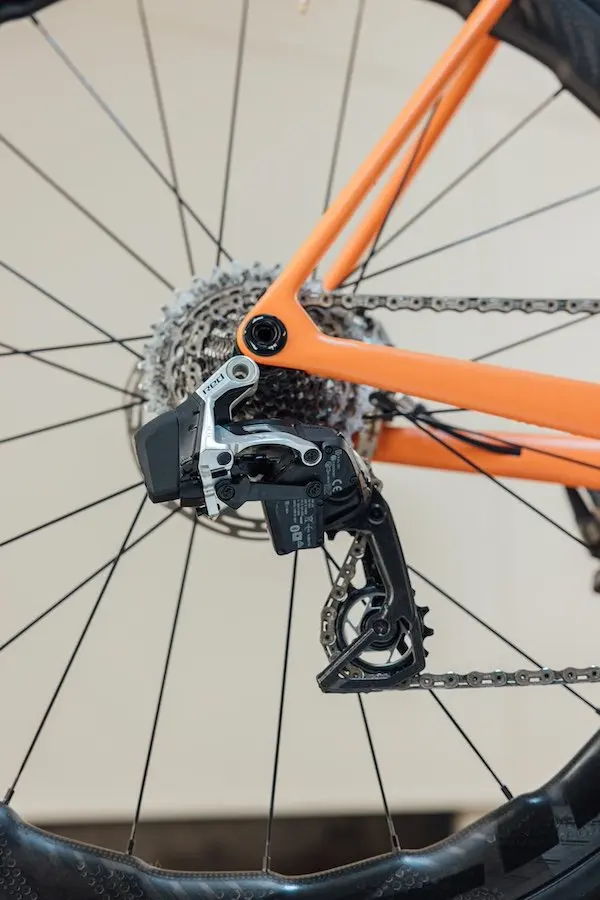
The derailleur’s operation seemed a touch faster than the previous version, on par with Dura-Ace. Over the course of more than 4,500 km of testing, I experienced no misalignment. I was struck by the silence of the drivetrain, regardless of the gear engaged, the impression of fluidity it conveys, and its precision.
Only the most extreme cross-chaining with the large chainring and the largest cog on the cassette showed some slight rubbing, but that’s a gear I only used once anyway. The small chainring/small cog cross-chaining is impossible as it is electronically prevented. Overall, on the first 11 cogs of the cassette with the large chainring, it’s absolute smoothness!
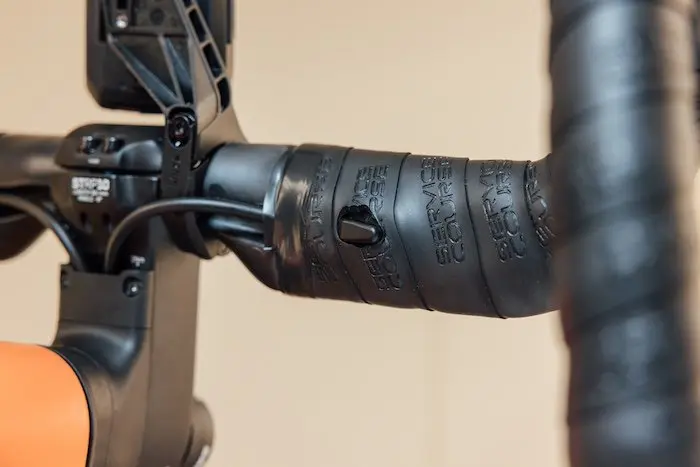
Thanks to the AXS app installed on the smartphone, which communicates via Bluetooth with the groupset, it is possible to assign different functions to the shift buttons (as with Shimano’s E-Tube app), and to the bonus buttons on the levers. It is also possible to modify the number of cog shifts with a prolonged press on a lever, to potentially avoid manipulation errors.
The application also allows you to choose whether or not to use sequential or semi-sequential shifting functions. For example, even though I used the small chainring very little, I configured the system so that each time I shifted from one chainring to another, the rear derailleur would shift two cogs on the cassette to compensate for the difference in gearing.
It is also with the application that you can configure the satellite blips (additional shift buttons to be placed anywhere on the cockpit). In short, simple to use, this application also brings a real benefit to the use of electronic shifting.

I pushed the battery life of the derailleurs to see what was possible. It was only at almost 2,000 km that the AXS app highlighted the need to recharge the rear derailleur battery, and almost 3,000 km for the front derailleur.
It should be noted that the two batteries are interchangeable, and it is always possible to swap them on the road in case one of them fails.
Red AXS Rear Derailleur
|
The front derailleur doesn’t change much from my point of view in terms of operation, but it now features easier adjustment with a new tool, to best determine the angle and height relative to the chainrings. I haven’t tested this tool, as I received the test bike already assembled.
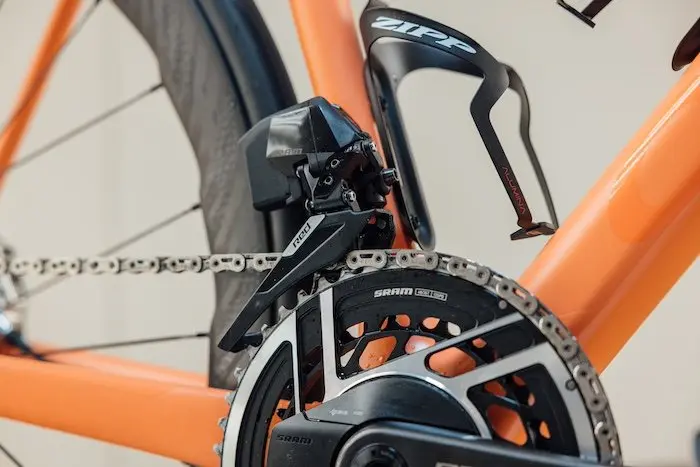
I had no problems to report with this derailleur, but I must admit I only changed chainrings perhaps five or six times in over 4,500 km.
The reason: the gear ratios on the test group were not necessarily suited to my use, with a 48-tooth large chainring sufficient for all the climbs in my region, especially with a 12-speed cassette from 10 to 33 teeth. The 35-tooth small chainring therefore proved almost useless for me.
Red AXS Front Derailleur
|
A crankset that is also lighter
Sram announces that it has lightened a crankset that was already among the lightest at this level of the range. The new carbon crank arm design saves 29 g compared to the previous model. In its range of crank arms, Sram adds a 160 mm length, to meet specific needs (small riders, time trial or triathlon…).
The chainrings are still linked in pairs, with a 13-tooth difference. To its already known ranges of 46-33, 48-35 and 50-37, Sram adds the options 52-39, 54-41 and 56-43, previously only reserved for pros.
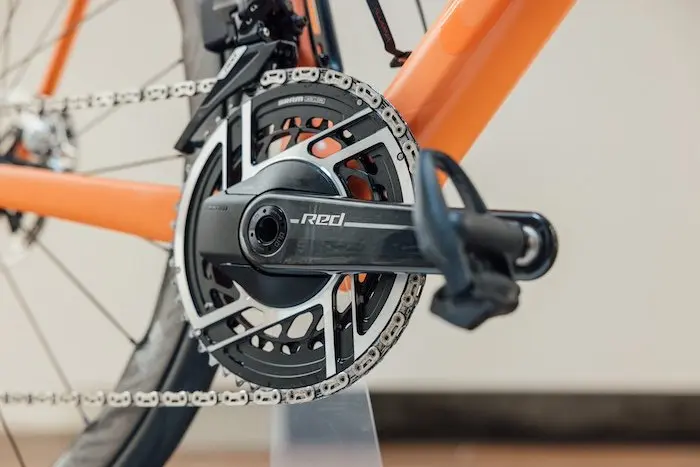
It should be noted that these last three chainring combinations are only offered with a Quarq power meter crank spider, available as an option on the groupset. A lightweight power meter (+ 35 g on the crankset), precise, reliable, and easy to use.
I was able to compare the data from this sensor with my Garmin Rally pedals and a Wahoo Kickr indoor trainer, sensors known for their accuracy. And I can confirm that this Quarq power meter is today one of the most recommendable on the market, especially since it only adds €560 to the price of the groupset.
Sram Red AXS Crankset
|
The Sram Red AXS crankset is also available in a single chainring version, with a direct mount chainring, with 48 or 50 teeth.
Two new cassettes to expand gearing choices
On this new Red AXS groupset, Sram retains the same type of 12-speed cassette, but adds two gearing options, with 10-30 and 10-36 joining the 10-28 and 10-33 that we already knew. This is one more choice than Campagnolo, and especially two more choices than Shimano. Indeed, at the time of the Dura-Ace launch, the availability of an 11-28 cassette was announced, but in practice, only the 11-30 and 11-34 were commercialized.
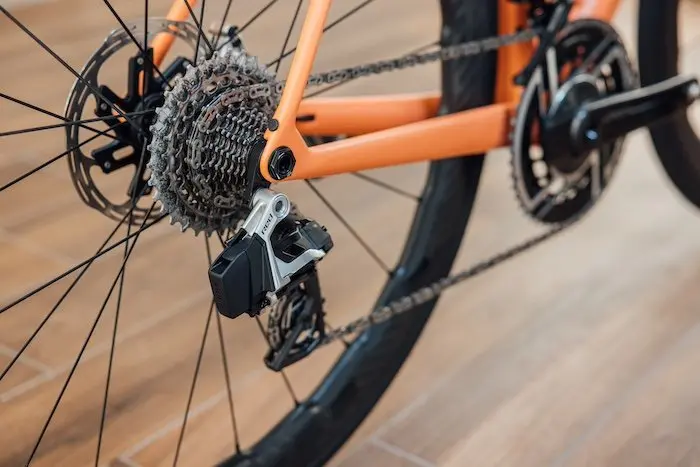
With Sram, the 10-tooth small cog is designed to increase the gearing range of the entire cassette, combined with a smaller chainring pair than Shimano. But this 10-tooth cog doesn’t always offer excellent efficiency (the chain describes a somewhat too restricted circle) and the difference in gearing with the 11-tooth is a bit too significant (+ 95 cm per pedal stroke when going from 48/11 to 48/10).
Obviously, the use of smaller chainrings increases the versatility of the drivetrain at the top of the cassette. This is the objective of this drivetrain, especially with the gearing I received on the test bike, the best suited for the general public, with 48-35 tooth chainrings (the best-selling) and a 10 to 33 tooth cassette.
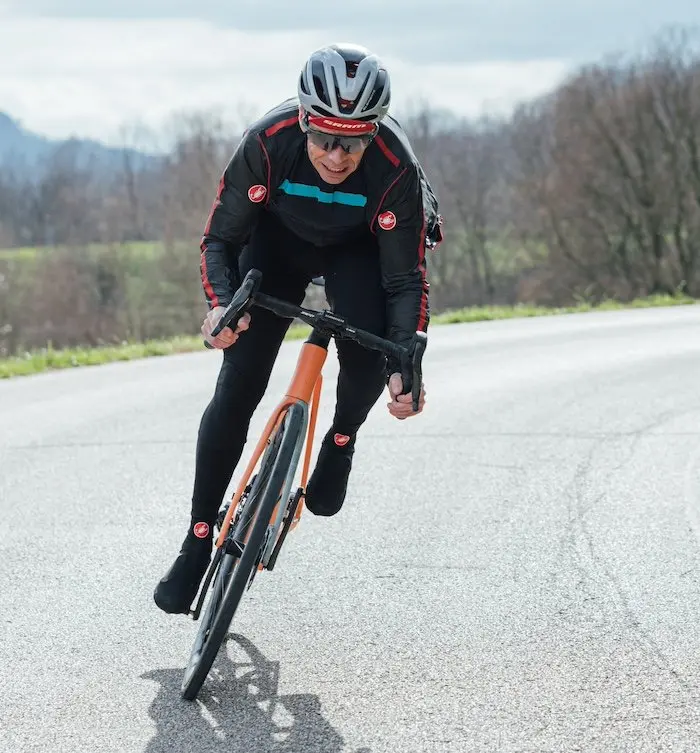
However, I confess that I would have preferred to try a drivetrain with gear ratios consistent with what I usually use. With 52 and 39 tooth chainrings and a 10 to 28 tooth cassette, I would certainly have almost never used the 52/10, but I would have been able to use the small chainring more often.
And above all, with such a cassette and its tighter spacing, I would have been able to ride with more comfort on the flats and false flats, or even into the wind. Over these more than 4,500 km, I most often rode on three gears: 48/14, 48/15, and 48/17, with an annoying gap between the 15 and 17 (82 cm difference in development between the two). Missing the right gear is ultimately ironic with a 12-speed rear drivetrain and two chainrings.
Red AXS Cassette
|
A durable, silent, and lighter chain
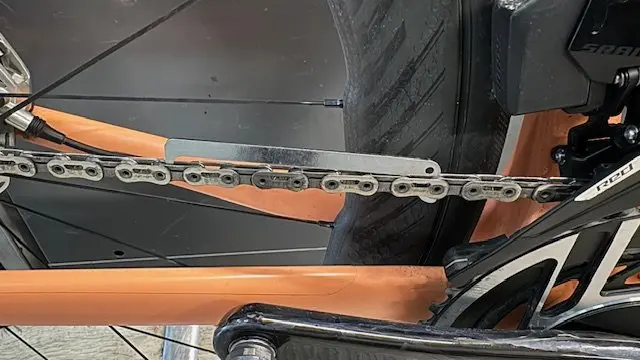
On the new Red AXS, Sram has even reworked the least visible component of the groupset: the chain. Solid pins, and internal and external plates save 13 g compared to the previous version, but without altering the precision, fluidity, and silence of the chain across the entire drivetrain. And especially not its durability. Chain wear depends on several factors: weather conditions, intensity of use, and cross-chaining on the drivetrain.
I didn’t use the Sram Red AXS in an extreme way, but I was still able to measure the chain wear after 4,000 km using a dedicated tool, and I was surprised to see that it was almost like new! No elongation was observed, which had never happened to me on any chain after this mileage. I estimate its lifespan (under the same conditions) to be at least 8,000 km. Not bad for a 12-speed. But in relation to the price, very high for this type of component.
Red AXS Chain
|
A largely positive assessment
This new Sram Red groupset, in my opinion, improves in all areas compared to the previous version: weight, ergonomics, braking, fluidity, silent drivetrain operation, and total absence of parasitic noises… not to mention the surprising durability of the chain, which suggests infrequent maintenance.
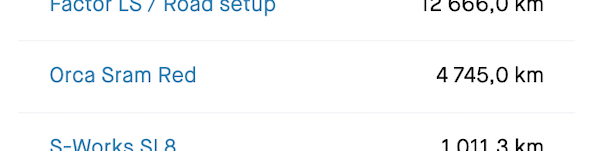
A truly premium groupset that adds pleasure to the effort, which is a way to soften the blow of a high price, at around €4,500 for the groupset without a power meter (it costs a little over €5,000 with the very good power meter integrated into the crankset). Note, however, that when purchasing a complete groupset alone, a new-generation Hammerhead Karoo bike computer is provided, with mounting accessories. A very good bike computer, by the way, which we will talk about again in a few weeks.
The fact remains that at this price and level of performance, it is essential to demand the correct combination of gears from the many options offered, by opting for the chainrings and cassette that best suit your use. This way, you can fully enjoy the performance of a groupset that is likely to quickly establish itself as the new benchmark.
=> Buy the new Sram Red groupset on sale for €3350
Summary of weights and prices of the components of the new Sram Red AXS groupset
| Weight | Price (total price may change depending on various options) | |
| Complete groupset | 2461 g | €4678 |
| Combined levers + brakes + rotors + hoses | 969 g | 1510 + €140 |
| Front derailleur | 169 g | 505 + €63 |
| Rear derailleur | 286 g | 785 + €63 |
| Crankset | 545 + 76 g | 785 + €38 |
| Cassette | 180 g | €505 |
| Chain | 236 g | €110 |
Power meter: 35 g + €560
Share the post "More than 4500 km with the new Sram Red AXS groupset"