Share the post "Questions about tubeless"
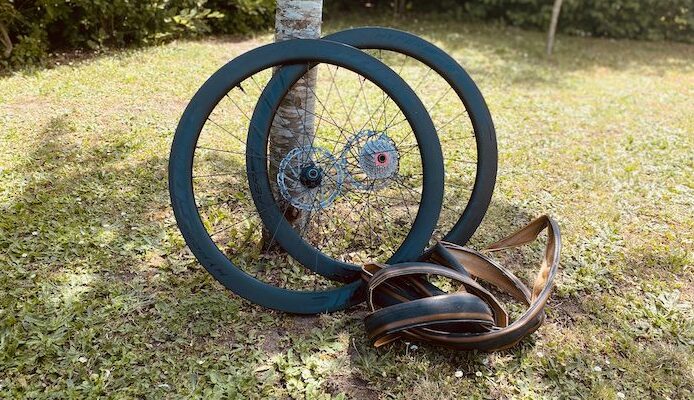
In just a few years, tubeless tires have become the norm for many tire, wheel, and bike manufacturers. Comfort, performance, and practicality are often cited as advantages of this technology. The same goes for new wheels with hookless rims. It’s hard to resist market pressure. However, many consumers still refuse to make the switch for road cycling. We can understand them. Here’s why.
By Guillaume Judas – Photos: depositphotos.com / 3bikes.fr / JF Tatard / DR
Tire prices have soared in recent years, with more choices for consumers, more performance, but not necessarily more durability for models offered for sport use. This phenomenon has been accentuated by the spread of tubeless tires, presented as an unbeatable solution by many manufacturers, but which remains quite expensive. It must be recognized that there are few or no entry- or mid-range tubeless tires.
For most avid riders, the right compromise between performance, grip, resistance, and practicality is still difficult to find. Whatever the tire. When you ride a lot and in a sporty way, you look for a safe and efficient tire, but you don’t necessarily have the means – or the desire – to change it every month.
The performance of tubeless in general is now beyond doubt. The proof is that it has almost completely supplanted tubulars among pros. And all independent tests show it: its low rolling resistance and the aerodynamics of the complete system save watts. However, I must admit, I am not 100% convinced by tubeless technology, and even less so by hookless rims. And I must not be the only one.
Superior performance and comfort
Among the advantages of tubeless, there can be a slight weight gain compared to a tubed tire. This is especially noticeable on large tire widths. Today, with wide rims, the 28 mm width has become the new standard. A tubed tire often weighs around 260-280 g in this width, while a tubeless tire is around 300-320 g (sometimes a little less). You have to add the weight of the inner tube on one side (70 to 110 g in general) and the weight of the sealant on the other (about 40 g). It’s a close match, but it often turns out to be (just barely) in favor of tubeless.
The system also allows you to ride with slightly lower inflation pressure without loss of performance, which is beneficial for comfort and grip. Slightly less stiff tires on the asphalt mean less rebound, more traction, and ultimately less fatigue for the cyclist. I also noticed that with lower inflation pressures with hookless rims, tire wear was less pronounced than expected. Riding with less pressure means less stress on the tire casing.
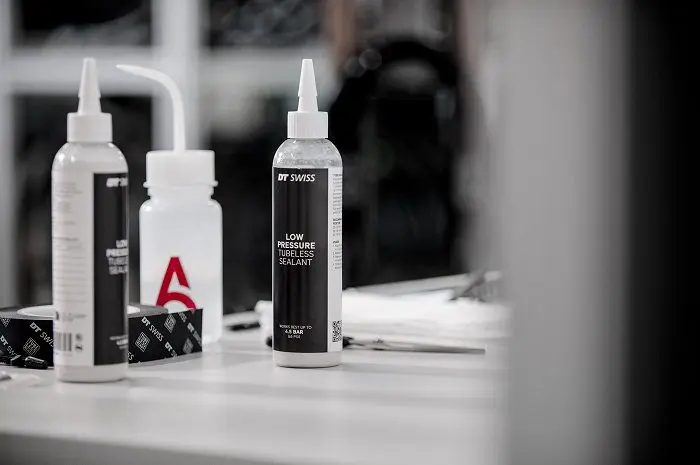
The sealant inserted into the tire and almost essential to ensure airtightness allows for self-repair in case of a puncture in many circumstances, without the need to stop on the side of the road to repair. In recent months, for example, I’ve had six punctures with tubeless tires, but it was only during the last puncture that I had to make a repair. The first five times, the sealant worked perfectly and I was able to continue my training without being bothered.
Finally, and as mentioned above, at the very high end, tubeless technology offers the lowest possible rolling resistance compared to tubed tires and tubulars. Today, pros ride tubeless in races. Some riders like Matej Mohorič claim to have gained about ten watts thanks to tires over the last four or five seasons. More pragmatically, Frédéric Porteleau, an aeronautical engineer and specialist in indirect power calculations, estimates the gain at 4 or 5 watts on climbs. That’s a lot. For the record, Tadej Pogacar has been riding 30 mm tubeless tires, inflated to 4 bar, for two years…
Still an imperfect system
On the downside, a hole in the tread caused by a puncture can sometimes be too large for the sealant to work. For a cyclist training or touring, this means they still have to carry their repair kit with them, consisting of an inner tube to slip into the tire. This negates the advantages of tubeless in terms of performance.
When repairing, you must first be able to unscrew the tubeless valve by hand before replacing it with an inner tube. With frozen and wet hands, this is not always an easy task. Tubeless tires are also often very difficult to unseat from the rim by hand, and when it is possible, you get sealant (which is a kind of liquid white latex) everywhere. Moreover, even in the event of a small puncture, when the liquid comes out of the tire, it is likely to stain clothes, mainly the back of the bib shorts. Finally, after repairing the tire (when possible) with a plug, for example, or during mounting/dismounting, you need a compressor or a special pump to seat the tire on the rim, otherwise it won’t work.
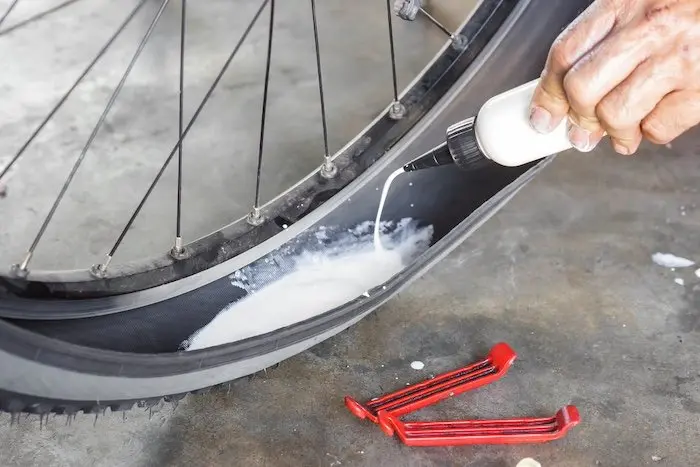
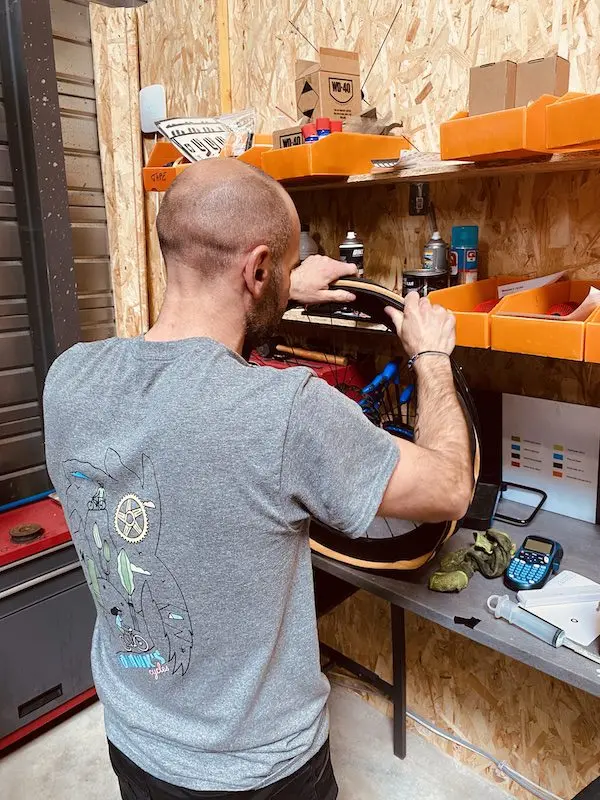
Mounting, moreover, is not always very easy on some rims. Or more precisely, the ease of mounting depends on the rim/tire combination. It requires a good knack, or a lot of force. I’ve been tinkering with my bikes since I was 14, but since the arrival of disc brakes and now tubeless, some maintenance or replacement operations are becoming increasingly difficult for me to do alone. With tubeless, you need space, tools, good dexterity, and to be prepared to spread sealant everywhere. Because I live in an apartment, like many people, I’ve given up on dealing with tubeless myself. For many riders, being forced to go to the bike shop to replace a tire or make a repair is a problem.
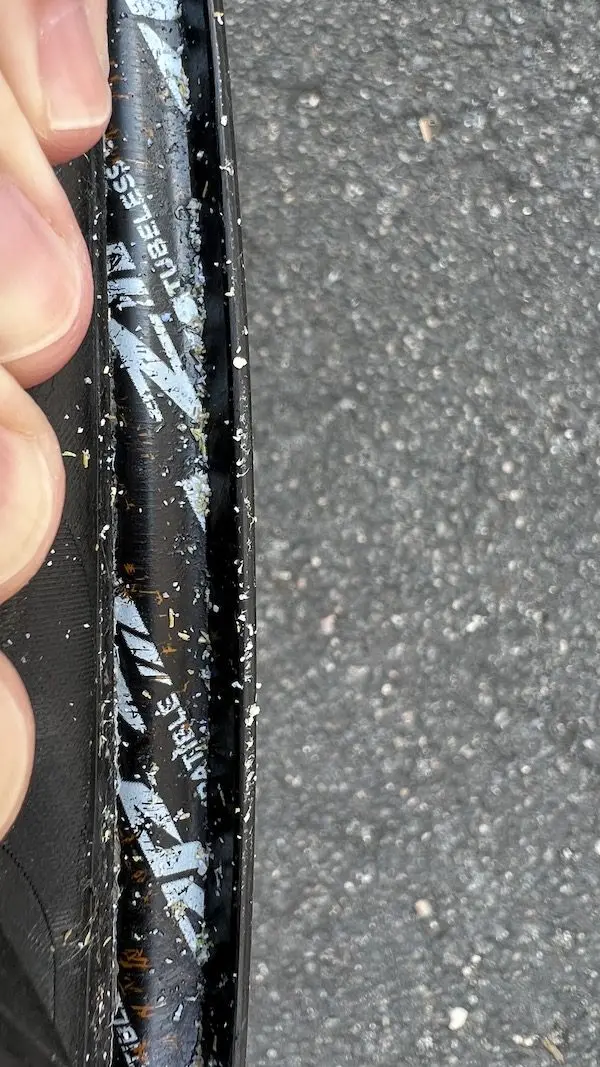
Regarding hookless rims, they are light but their main drawback is that they only accept compatible tubeless tires. This limits makeshift or emergency repairs in case of a problem, for example with a spare tire. Finally, they impose a maximum inflation pressure of 5 bar, otherwise they risk causing a tire blowout. Conversely, in the event of a tire bursting on the road due to a large cut, it can also quickly unseat due to the absence of hooks.
No ideal solution
Tubeless is increasingly appreciated by users for its comfort and performance, and it can be said that it is being pushed in this direction by manufacturers. However, for all the reasons mentioned above, and above all for practical reasons when they ride a lot, some refuse to make the leap. In pelotons, on forums, or on social networks, discussions about the advantages and disadvantages of tubeless are like debates about gear ratios – before almost everyone adopted an 11 or 12-speed cassette that offers a lot of versatility.
If you try tubeless for the first time, you will undoubtedly be delighted by many of its advantages, and rightly so. But the system is not miraculous, in addition to being generally more expensive than a more traditional tire/inner tube setup. Fortunately, you still have a choice, and that’s a good thing.
Share the post "Questions about tubeless"